

IR & AR WEEKLY ALERTS — ISSUE 129A (Asia and MENA Edition)
Coverage: India, Singapore, Hong Kong and MENA including UAE, Saudi Arabia and Qatar; secondary scan of Bahrain, Oman and Kuwait
Coverage Window Used: After 29 September 2026 at 18:00 IST through 23 October 2026 at 23:59 IST.
A. INDIA
1: Conditional merchant banker exemption becomes effective
SEBI circular dated 7 October 2026, effective immediately. Applies to the specified private-placement route at a face value of Rs 10,000.
New this period: the proposal covered in Issue 128A has become a final circular with detailed eligibility conditions.
What happened
Eligible issuers may dispense with mandatory merchant-banker appointment under the specified route. Conditions include Indian financial-sector regulation, at least one year of listing, no pending relevant LODR fines or penalties, and no default in the preceding three financial years or current year, supported by the statutory auditor. Debt must be senior and secured by a first or pari passu charge, with specified public-sector exceptions, and rated at least AA-. The lowest of multiple ratings applies.
Why it matters to issuers, Company Secretaries and IR
The exemption concerns a defined issuance route and is not general relief for every small debt placement. Eligibility and documentation need to be demonstrated before the transaction timetable assumes the exemption.
Action for CFO/Company Secretary/IR
-
Treasury and legal: check all conditions and the applicable security exception against the proposed instrument.
-
Company Secretary: obtain the required exchange confirmation and statutory-auditor certificate.
-
CFO: retain a clear allocation of internal diligence and disclosure responsibilities.
What investors will ask next
Why does this issue qualify, and who has performed the checks previously undertaken with a merchant banker?
Official Source:
SEBI merchant-banker exemption circular landing page
https://www.sebi.gov.in/legal/circulars/oct-2026/exemption-from-the-requirement-of-mandatory-merchant-banker-appointment-for-debt-issued-through-private-placement-by-certain-listed-issuers_105080.html
SEBI circular of 7 October 2026 on merchant-banker exemption
https://www.sebi.gov.in/sebi_data/attachdocs/oct-2026/1791374560264.pdf
2: Revised ISIN limits change the debt maturity planning register
SEBI circular dated 7 October 2026, effective immediately.
What happened
The revised framework generally permits 17 International Securities Identification Numbers (ISINs) maturing in a financial year: up to 12 for plain-vanilla debt and five for specified other categories. It provides additional capacity in defined cases, category-specific treatment and grandfathering. Government-serviced or Extra Budgetary Resources bonds and qualifying ESG debt securities are excluded from the applicable count.
Why it matters to issuers, Company Secretaries and IR
The control is the number and category of instruments maturing in each financial year. Counting new issues in the current year alone will not establish compliance. The treatment of existing instruments can also restrict room for a new maturity.
Action for CFO/Company Secretary/IR
-
Treasury: rebuild the maturity-year register by ISIN, instrument category, amount and claimed exclusion.
-
Company Secretary and depository: verify grandfathered instruments and available capacity before a new issue is approved.
-
CFO and IR: reconcile the revised funding plan with the published maturity and refinancing narrative.
What investors will ask next
Does greater issuance flexibility improve the maturity profile, or add to a concentrated refinancing requirement?
Official Source:
SEBI ISIN circular landing page
https://www.sebi.gov.in/legal/circulars/oct-2026/review-of-provisions-related-to-international-securities-identification-number-isin-for-debt-securities-issued-on-private-placement-basis_105076.html
SEBI circular of 7 October 2026 on private-debt ISIN limits
https://www.sebi.gov.in/sebi_data/attachdocs/oct-2026/1791374056536.pdf
3: Closing auction changes have two separate implementation dates
SEBI circular dated 15 October 2026. Most changes apply from 7 December 2026; provisions on transition of unexecuted orders apply from 8 February 2027.
What happened
SEBI has revised closing-auction timing, aspects of order handling and the expiry-day settlement methodology for derivatives. The framework specifies a 15:30 to 15:40 closing auction on normal trading days. The revised expiry settlement calculation uses the relevant last-30-minute continuous-session volume-weighted average price (VWAP) basis rather than simply adopting the auction closing price.
Why it matters to issuers, Company Secretaries and IR
A cash-market closing price and a derivatives expiry settlement value serve different purposes. Board market dashboards and results-day commentary should identify the price and time used. The later order-transition provisions should not be described as already live in December.
Action for CFO/Company Secretary/IR
-
IR and analytics providers: label cash close, auction volume and derivatives settlement measures separately.
-
Treasury and brokers: confirm the effects on execution windows and any relevant hedging procedures.
-
Company Secretary: record both implementation dates in market-communication and corporate-action calendars.
What investors will ask next
Was a late price movement driven by the auction or expiry mechanics, and which reference price is management using?
Official Source:
SEBI closing-auction review circular landing page
https://www.sebi.gov.in/legal/circulars/oct-2026/review-of-certain-aspects-of-the-closing-auction-session-market-timings-and-settlement-methodology-for-derivatives-contracts_105293.html
SEBI closing-auction circular of 15 October 2026
https://www.sebi.gov.in/sebi_data/attachdocs/oct-2026/1792079571420.pdf
B. SINGAPORE
1: ACRA changes require updated filing and inspection controls
ACRA announcement dated 6 October 2026; changes commenced 20 October 2026. BizFinx preparation tool version 4.0.1 released 19 October 2026.
What happened
Annual-return filers must confirm current particulars for relevant officers and members and answer an additional question about individuals performing the CEO role. Registered-office opening-hour requirements have changed, but records must remain available for inspection for at least two hours on relevant business days after reasonable notice. ACRA also released an updated BizFinx preparation tool for companies filing XBRL financial statements.
Why it matters to issuers, Company Secretaries and IR
These are filing and shareholder-access controls. Pre-filled data still needs review, and more flexible office opening arrangements do not remove inspection rights. The corporate-secretarial and financial-statement filing teams should use coordinated, current procedures.
Action for CFO/Company Secretary/IR
-
Company Secretary: reconcile Bizfile particulars and the CEO-role answer before submitting the annual return.
-
Registered-office provider: update inspection booking and availability procedures against the commenced requirements.
-
Finance: install the current BizFinx tool where used and validate the filing output.
What investors will ask next
Are statutory records and officer particulars current, and can shareholders exercise their inspection rights?
Official Source:
ACRA commencement announcement
https://www.acra.gov.sg/news-events/news-announcements/commencement-of-key-changes-under-the-corporate-and-accounting-laws–amendment–act-2025-on-20-october-2026/
ACRA XBRL filing tools update
https://www.acra.gov.sg/resources/eservice-tools-portals/xbrl-filing-tools/
2: Smaller board lots are now live for qualifying securities
Announced 1 July 2026; board-lot changes implemented 5 October 2026. Next quarterly review is in January 2027.
New this period: the October implementation date has passed; the change should now be reflected in applicable investor information.
What happened
For qualifying instruments priced above S$10 and up to S$100, the standard board lot reduces from 100 to 10 units; above S$100, it reduces to one unit. SGX’s framework provides quarterly reviews, with reductions retained even if prices subsequently fall below the thresholds.
Why it matters to issuers, Company Secretaries and IR
A smaller board lot lowers the minimum standard trading quantity, without changing the shares outstanding or creating a share split. Issuer FAQs and market statistics should use the actual applicable lot size rather than infer it from the current price alone.
Action for CFO/Company Secretary/IR
-
IR: confirm whether the Company’s security is affected and update trading FAQs.
-
Company Secretary and registrar: distinguish trading-lot mechanics from share capital and shareholder entitlements.
-
Analytics provider: use consistent units when comparing trade counts, volumes and retail participation.
What investors will ask next
Has access become more affordable, and is any reported participation change supported by actual trading evidence?
Official Source:
SGX custody and board-lot implementation release
https://links.sgx.com/FileOpen/SGX%20News%20Release.ashx?App=Announcement&FileID=895053
SGX board-lot implementation announcement
https://links.sgx.com/1.0.0/corporate-announcements/NA9CZL8NRVE4PGX3/
3: Environmental queries test the evidence behind impact statements
SGX RegCo queries dated 15 October 2026; Golden Agri-Resources response published 16 October 2026. Issuer-specific supervisory example.
What happened
Golden Agri-Resources published its responses to SGX RegCo questions concerning Indonesian forest and peatland fires and haze. The questions covered operational, financial, legal, regulatory and reputational impacts and the basis for the disclosure assessment. The Company reported no material impact and published its Indonesian subsidiary’s exchange clarification for consistency.
Why it matters to issuers, Company Secretaries and IR
The example shows the breadth of evidence that can be requested when an environmental event intersects with issuer disclosure. The Company’s responses are its own statements, not a regulator’s independent finding that no impact occurred.
Action for CFO/Company Secretary/IR
-
Operations and sustainability teams: maintain a dated incident, exposure and verification record.
-
CFO and legal: substantiate materiality assessments, including the basis for a statement that no material impact is expected.
-
Group IR: reconcile announcements across parent and subsidiary exchanges.
What investors will ask next
What evidence supports the impact assessment, and what new information would trigger an update?
Official Source:
Golden Agri-Resources response to SGX RegCo
https://links.sgx.com/1.0.0/corporate-announcements/3R6A1R3VG2Y5ARPQ/907365_GAR%20-%20Compliance%20Query%20on%2015%20Oct%202026.pdf
SGXNet publication record dated 16 October 2026
https://links.sgx.com/1.0.0/corporate-announcements/3R6A1R3VG2Y5ARPQ/5690246a7bba9b1bc481a5f9a5c75416f446e1fe6c90cebeddb83cd818690717
C. Hong Kong
1: Issuer Access Platform launch requires immediate preparation
Platform launch and related form and rule changes scheduled for 25 October 2026. Issuer registration is phased from October 2026, under individual onboarding letters.
New this period: October issuer onboarding is under way and the scheduled launch is two days after this edition’s cut-off.
What happened
HKEX’s Issuer Access Platform will support regulatory submissions and communication with the Listing Division. Related changes include revised Main Board Forms C1 and C3, GEM Form B and a Next Day Disclosure Return headline. The platform becomes mandatory for an issuer and its advisers upon onboarding.
Why it matters to issuers, Company Secretaries and IR
Launch and issuer-specific onboarding are separate milestones. A generic launch date should not be substituted for the registration timetable in the Company’s letter. Authorisations and submission responsibilities need to work before a live transaction or disclosure depends on them.
Action for CFO/Company Secretary/IR
-
Company Secretary: locate the onboarding letter and complete registration within its prescribed period.
-
Issuer and advisers: agree permissions, approvers and submission ownership; test the workflow.
-
Transaction teams: replace old forms and check the relevant headline and filing route.
What investors will ask next
Can the Company complete a time-sensitive regulatory submission without delay during the transition?
Official Source:
HKEX Issuer Access Platform launch and onboarding information
https://www.hkex.com.hk/Services/Platform-Services/Issuer-Access-Platform?sc_lang=en
HKEX initial platform announcement
https://www.hkex.com.hk/News/Regulatory-Announcements/2026/260629news?sc_lang=en
2: T plus 1 roadmap targets the second half of 2028
HKEX consultation conclusions published 16 October 2026. Target implementation is the second half of 2028, subject to readiness and regulatory approvals; market readiness is targeted by September 2028.
What happened
HKEX confirmed its intended move to T+1 after consultation, using a programme covering infrastructure, workflow tools and industry coordination. The conclusions identify funding, foreign exchange, settlement instructions, securities availability and automation as key dependencies.
Why it matters to issuers, Company Secretaries and IR
The conclusions establish an implementation direction and conditional target, rather than a fixed launch day. HKEX-listed groups should map the implications for their own treasury activity, corporate actions and cross-border investor servicing without presenting the change as an immediate liquidity benefit.
Action for CFO/Company Secretary/IR
-
Treasury: obtain a dependency assessment from brokers and custodians, including funding and FX cut-offs.
-
Company Secretary and registrar: identify corporate-action and cross-border servicing workflows needing future review.
-
IR: explain the target timetable accurately and distinguish readiness work from an implemented settlement change.
What investors will ask next
What operational changes will international shareholders and the Company’s treasury counterparties need to make?
Official Source:
HKEX T+1 roadmap announcement dated 16 October 2026
https://www.hkex.com.hk/News/Market-Communications/2026/261016news?sc_lang=en
HKEX October 2026 T+1 consultation conclusions
https://www.hkex.com.hk/-/media/HKEX-Market/News/Market-Consultations/2016-Present/April-2026-Accelerated-Settlement-for-the-Hong-Kong-Cash-Market/Conclusions-Oct-2026/cp202610cc.pdf
3: CFO and Company Secretary sanction highlights escalation duties
HKEX Statement of Disciplinary Action dated 6 October 2026 concerning a former CFO and Company Secretary of CHK Oil Limited.
What happened
HKEX found that the former executive failed to escalate material lease terminations to the Board, Audit Committee or auditors and caused materially inaccurate financial reporting. The decision explains why forwarding information to an unresponsive chairman was inadequate. The sanctions in this statement apply to the individual, not the Company or other personnel.
Why it matters to issuers, Company Secretaries and IR
A reporting-control failure can occur when important subsidiary information reaches finance but never reaches the people approving or auditing the accounts. Escalation must remain effective when the normal reporting line is unresponsive.
Action for CFO/Company Secretary/IR
-
CFO and Company Secretary: create an escalation route directly to the Audit Committee for unresolved material information.
-
Subsidiary management: certify material changes to licences, leases, rights and other key assets.
-
Audit Committee: require evidence that material adverse information has reached the auditors and informed accounting judgements.
What investors will ask next
Can a material subsidiary issue remain with one executive while the Board approves the accounts?
Official Source:
HKEX CHK Oil former CFO and Company Secretary disciplinary statement
https://www.hkex.com.hk/-/media/HKEX-Market/Listing/Rules-and-Guidance/Disciplinary-and-Enforcement/Disciplinary-Sanctions/2026/2610062_SoDA.pdf
D. UAE / MENA
1: DFSA reporting changes are already effective for authorised firms
DFSA announcement dated 5 October 2026. Prudential reporting changes effective 2 October 2026; credit-rating-agency changes effective 1 January 2027.
What happened
The DFSA has redesigned Form B110 to capture data previously reported in B180 and B120. Authorised firms complete the data items applicable to them. Separate rating-agency amendments address conflicts and disclosure requirements, while retaining sufficient information for users to understand how ratings were determined.
Why it matters to issuers, Company Secretaries and IR
The form change affects relevant DIFC-regulated entities and their group reporting controls, rather than all UAE listed companies. Different commencement dates require separate implementation checks. Reporting simplification still needs a complete reconciliation of data.
Action for CFO/Company Secretary/IR
-
Compliance and finance: map applicable old-form fields to the redesigned B110 and confirm the current return requirements.
-
Group CFO: reconcile regulatory reporting with relevant financial-reporting data.
-
Rating agencies and groups using them: assess the January changes where applicable and update conflict-control documentation.
What investors will ask next
Have all required data items survived the reporting migration, and who signs off the reconciliation?
Official Source:
DFSA reporting and rating-agency amendments announcement
https://www.dfsa.ae/news/dfsa-made-targeted-amendments-credit-rating-agency-and-prudential-reporting-requirements
DFSA October 2026 legislation amendments notice
https://www.dfsa.ae/news/notice-amendments-legislation-october-2026
2: ADGM consultation links late filings and listing fees to governance
FSRA Consultation Paper 6/2026 published 9 October 2026; responses due 6 November 2026. Proposals, not final rules.
What happened
ADGM’s FSRA proposes changes to its Fees and General Rulebooks. These include market-infrastructure fees, a supervision fee for securities on the Official List, increased late-regulatory-filing fees and clarifications concerning permission variations and certain change-in-control applications.
Why it matters to issuers, Company Secretaries and IR
Affected groups should connect the proposal to entity-level filing ownership and transaction costs. A recurring listing fee and a late-filing fee address different exposures and should not be treated as one generic compliance cost.
Action for CFO/Company Secretary/IR
-
Company Secretary and compliance: identify affected entities, securities and regulatory returns.
-
CFO: assess proposed recurring fees and late-filing exposure without presenting the proposals as current charges.
-
Board or delegated committee: decide whether to respond by 6 November 2026.
What investors will ask next
Which costs would change for the group, and are delays in regulated filings being escalated early enough?
Official Source:
ADGM FSRA fee consultation announcement
https://www.adgm.com/media/announcements/adgm-fsra-launches-consultation-on-revisions-to-its-fees-and-general-rulebooks
ADGM official public consultations and deadlines
https://www.adgm.com/legal-framework/public-consultations

E. SAUDI ARABIA / QATAR
Saudi Arabia: Revised market orders can execute across several prices
Saudi Exchange notice dated 1 October 2026; effective 4 October 2026 for the Main Market and Nomu.
What happened
A market order may now execute against liquidity at multiple price levels within five ticks of the best price. When that boundary is reached, or no more liquidity is available within it, the unexecuted balance becomes a limit order at the last executed price.
Why it matters to issuers, Company Secretaries and IR
The execution path and residual order can affect the interpretation of short-term price and volume patterns. An issuer should distinguish the exchange’s order mechanics from evidence of a change in business value or investor conviction.
Action for CFO/Company Secretary/IR
-
IR and market advisers: update explanations of unusual intraday trading using the revised order behaviour.
-
Treasury and execution brokers: assess effects on any permitted Company transactions and execution instructions.
-
Board reporting: distinguish order-book effects from fundamental developments when interpreting volatility.
What investors will ask next
Was the observed price movement associated with available liquidity and order execution, or with new information about the Company?
Official Source:
Saudi Exchange market-order notice dated 1 October 2026
https://www.saudiexchange.sa/wps/portal/saudiexchange/newsandreports/issuer-news/news-detail-wcm/?locale=en&newsId=9610
Qatar: Announced earnings calls require a coordinated publication timetable
Mannai Corporation notice dated 15 October 2026; Q3 FY2026 earnings call scheduled for 29 October 2026 at 13:30 Qatar time, with the investor presentation to be published that day.
What happened
QSE’s disclosure and earnings-call calendar is tracking the quarter ended 30 September 2026. Mannai’s notice provides a specific example of an announced call, registration route and presentation-publication date. These are issuer timetable commitments, not a new market-wide rule.
Why it matters to issuers, Company Secretaries and IR
The release, deck, website and spoken answers need one approved information set. The announced call date also gives investors a practical point at which to compare the financial statements with management’s explanation.
Action for CFO/Company Secretary/IR
-
IR: reconcile the announced filing, presentation and call dates and publish clear access instructions.
-
CFO and legal: approve a single Q&A using the filed numbers and authorised explanations.
-
Company Secretary: maintain evidence of publication timing and a process for correcting material inconsistencies.
What investors will ask next
Does management’s explanation reconcile with the filed results, including cash flow, financing and the outlook?
Official Source:
Mannai Corporation Q3 earnings-call notice on QSE
https://www.qe.com.qa/qdisclosure/api/NonFS/downloadAttachmentFileAPI?ig=e9d5f624-3699-4f34-99f3-10771721b492
QSE disclosure and periodic earnings-call calendar
https://www.qe.com.qa/disclosures-net-profit/loss-report
Bahrain, Oman and Kuwait were included in the secondary scan. No additional item was selected for full coverage; routine transaction announcements and general market commentary were excluded.

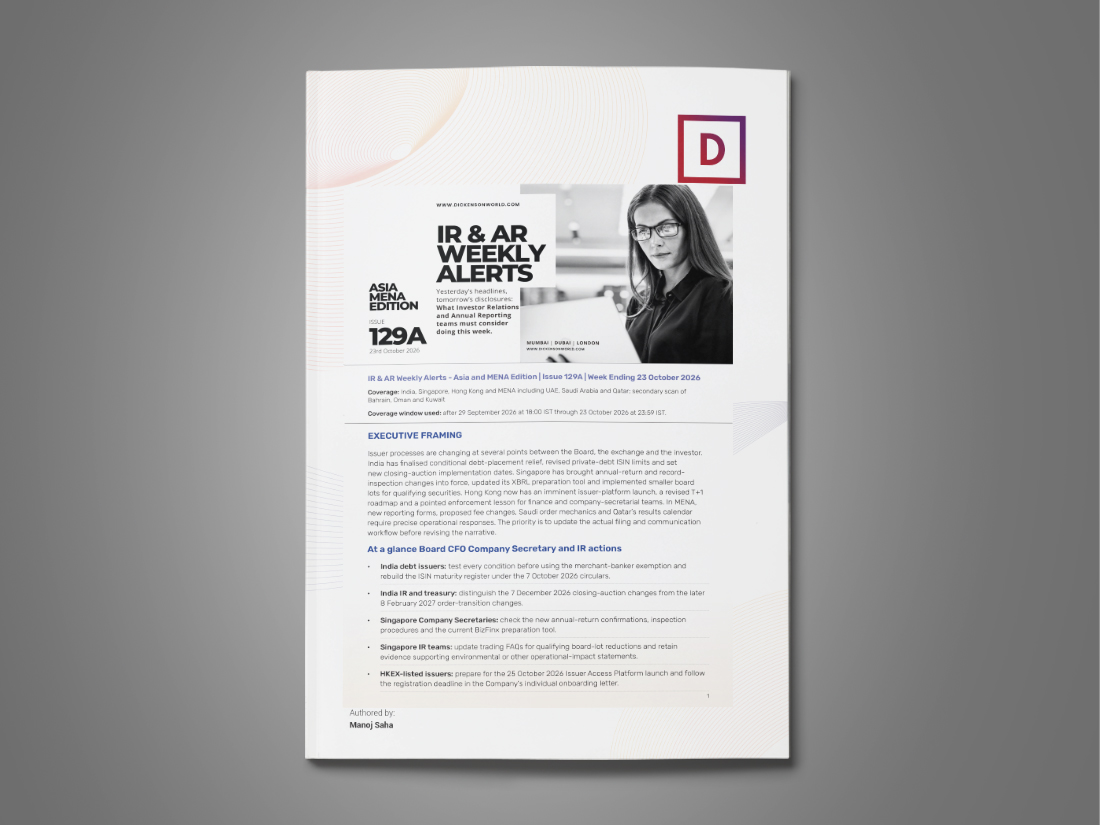
IR & AR WEEKLY ALERTS
To download and save this article.
Contact Us: To learn more or schedule a consultation, please reach out to us at www.dickensonworld.com
Email:enquiry@dickensonworld.com.
Leave A Comment