Arabic & English
Annual Reports
for The GCC Market
An annual report in the GCC has to do two jobs at once. It must satisfy boards, regulators, investors, analysts and rating agencies as a disclosure document — and it must carry equal institutional authority in English and Arabic.
Most reporting projects manage only the first. The English master is written, designed and approved; Arabic is commissioned at the end, as a translation. The results are familiar: literal phrasing, drifting financial and ESG terminology, an executive voice that loses its weight, layouts never conceived for right-to-left reading. The Arabic report exists — but it does not carry the institution the way the English one does.
HOC × Dickenson World was created to close that gap.
Two disciplines, one process
This is a specialist collaboration between two complementary practices. Dickenson World brings over two decades of annual report advisory: investor communications, reporting architecture, MD&A and performance narrative, Chairman and CEO messaging, ESG and integrated reporting, peer benchmarking and capital markets judgement. HOC brings GCC-native Arabic communications: Modern Standard Arabic editorial discipline, cultural adaptation, terminology governance, bilingual QA and right-to-left publication readiness.
Bilingual by design
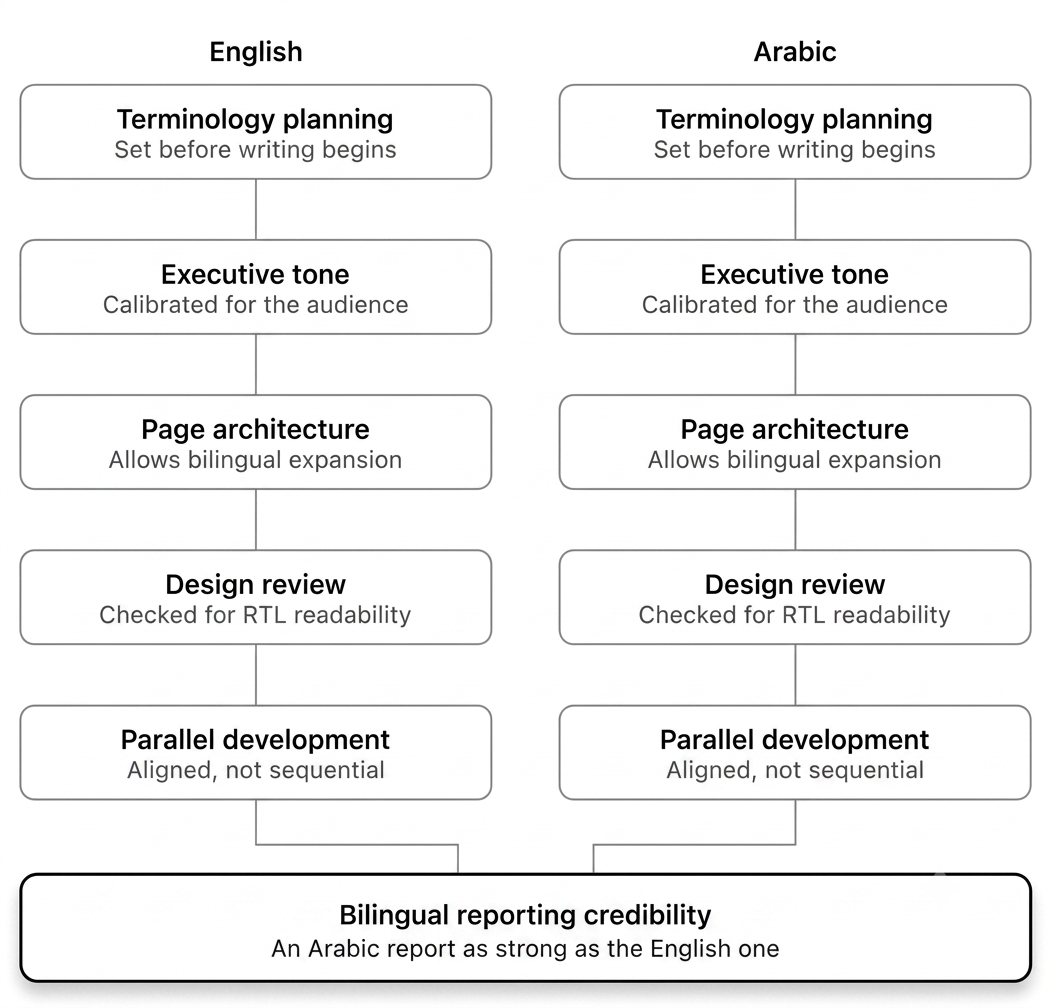
We work to one principle: Arabic enters the process at the briefing stage, not the production stage. Terminology is planned before writing begins. Executive tone is calibrated in both languages. Page architecture allows for bilingual expansion. Design is reviewed for right-to-left readability. English and Arabic are developed in alignment, not in sequence — reducing late-stage rework and producing a stronger report in both languages.
The objective is not translation accuracy alone. It is bilingual reporting credibility: an Arabic report as strong as the English one.
What we deliver
We support institutions across the full reporting cycle — annual reports, integrated reports, ESG and sustainability reports, leadership messaging, MD&A and performance narrative, investor communications and report architecture — with clear roles, senior accountability, confidentiality and disciplined project governance.
Who it’s for
The collaboration is built for GCC institutions where reporting standards and bilingual authority matter: listed companies, banks, sovereign-linked entities, government and semi-government institutions, and large groups answering to international investors and Arabic-speaking institutional audiences.
If your next report must work harder, we should talk
If your annual report needs to work as a disclosure document, an investor narrative and a bilingual institutional statement, HOC × Dickenson World was built for you.

AI Wrote It. Do Investors Still Trust It?
AI Wrote It. Do Investors Still Trust It? The debate around AI in communications is often framed as technological disruption. In capital markets, the issue is more precise. The question is not whether AI can write. The question is whether AI-assisted communication preserves credibility. In Investor Relations, credibility is not cosmetic. It is more cumulative. And once impaired, it is costly to rebuild. The Economic Case for AI Editing Is Already Settled Read More

Mind the Gap
Mind the Gap. Why Q3 Earnings Calls Demand a Different Spokesperson Mindset. Earnings season is often treated as a routine reporting exercise. Numbers are consolidated, presentations are finalised, and leadership teams prepare to explain quarter-on-quarter performance. Yet not all reporting periods are processed equally by the market. The third-quarter earnings call occupies a distinct position in the annual disclosure cycle. It is neither an exploratory update nor a conclusive summary. Instead, it represents a moment of validation in which previously communicated narratives, assumptions, and strategic intent are assessed in real time. Read More

Markets Have Memory
Markets Have Memory. Management Often Underestimates It. The Persistence of Market Memory Markets rarely forget what management has said. Companies often assume they do. In capital markets, information does not reset with each reporting cycle. Disclosures accumulate over time. Earnings calls, annual reports, investor presentations, interviews, and even informal public remarks form a continuous narrative record that investors reference, compare, and test against subsequent outcomes. Read More