

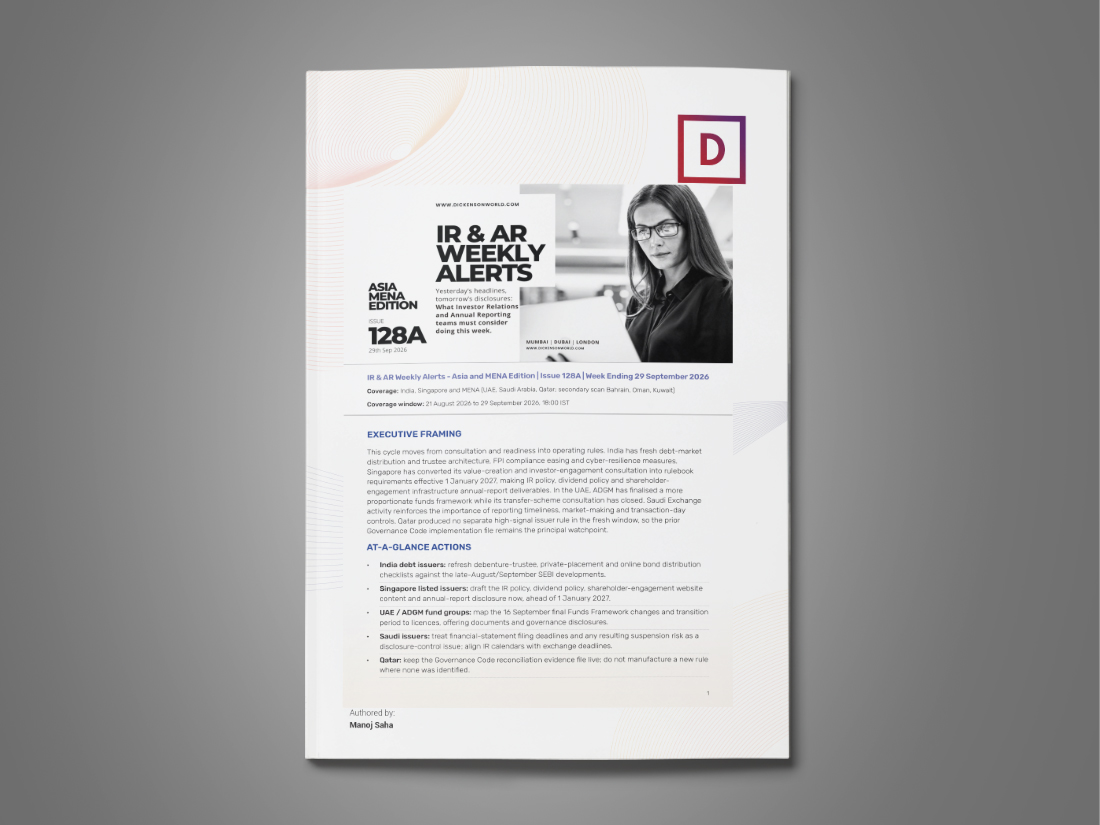
IR & AR WEEKLY ALERTS — ISSUE 128A (Asia and MENA Edition)
Coverage: India, Singapore and MENA (UAE, Saudi Arabia, Qatar; secondary scan Bahrain, Oman, Kuwait)
Coverage Window: 21 August 2026 to 29 September 2026, 18:00 IST
A. INDIA
1: SEBI opens the next phase of online bond distribution through FICPs and a revised OBPP advertising framework
Publication date / deadline: 21 August 2026; consultation-stage proposals.
What happened
SEBI published two debt-distribution consultations on 21 August: one on introducing Fixed Income Channel Partners for distribution of fixed-income securities through Online Bond Platform Providers, and another on revising the Advertisement Code for OBPPs.
Why it matters to issuers, Company Secretaries and IR
For listed debt issuers, the distribution channel is part of the disclosure chain. Wider channel participation and revised advertising controls can change who communicates product features to investors, how risk and return are framed, and where issuer-approved information can be distorted or oversimplified.
Action for CFO/Company Secretary/IR
-
Map every distributor, platform and channel partner that can reproduce issuer/product information.
-
Prepare a controlled product-information sheet covering issuer identity, instrument terms, liquidity, credit risk, tax caveats and grievance routes.
-
Require marketing and IR teams to reconcile digital advertisements with offer documents and exchange filings.
What investors will ask next
Who is responsible if a channel partner simplifies the instrument too aggressively, and can the issuer prove that market-facing claims match the filed disclosure?
Official Source:
2: SEBI consults on removing mandatory merchant-banker appointment for certain small-value private debt placements
Publication date / deadline: 27 August 2026; consultation paper.
What happened
SEBI published a consultation on exempting certain listed issuers from mandatory merchant-banker appointment for small-value debt raised through private placement.
Why it matters to issuers, Company Secretaries and IR
If finalised, a lighter intermediary layer could reduce transaction friction, but it would also put more weight on issuer-side governance, documentation quality, board approvals and the accuracy of debt disclosures. The communication risk is to confuse process simplification with reduced accountability.
Action for CFO/Company Secretary/IR
-
Identify whether any planned private debt issuance could fall within the proposed small-value category.
-
Ask legal and treasury to define which merchant-banker checks would need to be replicated internally if the exemption is used.
-
Keep investor materials explicit that any proposal remains subject to final SEBI rules.
What investors will ask next
Would a lighter process change diligence quality, covenant transparency or the evidence supporting the issuer’s funding narrative?
Official Source:
3: SEBI updates FPI compliance and market-infrastructure resilience
Publication date / deadline: 24 August to 7 September 2026.
What happened
SEBI aligned cyber incident reporting with the FIRE format and introduced an IT Resilience Index for Market Infrastructure Institutions on 24 August. On 7 September it also eased regulatory compliances for FPIs investing only in Government Securities.
Why it matters to issuers, Company Secretaries and IR
These are separate measures but share one issuer-facing message: access and resilience are becoming more standardised and measurable. For IR teams, foreign-investor access claims should be factual, while results-day and corporate-action playbooks should assume that market-infrastructure resilience is a governance dependency.
Action for CFO/Company Secretary/IR
-
Add market-infrastructure incident escalation to results-day and capital-action playbooks.
-
For debt and sovereign-linked investor conversations, update FPI onboarding notes without implying that compliance easing guarantees flows.
-
Ask key brokers/custodians how the resilience metrics affect their own contingency planning.
What investors will ask next
Can management distinguish improvements in market access from actual investor demand, and is there a tested response if market infrastructure is disrupted?
Official Source:
4: SEBI issues a fresh Master Circular for Debenture Trustees
Publication date / deadline: 28 September 2026.
What happened
SEBI published a new Master Circular for Debenture Trustees, creating an updated consolidated reference point for trustee obligations and debt-market processes.
Why it matters to issuers, Company Secretaries and IR
For listed debt issuers, the trustee relationship is embedded in covenant monitoring, security, event reporting and investor protection. A new consolidated source of truth should trigger a line-by-line refresh of issuer-side debt compliance maps rather than reliance on old circular chains.
Action for CFO/Company Secretary/IR
-
Ask the debenture trustee for a written delta note against the prior master circular.
-
Update debt compliance calendars, responsibility matrices and annual-report debt-governance wording.
-
Reconcile any live information memorandum, covenant tracker or investor FAQ with the new consolidated reference.
What investors will ask next
Has the Company’s debt-governance process been refreshed against the current consolidated rulebook, and are trustee escalations clearly owned?
Official Source:
B. SINGAPORE
1: SGX rulebook now embeds enhanced value-creation and investor-engagement disclosures from 1 January 2027
Publication date / deadline: Effective 1 January 2027.
New this period: The prior consultation has moved into the rulebook, with a stated 1 January 2027 effective date.
What happened
SGX Mainboard and Catalist rulebooks now contain future-effective requirements for issuers to maintain an investor relations policy and dividend policy, describe both in the annual report, maintain a shareholder-engagement website, and describe key shareholder-engagement activities. The rule-amendment page identifies the package as “Enhanced Disclosures: Value Creation and Investor Engagement”.
Why it matters to issuers, Company Secretaries and IR
This converts the earlier consultation into an implementation programme. IR policy is no longer just good practice: the rulebook expects channels, contact mechanisms and annual reporting of engagement. Dividend policy also becomes a stated framework against which deviations must be explained.
Action for CFO/Company Secretary/IR
-
Draft Board-approved IR and dividend policies during Q4 2026.
-
Build a shareholder-engagement web page containing the core documents, contacts, recent presentation materials and engagement calendar.
-
Create an annual engagement log that can feed directly into the annual report.
-
Align remuneration/value-creation narrative with the broader enhanced-disclosure package.
What investors will ask next
Is shareholder engagement systematic and Board-owned, and can management explain dividend decisions against a disclosed policy?
C. UAE / MENA
1: FSRA finalises enhancements to the Funds and Fund Managers framework
Publication date / deadline: 16 September 2026; transition for certain existing managers to 31 March 2027.
What happened
ADGM FSRA finalised enhancements to its Funds framework, including streamlined categories for managers of smaller funds and institutional-only funds, changes for certain asset managers, employee investment in private funds and revisions affecting Foreign Fund Managers.
Why it matters to issuers, Company Secretaries and IR
For listed or pre-IPO groups using ADGM fund structures, the changes can affect licence descriptions, governance maps, related-party/employee investment explanations and how asset-management activities are presented to investors. Transition status must be described accurately.
Action for CFO/Company Secretary/IR
-
Map every ADGM fund-management entity to the new category and transition position.
-
Update group structure charts, governance descriptions and investor decks where regulated status is described.
-
Check private-fund employee investment language for conflicts, approvals and related-party controls.
What investors will ask next
Which entities are changing regulatory category, what changes operationally, and are transition arrangements visible in governance and risk disclosures?
Official Source:
2: Transfer-scheme consultation closes, moving business-transfer governance into decision stage
Publication date / deadline: Consultation closed 21 September 2026.
New this period: The consultation deadline has passed; the next material event is final rulemaking.
What happened
ADGM FSRA’s consultation on a streamlined framework for transfers of business within ADGM closed on 21 September. The proposal retains court sanction for insurance transfers while proposing more proportionate notification or consent routes for other transfers.
Why it matters to issuers, Company Secretaries and IR
For groups considering reorganisations, carve-outs or regulated business transfers, the practical work is to preserve the consultation impact analysis and be ready to update transaction timetables when final rules appear.
Action for CFO/Company Secretary/IR
-
Keep an entity-by-entity transfer map for any contemplated reorganisation.
-
Identify customer, counterparty and disclosure dependencies before transaction documentation begins.
-
Do not describe the proposed streamlined route as final until FSRA publishes final rules.
What investors will ask next
Could a planned reorganisation move faster under the eventual framework, and what investor or client protections still govern the transfer?
Official Source:

D. SAUDI ARABIA / QATAR
Saudi Arabia: Exchange actions reinforce filing-timetable and transaction-day controls
Publication date / deadline: Late August to September 2026.
What happened
Saudi Exchange notices in the period included suspension actions for issuers that did not announce financial statements within the prescribed period, market-making developments in derivatives, and transaction-specific pre-market arrangements for an accelerated bookbuild.
Why it matters to issuers, Company Secretaries and IR
The transferable issuer lesson is operational: reporting deadlines can become trading-status events, while large transactions may require special market-session mechanics. IR, finance and Company Secretariat calendars need one source of truth for filing, trading and transaction dependencies.
Action for CFO/Company Secretary/IR
-
Run a pre-deadline financial-reporting readiness check with explicit escalation before the exchange deadline.
-
For accelerated placements or negotiated deals, align announcement timing, investor education and market-session mechanics with advisers and the Exchange.
-
Keep derivatives/market-making developments in the liquidity-monitoring pack for heavily traded names.
What investors will ask next
Could a reporting delay affect trading status, and does the Company have a documented escalation path before that point?
Official Source:
Qatar / secondary GCC scan
No separate high-signal issuer rule was identified in the fresh 21 August to 29 September scan for Qatar, Bahrain, Oman or Kuwait that met the Issue 128 materiality threshold. For Qatar, retain the Governance Code reconciliation and evidence file from Issue 127 as an implementation watchpoint rather than repeating it as new news.

IR & AR WEEKLY ALERTS
To download and save this article.
Contact Us: To learn more or schedule a consultation, please reach out to us at www.dickensonworld.com
Email:enquiry@dickensonworld.com.
Leave A Comment