

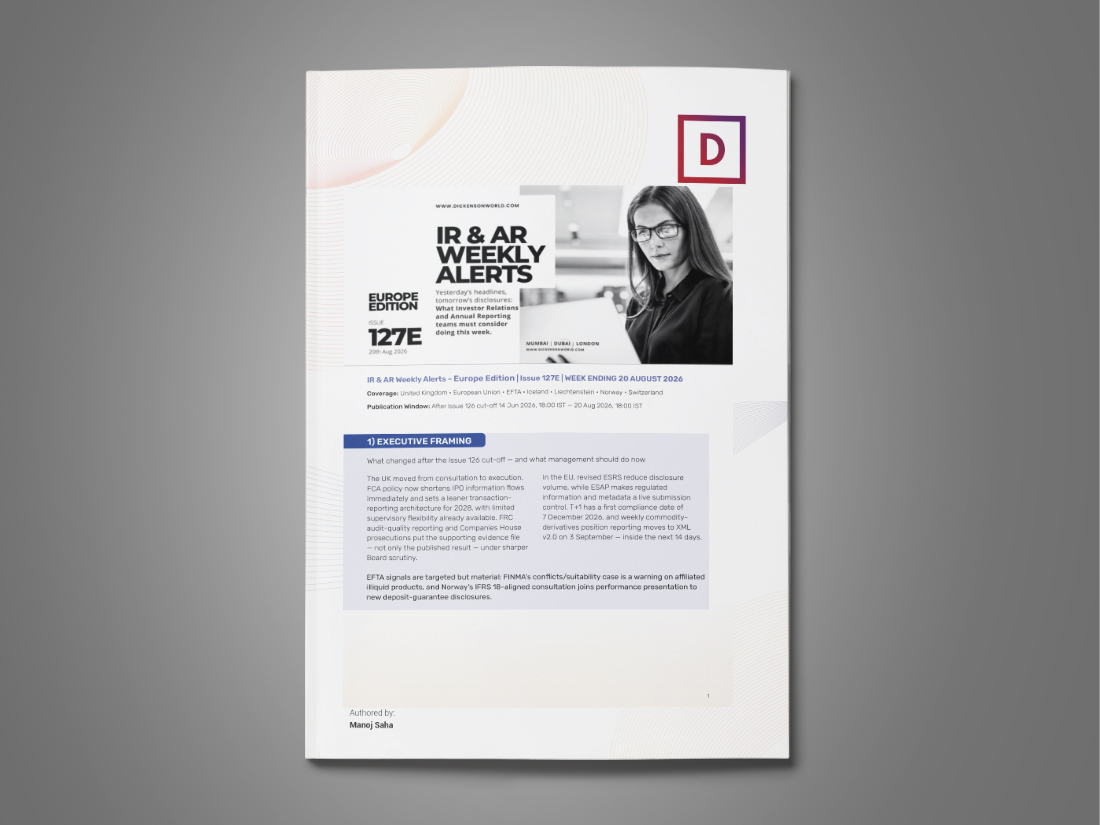
IR & AR WEEKLY ALERTS — ISSUE 127E (EUROPE EDITION)
Coverage: United Kingdom • European Union • EFTA (Iceland, Liechtenstein, Norway, Switzerland)
Publication Window: After Issue 126 cut-off 14 Jun 2026, 18:00 IST —20 Aug 2026, 18:00 IST
Issuer-impact intelligence for Boards, CFOs, Company Secretaries and Investor Relations teams
A. UNITED KINGDOM — TRANSACTION REPORTING
A leaner architecture and an implementation-period decision
UK 1. FCA finalises a leaner UK transaction-reporting regime
PUBLICATION / DEADLINE FCA PS26/15: 3 Aug 2026 • implementation period began 3 Aug 2026 • new regime: 3 Apr 2028
What happened
PS26/15 cuts transaction-report fields from 65 to 52, removes approximately 7 million EU-venue-only instruments and FX derivatives from scope, reduces default back-reporting from five to three years, exempts most corporate actions and introduces conditional single-sided reporting. The FCA expects annual firm savings above £100m. Draft schema, validation rules and guidance are due for consultation in October 2026.
Why It Matters
Simplification does not remove accountability for data quality or market-abuse surveillance. Firms that use the FCA’s supervisory flexibility from 3 August need a documented legal/control basis, while the 2028 build will require coordinated data, vendor, governance and testing decisions.
Action for CFO/Company Secretary/IR
-
Decide and document whether to use any implementation-period flexibility; preserve the conditions, UK EMIR dependency and control owner.
-
Map 65-to-52 field lineage, scope logic, corporate actions, back-reporting and vendor impacts; reserve October capacity for schema analysis.
-
Report change risk, savings and data-quality metrics to the Board rather than treating the programme as an IT reduction exercise.
Investor Question
How will the firm demonstrate that lower reporting volume still supports accurate surveillance, reconciliation and accountability?
Official Source:
FCA PS26/15:
https://www.fca.org.uk/publication/policy/ps26-15.pdf
UNITED KINGDOM — IPO INFORMATION FLOW
Continued: immediate change to research sequencing
UK 2. UK IPO research can move faster — information control still has to hold
PUBLICATION / DEADLINE FCA PS26/16: 5 Aug 2026 • changes effective immediately
What happened
The FCA removed the one/seven-day waiting period between publication of an approved registration document/prospectus and connected research. It also removed the requirement for syndicate banks to share the same information with a range of unconnected analysts. Engagement with unconnected analysts remains optional and can be arranged commercially.
Why It Matters
Execution can shorten, but the prospectus must remain the authoritative document and selective-disclosure risk does not disappear. Issuers, banks and counsel need a redesigned timetable, scripted analyst interaction, factual-verification process and records that withstand scrutiny.
Action for CFO/Company Secretary/IR
-
Re-cut live IPO timetables and responsibilities; do not reuse a pre-5 August analyst-access protocol without review.
-
Reconfirm inside-information boundaries, connected-research briefings, factual verification and consistency with the prospectus and investor presentation.
-
Have the Board/transaction committee approve the information-flow model, including the rationale for any unconnected-analyst access.
Investor Question
How will the issuer protect information symmetry and research credibility when the timetable is shorter and access is no longer mandated?
Official Source:
FCA PS26/16:
https://www.fca.org.uk/publication/policy/ps26-16.pdf
UNITED KINGDOM — ASSURANCE & FILINGS
Audit quality and personal director accountability
UK 3. FRC’s 2026 audit-quality review shifts focus to the firm-wide quality system
PUBLICATION / DEADLINE FRC Annual Review of Audit Quality: 22 Jul 2026 • FRC webinar: 23 Sep 2026
What happened
The FRC combined its assessment of audit firms’ Systems of Quality Management (SoQM) with file inspections. It reported improving audit quality but continuing inconsistency, including a persistent gap between the largest and smallest firms. The FRC also published Audit Firm Metrics to inform audit-committee discussion, not as a league table.
Why It Matters
Audit committees should test the system behind the engagement — workload, specialists, consultations, technology, root-cause remediation and quality indicators — rather than relying on brand or a clean prior-year outcome. The evidence belongs in audit planning and minutes.
Action for CFO/Company Secretary/IR
-
Ask the audit firm for relevant SoQM findings, engagement-specific quality indicators, remediation and partner/workload data.
-
Record challenge on estimates, going concern, controls, specialists, component auditors and technology — and how the auditor responded.
-
Use FRC metrics as discussion prompts and agree an escalation point for quality or timetable deterioration.
Investor Question
What evidence — beyond the firm’s name — shows that the engagement team and quality system can deliver this audit?
Official Source:
FRC announcement:
https://www.frc.org.uk/news-and-events/news/2026/07/frc-annual-review-of-audit-quality-equips-investors-and-audit-committees-to-make-better-decisions/
UK 4. Companies House prosecutions make filing discipline a personal director risk
PUBLICATION / DEADLINE Companies House release: 6 Aug 2026
What happened
Companies House reported that 23 directors were disqualified for a combined 70 years in the first half of 2026 for persistent or serious filing non-compliance. Between January and March, 360 directors of 332 companies were convicted of filing offences. Directors are personally responsible for ensuring annual accounts and confirmation statements are delivered on time.
Why It Matters
Group reporting risk often sits in dormant, acquired, overseas-managed or low-attention subsidiaries. A parent’s polished annual report does not cure entity-level filing failures, and the consequence can move from company penalty to criminal prosecution and director disqualification.
Action for CFO/Company Secretary/IR
-
Create a legal-entity filing heat map with statutory owner, due date, accounts status, confirmation statement, authentication and escalation.
-
Require a pre-deadline director attestation for red/amber entities and evidence contingency plans for auditor, data or identity-verification failure.
-
Include filing duties in director induction and place persistent exceptions before the parent Board.
Investor Question
Are there any subsidiaries where the Board cannot evidence on-time accounts and confirmation-statement ownership today?
Official Source:
Companies House / GOV.UK:
https://www.gov.uk/government/news/directors-disqualified-for-a-total-of-70-years-following-companies-house-prosecutions

B. EUROPEAN UNION — SUSTAINABILITY REPORTING
Revised ESRS and the scrutiny period
EU 1. Commission adopts revised ESRS with materially fewer datapoints
PUBLICATION / DEADLINE European Commission adoption: 3 Jul 2026 • Parliament/Council scrutiny: two months, extendable by two
What happened
The Commission adopted revised ESRS and a voluntary reporting standard for smaller companies. It says mandatory datapoints fall by more than 60%, total datapoints by more than 70%, and expected reporting cost by more than 30% per company. The voluntary standard includes a value-chain cap. The measures apply after the scrutiny period ends.
Why It Matters
Reporting volume may reduce, but materiality evidence, control ownership and investor usefulness remain. Prematurely deleting data or controls before the delegated acts become applicable could leave an issuer unable to support comparatives, assurance or investor questions.
Action for CFO/Company Secretary/IR
-
Freeze destructive template changes until formal scrutiny status/effective date is confirmed; retain the prior datapoint and evidence map.
-
Rebaseline the double-materiality assessment, mandatory/voluntary datapoints and value-chain requests against the adopted text.
-
Keep decision-useful metrics and targets even where no longer mandatory; document why each retained or removed disclosure serves users.
Investor Question
Which disclosures will become shorter, and how will the company preserve trend comparability and decision-useful information?
Official Source:
European Commission:
https://finance.ec.europa.eu/news/commission-adopts-revised-sustainability-reporting-standards-2026-07-03_en
EUROPEAN UNION — ESAP
Continued: regulated information becomes a metadata control
EU 2. ESAP’s first collection phase is live — regulated information becomes a metadata control
PUBLICATION / DEADLINE ESAP first-phase collection launched: 10 Jul 2026 • public portal expected by Jul 2027
What happened
Officially Appointed Mechanisms and national authorities began supplying entity information and metadata to ESAP. Phase one covers information under the Transparency Directive, Prospectus Regulation and Short Selling Regulation. Article 23a of the Transparency Directive requires in-scope entities to submit regulated information to the collection body at the same time, in data-extractable or machine-readable form, with prescribed metadata.
Why It Matters
The filing package now includes discoverability data — name, LEI, size, sector, information type and personal-data indication — as well as the document. A human-readable release that does not reconcile to the machine-readable file or metadata can create visibility and compliance failures.
Action for CFO/Company Secretary/IR
-
Confirm the applicable collection body/OAM, simultaneous-submission workflow, accepted format and contingency route in every relevant Member State.
-
Create a controlled metadata master for legal name, LEI, size, sector, information type and privacy flag; reconcile it to the released document.
-
Add ESAP/OAM confirmation, hash/version and timestamp to the disclosure evidence pack.
Investor Question
Who owns the machine-readable file and metadata — and can the company prove they match the public announcement?
Official Source:
ESMA launch:
https://www.esma.europa.eu/press-news/esma-news/esma-launches-data-collection-under-first-phase-esap
Transparency Directive Article 23a:
https://www.esma.europa.eu/publications-and-data/interactive-single-rulebook/transparency-directive/article-23a-accessibility
EUROPEAN UNION — MARKET OPERATIONS
T+1 and the 3 September commodity-reporting go-live
EU 3. ESMA sets the first hard T+1 compliance date for allocations and confirmations
PUBLICATION / DEADLINE ESMA statement: 20 Jul 2026 • first deadline: 7 Dec 2026 • EU T+1 go-live: 11 Oct 2027
What happened
ESMA told market participants to accelerate preparations for the EU move to T+1. The first compliance deadline is 7 December 2026 for improved timing of allocations and confirmations and default use of international communication standards. The final settlement-layer requirements and T+1 cycle apply from 11 October 2027.
Why It Matters
No participant can be ready alone. Issuers with active treasury, employee share plans, buy-backs or frequent capital-markets activity depend on brokers, custodians, CSD participants, vendors and reference data. Operational failure can become liquidity, counterparty and reputational risk.
Action for CFO/Company Secretary/IR
-
Map the full settlement ecosystem and obtain dated readiness evidence from brokers, custodians, administrators, CSD links and vendors.
-
Test allocations/confirmations, Standard Settlement Instructions and reference data under compressed exceptions, corporate actions and time zones.
-
Give the Board milestones, failure metrics and escalation thresholds through December 2026 and October 2027.
Investor Question
Which external dependency is least ready, and what happens to liquidity and counterparties if it misses the compressed cycle?
Official Source:
ESMA T+1 statement:
https://www.esma.europa.eu/sites/default/files/2026-07/ESMA74-2119945926-3773_T_1_statement.pdf
EU 4. Weekly commodity-derivatives position reporting goes live on 3 September
PUBLICATION / DEADLINE ESMA confirmation: 14 Aug 2026 • go-live: 3 Sep 2026
What happened
ESMA confirmed that the new weekly commodity-derivatives position-reporting framework will go live on 3 September 2026. Market participants must submit under updated reporting instructions, technical specifications and validation rules using XML schema version 2.0.
Why It Matters
The remaining window is operational, not interpretive. A schema-ready file can still fail because of position aggregation, identifiers, validation, sign-off, transfer or fallback. Commodity-exposed groups should also connect reporting incidents to treasury and market disclosure escalation.
Action for CFO/Company Secretary/IR
-
Complete end-to-end regression and negative testing against XML v2.0; resolve every warning or manual override before go-live.
-
Run a full dry submission with production-like positions, validation, acknowledgement, reconciliation and contingency evidence.
-
Name the accountable owner and fallback; include IR/Company Secretariat where a reporting failure could reveal a wider control issue.
Investor Question
Can the firm aggregate, validate, submit and reconcile the weekly report on time if the primary feed or vendor fails?
Official Source:
ESMA go-live confirmation:
https://www.esma.europa.eu/press-news/esma-news/esma-confirms-go-live-weekly-commodity-derivatives-position-reporting

C. EFTA — CONDUCT & PRESENTATION
Swiss conflicts enforcement and Norwegian IFRS 18 consultation
CH 1. FINMA enforcement turns affiliated illiquid products into a Board-level conflicts warning
PUBLICATION / DEADLINE FINMA press release: 29 Jun 2026
What happened
FINMA found serious FinSA conduct breaches involving conflicts, suitability and approximately CHF200m invested in illiquid, affiliated bonds. It revoked Swiss Fund Management AG’s licence, rejected BZ Berater Zentrum AG’s authorisation, ordered cessation of asset management, imposed an industry ban and confiscated more than CHF3m in illegally generated commission.
Why It Matters
Related-party product chains can turn disclosure, suitability and liquidity weaknesses into enforcement and reputational failure. Investor materials cannot cure a business model where proceeds, affiliations, fees, security and end-use are not understood and governed.
Action for CFO/Company Secretary/IR
-
Map affiliated issuers, products, distributors, advisers, fees, end-use of proceeds, security, liquidity and client concentration.
-
Reperform conflicts, appropriateness/suitability and diversification testing for illiquid or group-linked exposures; escalate exceptions.
-
Reconcile product claims to legal cash flows and evidence; remove any statement that implies independence, liquidity or security not supported.
Investor Question
Does the group distribute or hold any affiliated illiquid product whose conflicts, proceeds or suitability are not fully evidenced?
Official Source:
FINMA press release:
https://www.finma.ch/en/news/2026/06/20260629-mm-durchsetzung-verhaltensregeln/
NO 1. Norway consults on IFRS 18-aligned formats and deposit-guarantee notes
PUBLICATION / DEADLINE Finanstilsynet consultation: 7 Aug 2026 • comments due: 6 Nov 2026 • proposed effect: 1 Jan 2027
What happened
Finanstilsynet proposed changes to annual-account regulations for banks, credit institutions, finance companies and insurers to reflect IFRS 18 from 2027. The consultation also proposes note disclosure of deposits covered and not covered by the deposit-guarantee scheme. Listed groups’ consolidated accounts remain fully IFRS, while local-entity accounts use IFRS-adapted rules.
Why It Matters
Norwegian financial groups need one transition plan across consolidated IFRS 18, local statutory formats, deposit data and investor communication. New presentation can affect subtotals and comparability; deposit-guarantee splits can affect funding-quality and liquidity discussion.
Action for CFO/Company Secretary/IR
-
Map group IFRS 18 decisions to each Norwegian entity’s statutory format and consolidation/reporting pack.
-
Build guaranteed/non-guaranteed deposit data by required categories, validate ownership and prepare comparatives.
-
Respond on presentation, feasibility or data definitions before 6 November and pre-brief the Audit Committee.
Investor Question
How will IFRS 18 and the proposed deposit split change the group’s performance and funding-quality narrative?
Official Source:
Finanstilsynet consultation:
https://www.finanstilsynet.no/nyhetsarkiv/horinger/2026/horing—endringer-i-arsregnskapsforskrifter-for-banker-kredittforetak-og-finansieringsforetak/

IR & AR WEEKLY ALERTS
To download and save this article.
Contact Us: To learn more or schedule a consultation, please reach out to us at www.dickensonworld.com
Email:enquiry@dickensonworld.com.
Leave A Comment