

IR & AR WEEKLY ALERTS — ISSUE 127A (Asia and MENA Edition)
Coverage: India • Singapore • UAE • Saudi Arabia • Qatar | Secondary scan: Bahrain • Oman • Kuwait
Publication Window: After Issue 126 cut-off 14 Jun 2026, 18:00 IST — 20 Aug 2026, 18:00 IST
The catch-up issue: capital-allocation rules meet disclosure-control execution
| CAPITAL RETURN | IFRS 18 | CLIMATE | GOVERNANCE | RESILIENCE |
|---|
A. INDIA – CAPITAL RETURN
The reintroduced open-market buy-back route
1. Open-market buy-backs return — with a tighter timetable and promoter holding freeze
PUBLICATION / DEADLINE SEBI Board decision: 19 Jun 2026 • operational circular: 21 Jul 2026 • new route effective: 1 Aug 2026
What happened
SEBI approved the reintroduction of open market buy-backs through stock exchanges. The framework uses a maximum 66-working day period, requires at least 40% of the amount earmarked for the first half, and freezes promoter, promoter-group and associate holdings at ISIN level. SEBI’s 21 July circular required depositories to complete the operating framework before 1 August.
Why It Matters
A buy-back is now a compressed disclosure and-execution programme. Board papers, promoter dealing controls, depository coordination, funding evidence, public announcements and daily progress data must tell the same capital-allocation story. Failure to sequence the ISIN freeze or investor communications can create conduct and credibility risk.
Action for CFO/Company Secretary/IR
-
Update the buy-back board pack: route, 66-day critical path, first-half funding, cash headroom, covenants and downside scenarios.
-
Obtain written confirmation of the promoter-holding freeze workflow before announcement and test responsibility across company, RTA, broker and depository.
-
Pre-clear IR language explaining buy-back versus dividend, capex and deleveraging; reconcile EPS/accretion language to the finance model.
Investor Question
Why is a buy-back the best use of cash now, and what prevents execution risk or promoter dealing during the programme?
Official Source:
SEBI Board decision:
https://www.sebi.gov.in/sebi_data/attachdocs/jun-2026/1781871483886.pdf
SEBI operating circular:
https://www.sebi.gov.in/sebi_data/attachdocs/jul-2026/1784632576164.pdf
INDIA – CASH FLOW
Continued: InvIT distribution quality
2. InvIT NDCF change puts debt funded major road maintenance into the distribution bridge
PUBLICATION / DEADLINE SEBI circular: 14 Aug 2026 • effective immediately
What happened
SEBI modified the framework for calculating Net Distributable Cash Flows (NDCF) for InvITs. At the HoldCo/SPV level, major road-maintenance expenditure funded through external debt may be added back in the NDCF computation, subject to the circular’s framework.
Why It Matters
The change can alter the distributable cash bridge and the way investors interpret distribution quality. A mechanically higher NDCF is not the same as stronger operating cash generation; boards and IR teams need to distinguish operating performance, maintenance economics and incremental leverage.
Action for CFO/Company Secretary/IR
-
Rebuild the NDCF bridge and distribution sensitivity with treasury, trustee, valuer and auditor input.
-
Separate debt-funded maintenance from operating cash generation in results decks and explain covenant, maturity and lifecycle implications.
-
Retain the financing and qualifying expenditure evidence supporting every add-back and align it with offer/annual report definitions.
Investor Question
How much of the proposed distribution is supported by recurring operating cash, and how much depends on new borrowing?
Official Source:
SEBI circular:
https://www.sebi.gov.in/sebi_data/attachdocs/aug-2026/1786705393789.pdf
INDIA – DISTRIBUTION & CONTROL
Bond-platform disclosure and executive impersonation
3. Online bond platforms gain product flexibility — and new description risks
PUBLICATION / DEADLINE SEBI circular: 14 Aug 2026 • effective immediately
What happened
SEBI modified the Online Bond Platform Provider framework. OBPPs may offer specified IFSCA regulated products/services and certain tax benefit bonds, while ‘international’ or ‘overseas’ product presentation must carry appropriate description, features and disclaimers. The compliance-officer requirement is aligned to the 2026 Stock Brokers Regulations and applicable certification.
Why It Matters
Issuer and platform language is becoming more comparable — and more reviewable. Cross-border labels, tax-benefit references, credit/liquidity descriptions and the boundary between regulated Indian products and IFSCA offerings need a controlled taxonomy rather than marketing shorthand.
Action for CFO/Company Secretary/IR
-
Inventory every product tile, term sheet, issuer page and campaign that uses ‘international’, ‘overseas’, ‘tax-saving’ or similar labels.
-
Add jurisdiction, regulator, currency, liquidity, credit and investor-eligibility disclosures to the product approval checklist.
-
Reconfirm compliance-officer qualification, content sign-off and evidence retention across issuer, distributor and platform.
Investor Question
Can an investor tell, before clicking through, which regulator, currency, credit risk and liquidity regime applies?
Official Source:
SEBI circular:
https://www.sebi.gov.in/sebi_data/attachdocs/aug-2026/1786705729757.pdf
4. SEBI’s ‘Boss Scam’ warning turns executive impersonation into an issuer disclosure control
PUBLICATION / DEADLINE SEBI caution: 17 Jul 2026
What happened
SEBI warned regulated entities and listed companies about CEO/MD impersonation through email, WhatsApp or collaboration tools, including deepfake voice/video, malware attachments and fabricated requests involving payments or purported unpublished price sensitive information (UPSI).
Why It Matters
This is not only a treasury fraud scenario. A credible impersonation can compromise UPSI, trigger false disclosure decisions, redirect funds, contaminate board communications or create an incident that itself becomes material. Controls must assume that voice, image and seniority cues can be forged.
Action for CFO/Company Secretary/IR
-
Adopt a mandatory call-back to a known number plus dual approval for payment, file-installation or UPSI requests initiated outside approved workflows.
-
Run a Board/C-suite tabletop covering deepfake instructions, compromised collaboration accounts, exchange disclosure and law-enforcement escalation.
-
Add IR, Company Secretariat and treasury to the cyber incident tree; pre-draft holding statements and preserve logs immediately.
Investor Question
How quickly could the company authenticate a CEO instruction, protect UPSI and decide whether an incident requires market disclosure?
Official Source:
SEBI circular:
https://www.sebi.gov.in/sebi_data/attachdocs/jul-2026/1784288188963.pdf

B. SINGAPORE & UAE
Sustainability standards and regulated business transfers
SG 1. Singapore publishes draft sustainability standards — climate first, broader sustainability voluntary
PUBLICATION / DEADLINE ACRA consultation opened: 27 Jul 2026 • comments due: 25 Oct 2026
What happened
ACRA’s Interim Sustainability Standards Committee published draft Singapore Sustainability Disclosure Standards based on ISSB Standards. Draft SFRS S2 climate disclosures would be mandatory within Singapore’s phased roadmap; broader SFRS S1 sustainability disclosure would remain voluntary. The drafts include local transition reliefs and a statement-of-compliance approach. A Sustainability Assurance Body of Knowledge was launched alongside them.
Why It Matters
The roadmap is moving into a local standards-and-assurance operating model. Issuers must distinguish what is mandatory, voluntary and transitional — while preserving the data lineage, governance and controls investors expect from an ISSB-aligned report.
Action for CFO/Company Secretary/IR
-
Gap-map the draft SFRS S2 requirements against the latest climate report, ISSB workpapers and group reporting perimeter.
-
Assign owners for climate metrics, scenario analysis, financed/Scope 3 data where relevant, controls and assurance evidence.
-
Prepare a focused consultation response on reliefs, compliance wording, proportionality and assurance-readiness friction.
Investor Question
Which climate disclosures are already decision-useful and assured, and which still depend on estimates or weak source systems?
Official Source:
ACRA announcement:
https://www.acra.gov.sg/news-events/news-announcements/acra-launches-public-consultation-on-sustainability-disclosure-standards/
UAE 1. ADGM proposes a proportionate transfer-scheme regime
PUBLICATION / DEADLINE FSRA Consultation Paper 2 of 2026: 27 Jul 2026 • closes: 21 Sep 2026
What happened
ADGM’s FSRA proposed a new Chapter 8A of GEN for transfers of business. Insurance transfers would retain mandatory court sanction under Part 7 of FSMR; non-insurance transfers would move to a more streamlined notification/consent framework while retaining client protections.
Why It Matters
For groups restructuring ADGM-regulated activities, legal form, client consent, regulatory sequence and investor narrative must be designed together. A streamlined route can reduce friction, but it does not remove conduct, continuity, conflict or disclosure risk.
Action for CFO/Company Secretary/IR
-
Map planned intra-group transfers, portfolio migrations and legal-entity simplifications against the proposed insurance/non-insurance routes.
-
Build a stakeholder plan covering FSRA engagement, client notices/consents, contracts, service continuity, data, employees and market disclosure.
-
Respond where the proposed thresholds, evidence or timing could impair an otherwise sound transaction.
Investor Question
Would the transfer alter client rights, ring-fencing, service continuity or the economics investors have been shown?
Official Source:
ADGM FSRA announcement:
https://www.adgm.com/media/announcements/fsra-publishes-proposed-regulatory-framework-for-transfer-schemes

C. UAE & SAUDI ARABIA
Retail debt benchmark and IFRS 18 implementation
UAE 2. First UAE sovereign retail Treasury sukuk lists on Nasdaq Dubai
PUBLICATION / DEADLINE DFSA confirmation: 2 Jul 2026
What happened
The DFSA confirmed admission of the UAE Ministry of Finance’s inaugural Sovereign Retail Treasury Sukuk to trading on Nasdaq Dubai. It is the UAE’s first sovereign sukuk targeted at retail investors and admitted to a regulated exchange in the DIFC; it is secondary-market tradeable after admission.
Why It Matters
The listing creates a visible benchmark for retail-accessible debt communication in the DIFC. Corporate issuers considering sukuk or bond distribution should expect sharper comparisons on denomination, access, liquidity, risk explanation, use of proceeds and continuing disclosure.
Action for CFO/Company Secretary/IR
-
Benchmark retail debt/sukuk materials against the new sovereign reference: eligibility, dealing access, liquidity, pricing, risk and disclosure sequence.
-
Remove institutional shorthand from retail-facing materials and test comprehension without diluting legal accuracy.
-
Align issuer, exchange, distributor and IR website information so no channel implies a different risk or liquidity profile.
Investor Question
Could a retail investor understand how the instrument trades, what can move its price, and whether liquidity is assured?
Official Source:
DFSA announcement:
https://www.dfsa.ae/news/dfsa-confirms-admission-uaes-inaugural-sovereign-retail-treasury-sukuk-listing-nasdaq-dubai-marking-new-milestone-capital-market
KSA 1. Saudi CMA makes IFRS 18 readiness visible in 2026 financial statements
PUBLICATION / DEADLINE CMA decision announced: 30 Jun 2026 • mandatory IFRS 18: periods beginning on/after 1 Jan 2027
What happened
Saudi-listed joint-stock companies may early-adopt IFRS 18 in 2026, while continuing to file approved IAS 1 financial statements. Early adopters must announce the IFRS 18 statements and effect on Tadawul. All listed companies must include a preliminary assessment of expected IFRS 18 impact in approved interim and annual statements for periods beginning on or after 1 April 2026; boards are expected to monitor readiness.
Why It Matters
The transition is now an investor-facing 2026 disclosure, not a 2027 accounting project. Operating-profit subtotals, management-defined performance measures (MPMs), aggregation and comparatives can change the way performance and guidance are understood.
Action for CFO/Company Secretary/IR
-
Put a quantified readiness dashboard and preliminary impact assessment before the Board/Audit Committee; retain challenge and decisions.
-
Inventory every management KPI/MPM across results, guidance, presentations and remuneration; map it to the IFRS 18 note and reconciliations.
-
Run 2025/2026 comparative statements and draft investor Q&A before the next reporting lock.
Investor Question
Which reported subtotals and management KPIs will change under IFRS 18, and will prior guidance remain comparable?
Official Source:
Saudi Exchange / CMA announcement:
https://www.saudiexchange.sa/wps/portal/saudiexchange/newsandreports/issuer-news/news-detail-wcm/?locale=en&newsId=9475
D. SAUDI ARABIA & QATAR
Market resilience and governance evidence
KSA 2. 19 August trading suspension and resumption is a live IR resilience test
PUBLICATION / DEADLINE Saudi Exchange announcement: 19 Aug 2026 • auction resumed 10:15; trading resumed 10:30
What happened
After an earlier suspension on 19 August, Saudi Exchange announced that market activities would resume the same day, with an auction from 10:15 and trading from 10:30, and that all functions were operating normally.
Why It Matters
Even a resolved interruption can affect announcement timing, price references, dealing windows, investor access and the integrity of published timestamps. Issuers need a market-infrastructure incident playbook that joins IR, Company Secretariat, treasury, brokers and disclosure counsel.
Action for CFO/Company Secretary/IR
-
Validate whether any issuer announcement, employee dealing, buy-back, placement or corporate-action instruction was delayed or time-stamped unexpectedly.
-
Rehearse a suspension/resumption checklist: exchange confirmation, disclosure clock, website/social channels, advisers, spokesperson and audit trail.
-
Avoid speculating on cause; communicate only verified operational impact and follow-up actions.
Investor Question
Did the interruption affect any announcement, transaction or price-dependent process — and can the company prove the answer?
Official Source:
Saudi Exchange resumption notice:
https://www.saudiexchange.sa/wps/portal/saudiexchange/newsandreports/issuer-news/news-details?1dmy=&urile=wcm%3Apath%3A%2FTadawul_en%2FSA-Tadawul%2FSA-PricesAndIndeces%2FSA-News%2FSA-MarketNews%2FCT-marketnews-19082026-2
QATAR 1. QFMA Governance Code reaches its one-year reconciliation milestone
PUBLICATION / DEADLINE Code published in Official Gazette: 17 Aug 2025 • one-year reconciliation period reached: 17 Aug 2026 • Chairman may extend
What happened
QFMA Decision No. 5 of 2025 required addressees to reconcile their positions with the new Governance Code within one year of publication in the Official Gazette; the Chairman may extend the period. Main-market companies must adhere, while secondary-market companies apply ‘comply or explain’. The annual Governance Report is signed by the Chairman and submitted with the annual report.
Why It Matters
The practical issue is evidence of completion, not a generic statement of compliance. Board composition and independence, committee/charter architecture, insider and conflicts controls, whistleblowing, climate/environment policies and annual-report governance disclosure need a traceable gap-close file.
Action for CFO/Company Secretary/IR
-
Record the company’s compliance position as at the milestone and verify directly whether any formal QFMA extension applies.
-
Close or escalate gaps in Board size/independence/tenure, charters, conflicts, insider controls, whistleblowing and sustainability oversight.
-
Draft the Chairman-signed Governance Report from evidence, with precise explanations and approved remediation where applicable.
Investor Question
Which Code requirements remain open, who owns remediation, and has the Board approved any reliance on an extension or explanation?
Official Source:
QFMA Governance Code:
https://www.qfma.org.qa/English/Legislation/Legal_decisions/Documents/Governance%20Code%20for%20Listed%20Companies.pdf

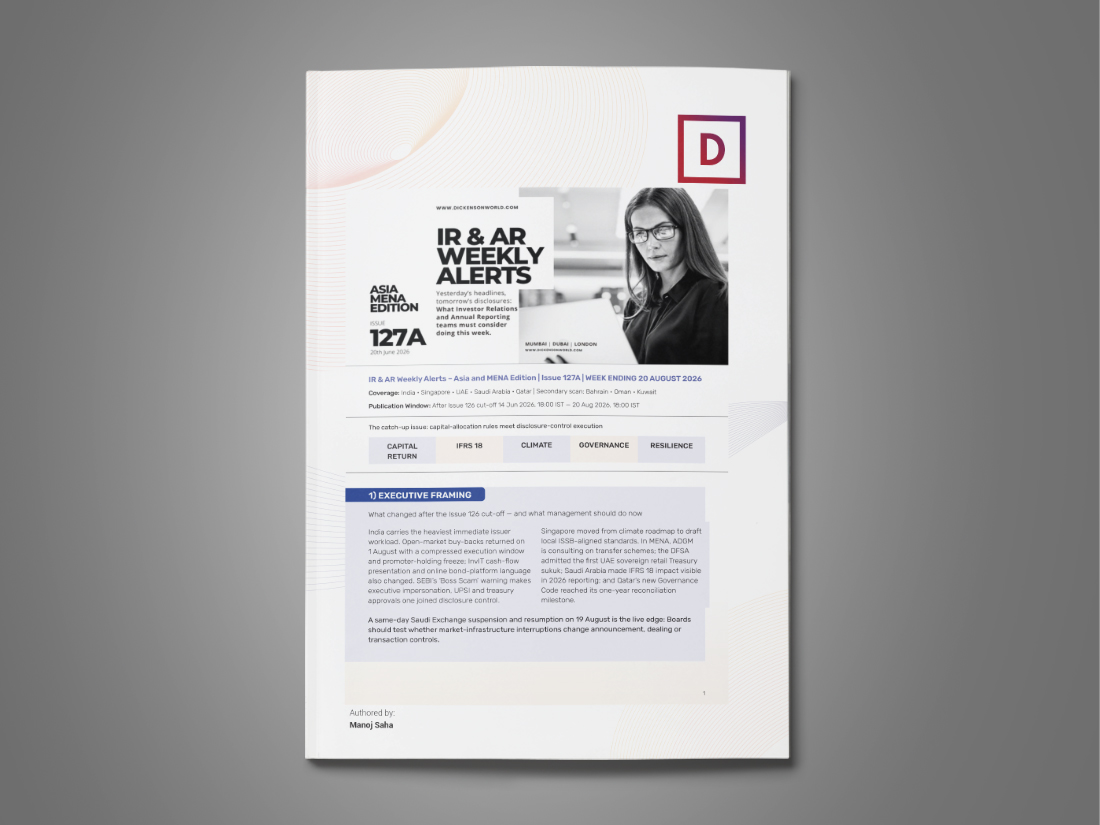
IR & AR WEEKLY ALERTS
To download and save this article.
Contact Us: To learn more or schedule a consultation, please reach out to us at www.dickensonworld.com
Email:enquiry@dickensonworld.com.
Leave A Comment