

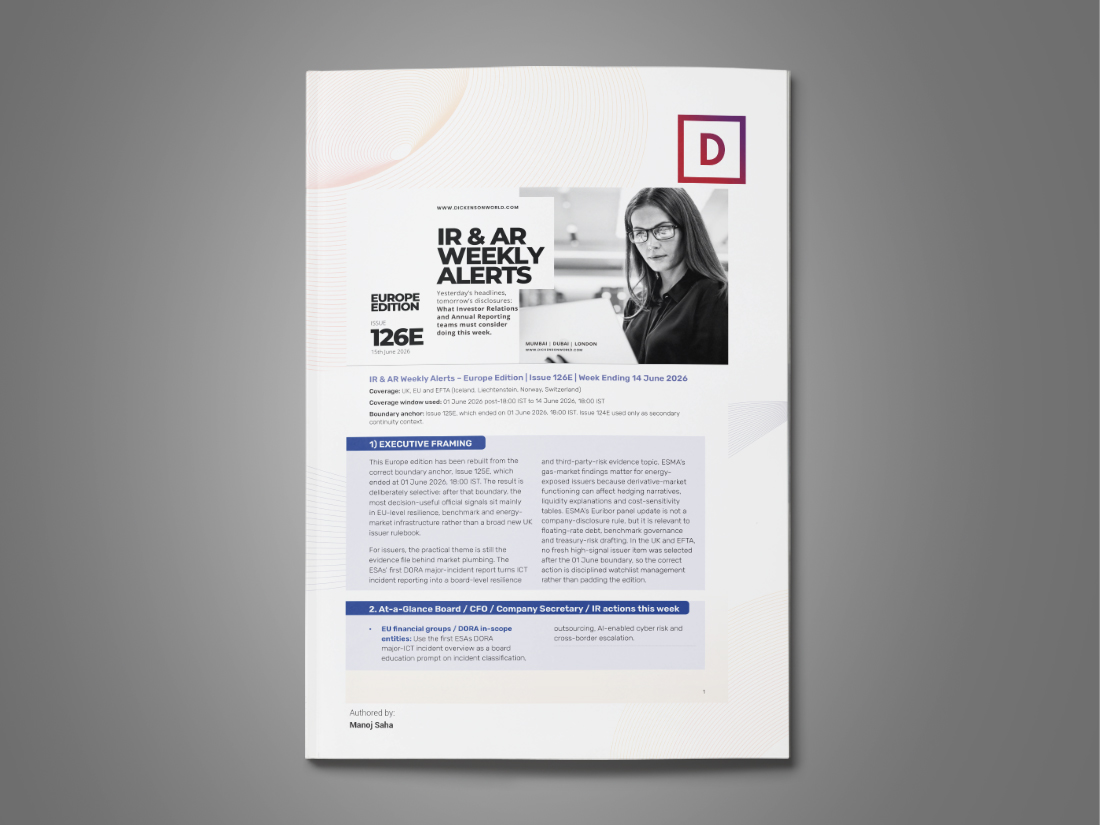
IR & AR WEEKLY ALERTS — ISSUE 126E
Coverage: UK, EU and EFTA (Iceland, Liechtenstein, Norway, Switzerland)
Coverage window used: 01 June 2026 post-18:00 IST to 14 June 2026, 18:00 IST
Boundary anchor: Issue 125E, which ended on 01 June 2026, 18:00 IST. Issue 124E used only as secondary continuity context.
A. UNITED KINGDOM
A1. No fresh high-signal issuer rule selected after the 01 June boundary
Publication date / deadline: Coverage review to 14 June 2026.
What happened
No new UK official item with sufficient direct issuer materiality was selected in the post-01 June review window. Issue 125E had already covered the FRC structured digital-reporting review, FRS 101 annual-review amendments, FRC audit enforcement, FCA CP26/16 and FCA PS26/8.
Why it matters to issuers, Company Secretaries and IR
The issuer action is to keep those 125E items live rather than repeat them without a fresh rule, deadline or enforcement delta. For annual-report teams, the highest-risk UK carry-forward remains digital-reporting QA, audit evidence discipline and authorised-fund asset-registration consultation tracking where relevant.
Action for CFO/Company Secretary/IR
-
Keep ESEF / structured-digital-reporting QA on the Audit Committee timetable.
-
For UK groups using FRS 101, confirm subsidiary reporting instructions have been updated from Issue 125E actions.
-
For authorised AIF exposure, continue tracking FCA CP26/16 ahead of its 9 July 2026 deadline, but do not repeat it as a new item unless preparing a response.
-
Re-check FCA, FRC and LSE sources before final publication if the cut-off is extended.
What investors will ask next
Investors will expect continuity on previously identified UK controls, not repetition of low-signal updates.
Source link(s): FCA publications page | FRC news page

B. EUROPEAN UNION (EU)
B1. ESAs publish first DORA report on major ICT-related incidents
Publication date / deadline: Published 03 June 2026.
What happened
The European Supervisory Authorities published the first annual overview of major ICT-related incidents in the EU financial sector under DORA. ESMA’s release states that ICT risks are increasingly borderless and interconnected, that about one third of reported major incidents had cross-border impact, and that system failures and external events were main drivers.
Why it matters to issuers, Company Secretaries and IR
For issuers and financial groups, this converts cyber and operational resilience from a generic risk-factor theme into an evidence file: incident classification, reporting ownership, outsourced-service oversight, service-provider coordination and AI-enabled cyber risk should all be traceable. Even non-financial issuers should consider whether disclosure-critical systems — reporting platforms, investor websites, webcast vendors, registrar interfaces and market-disclosure systems — are governed with enough specificity.
Action for CFO/Company Secretary/IR
-
Map disclosure-critical systems and vendors, including annual-report production, investor website, webcast, RNS / exchange filing, registry and cloud providers.
-
Ask risk and IT owners whether incident classification and escalation protocols would support timely regulatory and investor communications.
-
Refresh annual-report risk wording so it distinguishes cyber, operational resilience, third-party dependence and incident-response governance.
-
Brief the Audit / Risk Committee on DORA incident themes if the group has EU financial entities or material outsourced technology exposure.
What investors will ask next
Investors will ask whether operational-resilience statements are backed by real incident reporting, vendor oversight and recovery testing.
Source link(s): ESMA / ESAs DORA incident report release
B2. Gas Market Task Force findings keep commodity-market functioning in issuer risk narratives
Publication date / deadline: Published 02 June 2026.
What happened
ESMA published that the Gas Market Task Force had presented its findings on EU gas and gas derivative markets, summarising analytical work conducted in 2025 and suggesting further work to ensure the markets continue performing as expected.
Why it matters to issuers, Company Secretaries and IR
This is not a direct reporting rule, but it matters for energy-intensive issuers, utilities, industrials and commodity-trading groups. Gas and derivative-market functioning affects hedging capacity, margin calls, liquidity management, input-cost sensitivity and investor interpretation of commodity exposure. Annual-report and investor-deck language should avoid generic hedging claims if market structure or liquidity assumptions are material.
Action for CFO/Company Secretary/IR
-
Ask treasury to refresh gas-price, collateral and hedge-effectiveness sensitivity tables where gas or energy derivatives are material.
-
Check whether MD&A cost-pass-through statements are supported by actual contract and hedge evidence.
-
For utilities and energy-intensive industrials, include market-functioning assumptions in risk-factor backfiles.
-
Avoid overstating hedging protection where liquidity, collateral or derivative-market access is constrained.
What investors will ask next
Investors may ask whether gas-market volatility affects margins, hedging costs, collateral requirements or covenant headroom.
Source link(s): ESMA GMTF gas-market findings release
B3. Euribor panel expansion strengthens benchmark-governance watch for treasury disclosures
Publication date / deadline: Published 11 June 2026.
What happened
ESMA and the Belgian FSMA welcomed the inclusion of KBC Bank in the Euribor panel. ESMA described the development as contributing to the robustness and reliability of a critical benchmark, and noted ESMA’s supervisory role over EMMI as Euribor administrator under the Benchmarks Regulation.
Why it matters to issuers, Company Secretaries and IR
For most issuers this is not a disclosure event. However, issuers with material Euribor-linked debt, derivatives, leases or cash-pooling arrangements should treat benchmark governance as part of treasury-risk hygiene. Stronger benchmark representativeness is positive, but it does not remove the need for fallback language, sensitivity analysis and clear interest-rate-risk controls.
Action for CFO/Company Secretary/IR
-
Ask treasury to confirm Euribor-linked instruments, fallback provisions and hedge documentation are current.
-
Check interest-rate risk notes and sensitivity tables for consistency with actual debt and derivative exposure.
-
For banks and financial issuers, ensure benchmark governance is covered in risk, compliance and product-control documentation.
-
Avoid presenting benchmark-panel expansion as a change to issuer economics unless treasury confirms a direct impact.
What investors will ask next
Investors may ask whether floating-rate debt, hedges or customer products rely on robust benchmark governance and fallback mechanics.
Source link(s): ESMA Euribor panel update
B4. Revised ESRS consultation deadline has passed; move the file from response mode to readiness mode
Publication date / deadline: European Commission feedback deadline referenced in prior issue watchlist: 03 June 2026.
What happened
Issue 124E and Issue 125E had already flagged the revised ESRS simplification workstream and the 03 June 2026 feedback deadline. New this cycle: the deadline has now passed. The item should move from response drafting to monitoring for final text, implementation guidance and implications for data architecture.
Why it matters to issuers, Company Secretaries and IR
This matters because simplification should not be misread as permission to weaken sustainability evidence. Issuers still need to maintain defensible data ownership, audit trails, materiality logic, digital tagging readiness and consistency between Annual Report, sustainability statements and investor claims.
Action for CFO/Company Secretary/IR
-
Archive the submitted feedback or internal response position, including board or committee rationale.
-
Prepare a gap table separating likely disclosure simplification from unchanged underlying data and controls.
-
Keep ESRS, EU Taxonomy, ESEF and assurance-readiness owners aligned.
-
Do not rewrite investor-facing sustainability commitments until final text or implementation guidance is available.
What investors will ask next
Investors will ask whether simplification reduces clutter without weakening comparability, data quality or accountability.
Source link(s): European Commission finance consultations page
C. EFTA
C1. EFTA watch: no high-signal new issuer item selected after 01 June boundary
Publication date / deadline: Coverage review to 14 June 2026.
What happened
No fresh Switzerland, Norway, Iceland or Liechtenstein item with sufficient issuer materiality was selected for this cycle. Prior EFTA filing-discipline, Swiss governance / banking-stability and Norwegian reporting-control items remain on watch but are not repeated without a fresh regulatory or enforcement delta.
Why it matters to issuers, Company Secretaries and IR
The absence of a selected item should be treated as editorial discipline, not inactivity. EFTA-exposed issuers should keep existing filing, AML, beneficial-ownership, prospectus, final-terms and reporting-control trackers active.
Action for CFO/Company Secretary/IR
-
Maintain existing EFTA filing and annual-report controls.
-
Re-check FINMA, SIX Exchange Regulation and Finanstilsynet sources before publication if the cut-off is extended.
-
Do not add low-signal procedural items unless they create a concrete issuer action.
-
Keep Swiss and Norwegian evidence-file controls visible to Company Secretariat and finance teams.
What investors will ask next
Investors will expect materiality discipline and will not benefit from low-signal procedural items unless they affect disclosure, filings or governance.
Source link(s): FINMA news page | SIX Exchange Regulation notifications | Finanstilsynet news page


IR & AR WEEKLY ALERTS
To download and save this article.
Contact Us: To learn more or schedule a consultation, please reach out to us at www.dickensonworld.com
Email:enquiry@dickensonworld.com.
Leave A Comment