

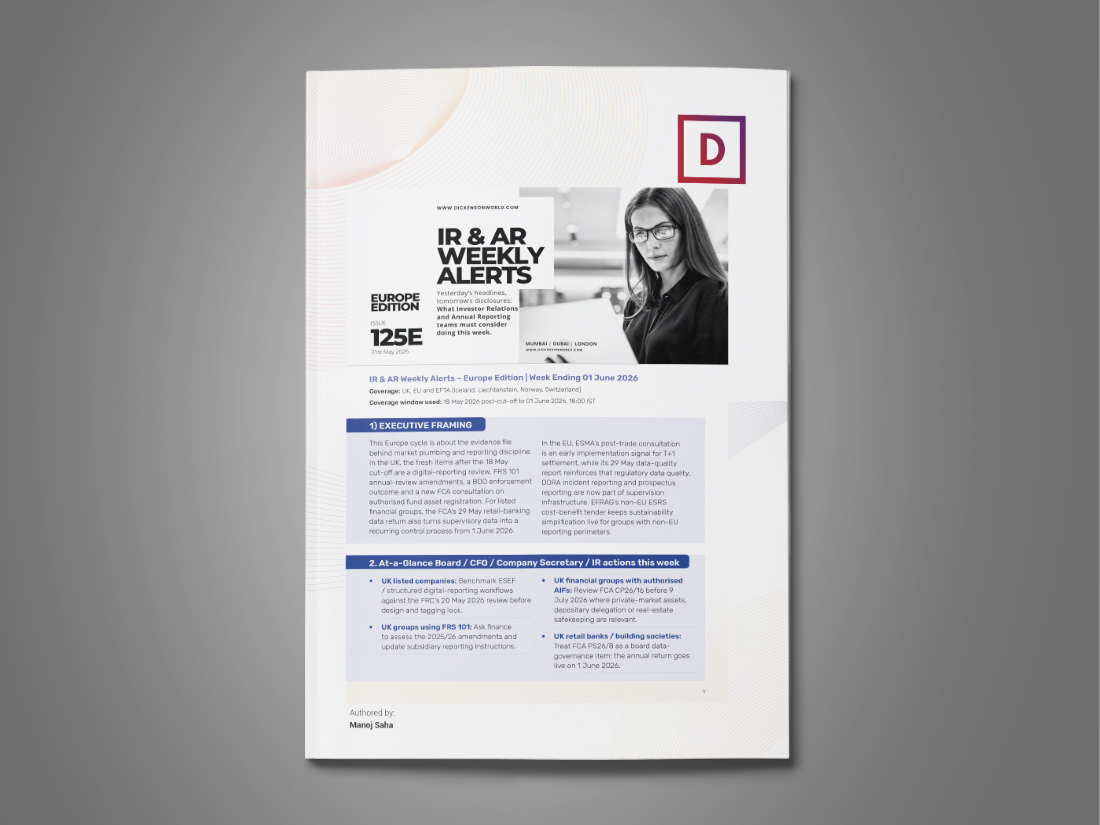
IR & AR WEEKLY ALERTS — ISSUE 125E
Coverage: UK, EU and EFTA (Iceland, Liechtenstein, Norway, Switzerland)
Coverage window used: 18 May 2026 post-cut-off to 01 June 2026, 18:00 IST
A. UNITED KINGDOM
A1. FRC highlights opportunities to improve structured digital reporting by UK listed companies
Publication date / deadline: 20 May 2026.
What happened
The FRC published its latest review of structured digital reporting by UK listed companies. The FRC news listing states that the review focuses on structured digital reporting quality.
Why it matters to issuers, Company Secretaries and IR
Digital reporting errors are increasingly visible to investors, data providers and regulators. A clean PDF is not enough if tags, extensions, anchoring, labels and consistency between primary statements, notes and narrative do not hold. For annual reports, this affects production workflow, vendor QA, audit committee oversight and the post-filing evidence file.
Action for CFO/Company Secretary/IR
-
Commission a pre-close digital-reporting QA review covering ESEF tags, extension use, anchoring and consistency between human-readable and machine-readable outputs.
-
Ask the tagging vendor for a written issue log and remediation plan before design lock.
-
Add digital reporting to the Audit Committee timetable rather than leaving it to the last production sprint.
-
Keep a final sign-off checklist showing finance, company secretariat, IR and vendor approval.
What investors will ask next
Investors and data users will ask whether the tagged report supports reliable comparability, not only whether the annual report was filed on time.
Source: FRC news and events
A2. FRC concludes annual review of FRS 101 Reduced Disclosure Framework
Publication date / deadline: 21 May 2026.
What happened
The FRC issued “Amendments to FRS 101 Reduced Disclosure Framework – 2025/26 cycle”, bringing the latest annual review of FRS 101 to a close.
Why it matters to issuers, Company Secretaries and IR
This is relevant for UK groups with qualifying subsidiaries using FRS 101. The practical risk is that subsidiary reporting packs, group consolidation instructions and notes-disclosure exemptions are not updated before year-end. For listed parents, weak subsidiary reporting discipline can create timetable and audit-friction problems even when the parent’s main market disclosure is under IFRS.
Action for CFO/Company Secretary/IR
-
Ask group finance to issue updated FRS 101 instructions to subsidiaries using the framework.
-
Confirm whether any disclosure exemptions, measurement references or note templates change.
-
Include the FRS 101 update in the group reporting timetable and audit planning file.
-
Ensure investor-facing commentary is not affected by subsidiary reporting simplifications.
What investors will ask next
Investors are unlikely to ask about FRS 101 directly, but they will care if subsidiary reporting issues delay audit completion or create consolidation adjustments.
Source: FRC news and events | FRC accounting standards
A3. FRC sanctions BDO LLP and audit partner — audit evidence and challenge remain enforcement themes
Publication date / deadline: 28 May 2026.
What happened
The FRC news listing records sanctions against BDO LLP and Geraint Jones, an audit engagement partner, under the Audit Enforcement Procedure.
Why it matters to issuers, Company Secretaries and IR
Although the action is against the auditor, issuers should treat it as an audit-quality signal. Enforcement outcomes often translate into more rigorous evidence requests, clearer challenge documentation, tighter audit committee minutes and more careful treatment of judgemental disclosures.
Action for CFO/Company Secretary/IR
-
Ask the audit partner whether any audit-quality or enforcement learnings affect the FY2026 evidence request list.
-
Strengthen documentation for complex estimates, revenue, impairment, provisions and going-concern assumptions.
-
Ensure Audit Committee minutes record challenge and response, not only approval.
-
Align the Annual Report narrative with the evidence actually available to auditors.
What investors will ask next
Investors will ask whether the audit committee is challenging management and auditors on high-judgement areas with sufficient specificity.
Source: FRC news and events
A4. FCA CP26/16 proposes changes to authorised fund asset registration and depositary delegation
Publication date / deadline: Consultation opened 21 May 2026; closes 9 July 2026.
What happened
The FCA opened CP26/16 on Registration of authorised fund assets. It proposes changes allowing depositaries of authorised AIFs managed by full-scope AIFMs to delegate certain safekeeping functions for private-market asset types to specified third parties, permits delegation for non-custodial private-market assets such as real estate to AFM affiliates subject to protections, clarifies authorised fund registration requirements and CASS 6 custody treatment, and proposes a permanent rule change for guarantees and indemnities.
Why it matters to issuers, Company Secretaries and IR
For listed asset managers, REIT-adjacent groups, real-asset platforms and financial groups with authorised AIFs, this could alter private-market operating models, depositary oversight, affiliate conflicts, custody narratives and investor due-diligence materials. It also affects how boards explain private-market governance and third-party oversight.
Action for CFO/Company Secretary/IR
-
Map which authorised funds, depositaries, AFM affiliates and private-market assets could be affected.
-
Review whether delegation to affiliates creates conflicts or governance disclosures that need board approval.
-
Prepare consultation feedback by 9 July 2026 if real estate, infrastructure or partnership vehicles are material.
-
Update investor materials only after final rules; for now, describe this as a consultation.
What investors will ask next
Fund investors will ask whether delegation improves operational efficiency without weakening asset safeguarding or increasing conflicts.
Source: FCA CP26/16 – Registration of authorised fund assets
A5. FCA PS26/8 makes retail banking business-model data an annual return from 1 June 2026
Publication date / deadline: Policy statement published 29 May 2026; rules come into force 1 June 2026.
What happened
The FCA published PS26/8 on Retail Banking Business Models data. The FCA states it is transforming a previously ad hoc R2B2 data collection into an annual regulatory return, with the new rules coming into force on 1 June 2026 and the return accessible via RegData.
Why it matters to issuers, Company Secretaries and IR
For listed retail banks and building societies, recurring supervisory data becomes part of the control environment. Annual returns require data ownership, reconciliations, sign-off governance and consistency between regulatory submissions, business-model commentary and investor materials.
Action for CFO/Company Secretary/IR
-
Nominate a data owner for the R2B2 annual return and map data fields to finance and product systems.
-
Create a board / ExCo sign-off route for the first annual submission.
-
Check that business-model and segment commentary in investor materials is not inconsistent with data submitted to the FCA.
-
Add RegData submission evidence to the regulatory reporting backfile.
What investors will ask next
Investors will ask whether recurring supervisory data collection reveals margin, product, volume or business-model trends that management commentary should already address.
Source: FCA PS26/8 – Retail Banking Business Models data

B. EUROPEAN UNION (EU)
B1. ESMA consults on revised allocation and confirmation guidelines to support T+1 readiness
Publication date / deadline: Published 26 May 2026; feedback due 7 July 2026; revised guidelines expected by October 2026.
What happened
ESMA launched a consultation on updates to guidelines on standardised procedures and messaging protocols. ESMA says the review supports preparation for T+1 settlement, makes post-trade communication faster, clearer and more consistent, and reflects proposed RTS amendments on Settlement Discipline. The proposed changes include mandatory use of electronic, standardised channels and international messaging standards, with non-electronic methods removed except during temporary technical disruption.
Why it matters to issuers, Company Secretaries and IR
The obligation sits mainly with market participants, but issuers feel the impact through settlement-cycle compression, record-date management, corporate actions, placings, buybacks and investor communications. Issuers should not wait until the 11 October 2027 T+1 date to identify where late allocations or non-standard confirmations could affect market execution.
Action for CFO/Company Secretary/IR
-
Ask brokers, custodians and registrars for a T+1 readiness note covering allocation, confirmation and corporate-action timelines.
-
Update capital-action playbooks to reflect tighter post-trade windows.
-
Add T+1 dependencies to the treasury and company secretariat regulatory watchlist.
-
Consider whether to submit feedback by 7 July 2026 through advisers or industry bodies.
What investors will ask next
Investors will ask whether settlement compression increases failed-trade or entitlement risk around event-heavy periods.
Source: ESMA consultation – revised allocation and confirmation guidelines
B2. ESMA annual data report elevates regulatory data quality, DORA incident reporting and prospectus reporting
Publication date / deadline: 29 May 2026.
What happened
ESMA published its annual report on the quality and use of regulatory data. ESMA states that improved data quality and use support supervision and market monitoring, and that the report now includes additional regimes and registers such as Prospectus reporting and ICT-related incident reporting under DORA.
Why it matters to issuers, Company Secretaries and IR
For issuers and financial groups, this is a reminder that regulatory data quality is no longer a back-office topic. Prospectus reporting, DORA incident reporting, EMIR / SFTR / MiFIR data dependencies and market-data accuracy can all become supervisory evidence. Boards should understand data governance around disclosure-critical systems.
Action for CFO/Company Secretary/IR
-
Map disclosure-critical data feeds: prospectus reporting, transaction reporting dependencies, DORA incident inputs, market data and register submissions.
-
Assign owners for data quality, reconciliation and error correction.
-
Ensure annual-report risk language on operational resilience and regulatory reporting is specific enough to be credible.
-
Use ESMA’s report as a board education prompt on data-led supervision.
What investors will ask next
Investors will ask whether regulatory data failures could create operational, reputational or enforcement risk.
Source: ESMA annual data report
B3. EFRAG starts cost-benefit work on non-EU company ESRS reporting standards
Publication date / deadline: 21 May 2026.
What happened
EFRAG’s news page records a call for tender for a cost and benefit analysis of ESRS reporting standards for non-EU companies (N-ESRS).
Why it matters to issuers, Company Secretaries and IR
This matters for non-EU parent groups, EU subsidiaries in global groups and companies preparing for the outer perimeter of CSRD / ESRS reporting. The cost-benefit work is not a final rule, but it indicates that the non-EU ESRS reporting architecture is still active and will need evidence on feasibility, cost and usefulness.
Action for CFO/Company Secretary/IR
-
For non-EU groups with EU reporting exposure, keep N-ESRS on the sustainability roadmap.
-
Map which entities could be in scope and what data gaps exist across EU and non-EU reporting boundaries.
-
Avoid designing sustainability systems that assume only EU-subsidiary data will matter.
-
Track EFRAG outputs for implications on XBRL, interoperability and group-level reporting burden.
What investors will ask next
Investors will ask whether global reporting perimeters are consistent and whether non-EU group data can support ESRS-style disclosures.
Source: EFRAG news page
C. EFTA
C1. EFTA watch: no high-signal new issuer item identified after 18 May cut-off
Publication date / deadline: Coverage review to 01 June 2026.
What happened
No new EFTA item with sufficient issuer materiality was selected for this cycle. Swiss and Norwegian filing-discipline and governance items from prior issues remain on watch, but were not repeated without a fresh rule, deadline or enforcement delta.
Why it matters to issuers, Company Secretaries and IR
The absence of a new selected item should not be treated as inactivity. For EFTA-exposed issuers, maintain existing watchlists for Swiss governance / banking-stability items, SIX filing mechanics and Norwegian reporting-control discipline.
Action for CFO/Company Secretary/IR
-
Keep existing EFTA filing and annual-report controls active.
-
Re-check official EFTA / FINMA / SIX / Finanstilsynet sources before final publication if the cut-off is extended.
-
Do not pad the edition with low-signal items unless they create concrete issuer action.
What investors will ask next
Investors will expect discipline in what is included; low-signal procedural items should be left out unless they affect disclosure, filings or governance.
Source: FINMA | SIX Exchange Regulation | Finanstilsynet Norway


IR & AR WEEKLY ALERTS
To download and save this article.
Contact Us: To learn more or schedule a consultation, please reach out to us at www.dickensonworld.com
Email:enquiry@dickensonworld.com.
Leave A Comment