

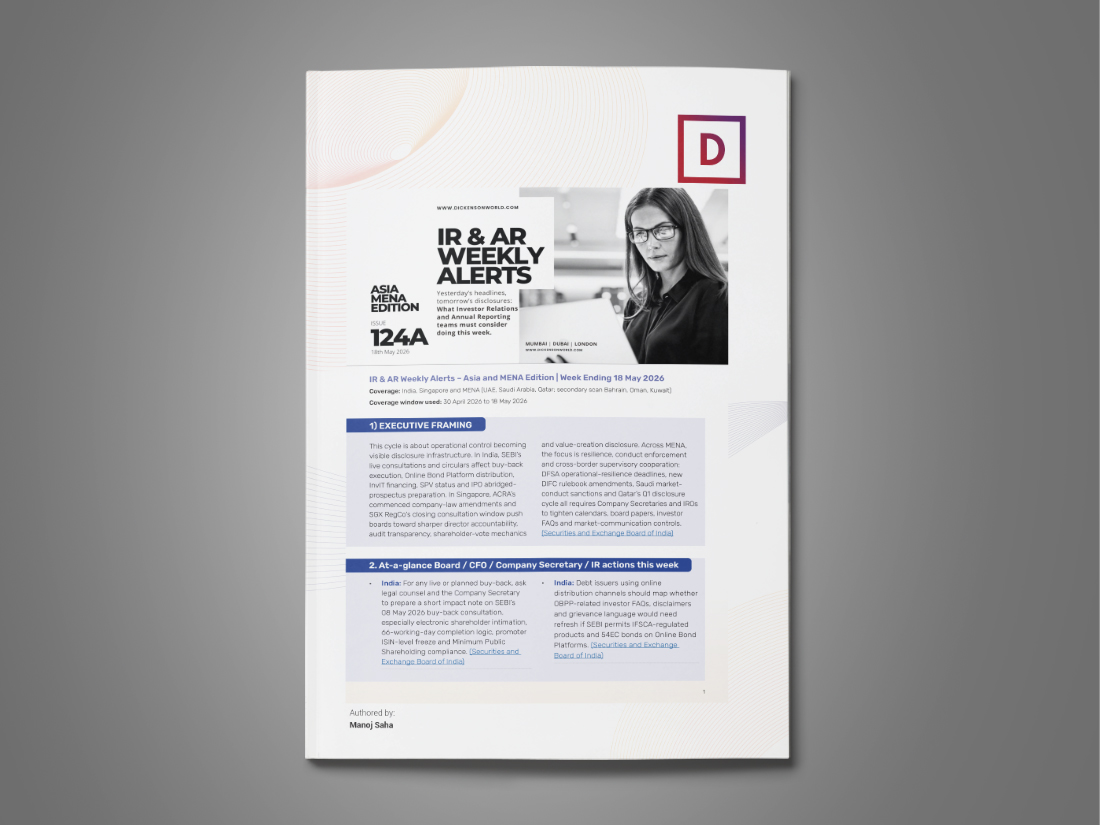
IR & AR WEEKLY ALERTS — ISSUE 124A (Asia and MENA Edition)
Coverage: India, Singapore and MENA (UAE, Saudi Arabia, Qatar; secondary scan Bahrain, Oman, Kuwait)
Coverage window used: 30 April 2026 to 18 May 2026
A. INDIA
1. SEBI consults on rationalising the buy-back framework
Publication date / deadline: Published 08 May 2026; public comments reported as invited until 29 May 2026.
What happened
SEBI published a consultation paper on review and rationalisation of the SEBI (Buy-Back of Securities) Regulations, 2018. The SEBI public-comments form lists proposals covering electronic intimation to shareholders, a maximum 66-working-day completion timeline for open-market buy-backs through the stock exchange mechanism, dispensing with a separate trading window, freezing promoter and associate holdings at ISIN level during the buy-back period, explicit Minimum Public Shareholding compliance, alignment of intervals between buy-backs with the Companies Act, and dispensing with the mandatory merchant banker requirement. (Securities and Exchange Board of India)
Why it matters to issuers, Company Secretaries and IR
This is a direct issuer-execution item. Buy-backs sit at the intersection of board approval, shareholder communication, promoter dealing restrictions, market signalling and investor Q&A. If finalised, the proposals could alter buy-back checklists, the role of merchant bankers, electronic communication workflows, promoter-freeze controls and how companies’ evidence MPS compliance during capital-return programmes.
Action for CFO/Company Secretary/IR
-
Prepare a one-page “buy-back readiness” note covering current policy, promoter holdings, MPS headroom and shareholder-communication channels.
-
Re-check whether the registrar, depository and company secretariat can support electronic intimation and promoter ISIN-level freeze workflows.
-
For any likely FY2026 buy-back, ask counsel to model the timetable under the proposed 66-working-day structure.
-
Update draft investor Q&A so the company avoids describing the proposals as final rules until SEBI completes the consultation.
What investors will ask next
Investors will ask whether a proposed buy-back can be executed faster, whether promoter participation or freeze rules change market confidence, and whether dispensing with a merchant banker weakens or simplifies governance.
Source link(s): SEBI consultation page and SEBI public-comments proposal list. (Securities and Exchange Board of India)
2. SEBI consults on Online Bond Platform Provider framework changes
Publication date: 05 May 2026.
What happened
SEBI published a consultation paper on modification of the regulatory framework for Online Bond Platform Providers. The public-comments form identifies proposals to permit OBPPs to offer IFSCA-regulated products, securities or services subject to applicable FEMA / overseas-investment requirements; permit 54EC-style bonds on Online Bond Platforms; require clearer feature, tax and grievance disclosures; and align OBPP compliance-officer requirements with stock brokers. (Securities and Exchange Board of India)
Why it matters to issuers, Company Secretaries and IR
For issuers using digital channels to distribute listed debt, this is not only an intermediary reform. If OBP product scope widens, issuers must be clearer about which products are theirs, what tax features are being described, which grievance route applies, and whether distribution material is being presented by a regulated platform, broker or issuer. Debt IR materials and website FAQs should avoid creating confusion between issuer obligations and platform obligations.
Action for CFO/Company Secretary/IR
-
Inventory all digital bond-distribution partners and confirm whether investor-facing material distinguishes issuer disclosures from platform disclosures.
-
Review tax-feature language for any 54EC or tax-sensitive bond products; keep disclaimers factual and not promotional.
-
Ask legal and treasury teams to update grievance-routing scripts for debt investors who enter through OBPP channels.
-
Ensure investor decks do not imply issuer endorsement of every product available on a platform.
What investors will ask next
Debt investors may ask whether a digital bond product is issuer-originated, platform-distributed, tax-benefit eligible, or routed through a GIFT-IFSC / IFSCA-regulated channel.
Source link(s): SEBI OBPP consultation page and SEBI public-comments proposal list. (Securities and Exchange Board of India)
3. SEBI issues two InvIT circulars on SPV status and fresh borrowings
Publication date: 15 May 2026.
What happened
SEBI issued two InvIT circulars. The first addresses the status of SPVs after conclusion or termination of a concession agreement. The second addresses permitted use of fresh borrowings for InvITs where net borrowings exceed 49% of InvIT asset value. (Securities and Exchange Board of India)
Why it matters to issuers, Company Secretaries and IR
InvIT structures depend heavily on project SPVs, concession timelines, leverage tests and investor confidence in cash-flow visibility. Even where the full operational detail sits with investment managers and trustees, listed InvITs and sponsors should expect investor questions on post-concession asset strategy, debt headroom, refinancing use and whether annual-report disclosure sufficiently explains SPV-level liabilities, contingent claims and exit plans.
Action for CFO/Company Secretary/IR
-
Ask the investment manager to map every SPV with a concession nearing expiry, terminated or under dispute.
-
Update debt and capital-management notes to show how fresh borrowing use is approved and monitored.
-
Prepare Board / Audit Committee wording on SPV-level contingent liabilities, claims and repayment schedules.
-
If refinancing is contemplated, align treasury commentary with the specific SEBI circular rather than using generic “growth capital” language.
What investors will ask next
Investors will ask whether completed or terminated concession SPVs remain investible, whether leverage above 49% is being used for capex, maintenance or refinancing, and whether project-level liabilities are transparent.
Source link(s): SEBI InvIT circulars dated 15 May 2026. (Securities and Exchange Board of India)
4. Draft abridged prospectus format is now visible in live SEBI filings
Publication date: 14 May 2026.
What happened
SEBI’s public-issues filings page records InCred Holdings Limited’s UDRHP-I and Draft Abridged Prospectus on 14 May 2026. The draft abridged prospectus states that it has been prepared in the revised format prescribed under the SEBI ICDR Regulations pursuant to the 2026 ICDR Amendment Regulations. (Securities and Exchange Board of India)
Why it matters to issuers, Company Secretaries and IR
New this period: the revised abridged-prospectus format is no longer only a rule-change topic; it is appearing in live offer-document workflow. IPO candidates should treat the abridged prospectus as an early investor-facing document, not as a late-stage compliance summary. Risk factors, KPI presentation, issue objects and financial highlights must be consistent across the DRHP / UDRHP, abridged prospectus, website hosting and roadshow materials.
Action for CFO/Company Secretary/IR
-
Add “draft abridged prospectus” to the DRHP-stage workplan, not only the launch-stage checklist.
-
Assign plain-language review ownership to IR and legal before website publication.
-
Ensure issue objects, business summary, risk factors and financial metrics reconcile to the main offer document.
-
Prepare Board sign-off papers that treat the abridged prospectus as a reputational disclosure document.
What investors will ask next
Retail and HNI investors will ask whether the abridged prospectus gives a fair, concise and complete reading of risk, use of proceeds and financial performance without requiring them to interpret the full offer document first.
Source link(s): SEBI public-issues filing page and InCred Draft Abridged Prospectus. (Securities and Exchange Board of India)

B. SINGAPORE
1. ACRA company-law changes commenced on 06 May 2026
Publication date / effective date: Announced 16 April 2026; selected provisions commenced 06 May 2026.
What happened
ACRA announced phased commencement of selected provisions under the Corporate and Accounting Laws (Amendment) Act 2025 from 06 May 2026. Key amendments include higher penalties for directors, money-laundering-related director disqualification, named identification of the public accountant primarily responsible for an audit engagement in audit reports, and a new two-tier approval process for selective off-market share purchases. (ACRA)
Why it matters to issuers, Company Secretaries and IR
This is governance and shareholder-rights infrastructure. Listed and pre-listing Singapore companies should ensure director training, audit-report review, selective-buyback approvals and related explanatory statements reflect the new position. The two-tier approval requirement for selective off-market purchases is especially relevant where capital management or founder / strategic shareholder exits are being considered.
Action for CFO/Company Secretary/IR
-
Update director induction and annual compliance declarations to reflect the heavier penalties and AML-linked disqualification consequences.
-
Ask the audit partner how named audit-partner disclosure will appear in the audit report and whether board papers need a short explanatory note.
-
For selective off-market share purchases, revise shareholder-meeting checklists to include both approval thresholds.
-
Review governance-report wording so it does not imply outdated director-penalty or audit-signature practice.
What investors will ask next
Investors and proxy advisers may ask whether the board has refreshed director-accountability training and whether any selective share purchase protects affected class shareholders fairly.
Source link(s): ACRA announcement. (ACRA)
2. SGX RegCo value-creation disclosure consultation moves into closing window
Publication date / deadline / proposed implementation: Published 22 April 2026; comments due 22 May 2026; phased implementation expected from 01 January 2027 if supported.
What happened
New this period: the consultation deadline is now within the immediate action window. SGX RegCo proposes rules requiring issuers to disclose annual-report KPIs used to determine board and key-management remuneration and explain alignment with long-term shareholder value, maintain and describe a dividend policy, maintain an investor-engagement website, and publish an IR policy while describing investor-engagement activities in the annual report.
Why it matters to issuers, Company Secretaries and IR
This converts value creation and investor engagement into annual-report architecture. Even though first affected annual reports would likely be issued in 2028 if the rules proceed, boards should not wait. Dividend policy, remuneration metrics and IR policy are board-owned statements that require internal alignment before they are disclosed.
Action for CFO/Company Secretary/IR
-
By 22 May 2026, decide whether to submit feedback on implementation timeline, scope or proportionality.
-
Prepare a gap checklist: dividend policy, remuneration KPI map, IR policy, investor-engagement website and annual-report narrative.
-
Ask the Remuneration Committee to confirm whether current KPIs can be explained in shareholder-value terms.
-
Review whether the current IR website would meet the spirit of an “investor engagement website.”
What investors will ask next
Investors will ask whether remuneration metrics are genuinely linked to value creation, whether dividend policy is disciplined or discretionary, and whether the company has a credible IR policy rather than a website placeholder.
Source link(s): SGX RegCo news release.

C. UAE
1. DFSA operational-resilience consultation approaches comment deadline
Publication date / deadline: Published 27 March 2026; comments due 26 May 2026.
What happened
New this period: the DFSA CP170 comment deadline is now inside the next 14-day window. DFSA released Consultation Paper No. 170 on Operational Resilience and set 26 May 2026 as the deadline for comments. (dfsa.ae)
Why it matters to issuers, Company Secretaries and IR
For issuer groups with DIFC-regulated entities, operational resilience affects more than regulated operations. Investor websites, market-disclosure workflows, cyber vendors, client portals, outsourcing chains and communications infrastructure can all create disclosure-continuity risk. Boards should treat the consultation as a prompt to document ownership of important business services and third-party dependencies.
Action for CFO/Company Secretary/IR
-
Ask DIFC-regulated entities to identify important business services that touch investor or market communications.
-
Map disclosure-critical vendors, including investor websites, webcast platforms, cloud providers and cyber-response vendors.
-
Prepare a Risk Committee update on operational-resilience ownership, testing cadence and escalation routes.
-
Decide whether to submit comments before 26 May 2026.
What investors will ask next
Investors may ask whether a cyber incident, vendor outage or regulated-entity disruption could delay disclosures, investor communications or client servicing.
Source link(s): DFSA CP170 notice. (dfsa.ae)
2. DFSA finalises May 2026 rulebook amendments with 01 January 2027 commencement
Publication date / effective date: Published 12 May 2026; rulemaking instruments come into force on 01 January 2027.
What happened
DFSA published a Notice of Amendments to Legislation following Consultation Paper No. 167. The DFSA Board made amendments to the Rulebook, including GEN, PIB, GLO and IFR rulemaking instruments, with commencement on 01 January 2027. (dfsa.ae)
Why it matters to issuers, Company Secretaries and IR
This is a compliance-calendar trigger for groups with DIFC-regulated entities or Islamic-finance activities. Annual-report governance and risk disclosures should avoid static language that says policies are “current” without noting pending rule changes where material. The 01 January 2027 date gives boards time to approve policy refreshes, but not enough time to leave implementation until year-end.
Action for CFO/Company Secretary/IR
-
Add the DFSA 01 January 2027 commencement date to the legal and compliance calendar.
-
Ask Compliance to provide a short delta note on GEN, PIB, GLO and IFR changes relevant to the group.
-
Where regulated DIFC activity is material, prepare draft FY2026 governance wording on rulebook-change readiness.
-
Align Islamic-finance disclosures with the IFR amendment workstream where applicable.
What investors will ask next
Investors may ask whether DIFC-regulated operations face compliance cost, policy changes or governance-control updates before the 01 January 2027 effective date.
Source link(s): DFSA Notice of Amendments to Legislation, May 2026. (dfsa.ae)

E. Saudi Arabia
1. CMA enforcement decisions underline market-conduct and class-action risk
Publication date: 14 May 2026.
What happened
Saudi Arabia’s CMA announced ACRSD final decisions against 15 violators, with fines of more than SAR 10.7 million and obligations, together with other investors, to pay more than SAR 12 million. The violations related to manipulation and fraud in listed insurance shares, including purchase orders intended to affect share prices and some linked sale orders. CMA also noted that affected persons may file compensation claims individually or as a class action after filing a complaint with CMA. (saudiexchange.sa)
Why it matters to issuers, Company Secretaries and IR
This is a supervisory signal for trading-window governance, rumour handling and investor-response discipline. Issuers should not treat manipulation cases as investor-only matters: abnormal trading around results, corporate actions or sector news can create pressure on IR teams to comment prematurely. The class-action reference also strengthens the litigation-risk angle in market-conduct narratives.
Action for CFO/Company Secretary/IR
-
Refresh market-abuse escalation protocols for unusual trading, leaks or rumour spikes.
-
Brief IR teams to avoid speculative commentary on trading patterns; escalation should go through legal and market advisers.
-
For Saudi-listed groups, review annual-report risk wording on market conduct, litigation and investor claims.
-
Ensure board papers for capital actions include a note on trading surveillance and communication discipline.
What investors will ask next
Investors may ask whether the company has processes to detect leaks, respond to market rumours and avoid selective disclosure during abnormal trading periods.
Source link(s): Saudi Exchange / CMA market news. (saudiexchange.sa)
2. CMA Capital Market Law consultation closes on 21 May 2026
Publication date / deadline: Published 21 April 2026; comments due 21 May 2026.
What happened
New this period: the consultation closes this week. CMA called for public consultation on draft amendments to Article Five and Article Eighteen of the Capital Market Law. Saudi Exchange’s notice states that the proposed draft aims to enhance international cooperation between CMA and foreign counterpart authorities, in line with international best practice and confidence in the capital market. (saudiexchange.sa)
Why it matters to issuers, Company Secretaries and IR
The proposal is not an issuer-disclosure rule by itself, but it affects the supervisory environment for issuers with cross-border investors, listings, advisers or regulated affiliates. Stronger cooperation between regulators can increase the practical importance of consistency across Saudi, GCC and international disclosures.
Action for CFO/Company Secretary/IR
-
Decide immediately whether to submit comments before 21 May 2026.
-
For cross-border groups, ask legal to map which foreign regulator relationships or disclosure records could become more visible.
-
Ensure investor presentations used outside Saudi Arabia do not conflict with local disclosures.
-
Add cross-border supervisory cooperation to the compliance watchlist for capital-market transactions.
What investors will ask next
International investors may ask whether enhanced cooperation will improve enforcement credibility, disclosure quality and confidence in cross-border participation.
Source link(s): Saudi Exchange / CMA consultation notice. (saudiexchange.sa)
D. Qatar
1. QSE Q1 earnings cycle reinforces disclosure discipline
Publication date: 03 May 2026.
What happened
Qatar News Agency reported that QSE-listed companies posted QR 12.76 billion in net profits for Q1 2026, down 3.29% year-on-year from QR 13.19 billion. The report states that QSE said main-market firms had disclosed financial results for the period ended 31 March 2026, excluding Al Faleh Educational Holding Company and Qatari German Medical Devices, and that all financial data was available on the QSE website. (qna.org.qa)
Why it matters to issuers, Company Secretaries and IR
This is not a new rule, but it is a useful disclosure-cycle marker. Qatari issuers should expect investors to compare Q1 narrative quality, segment explanations and conference-call discipline against market-wide profit movement. Where results are delayed or excluded from aggregate commentary, the company should ensure the reason and expected disclosure path are clear.
Action for CFO/Company Secretary/IR
-
Reconcile Q1 earnings decks to the exact financial statements posted on QSE channels.
-
Prepare investor Q&A on whether profit movement is market-wide, sector-specific or company-specific.
-
For any delayed disclosure, ensure the market-facing explanation is consistent across QSE filings, website and investor emails.
-
Keep the QSE financial-data page as the authorised source in investor scripts.
What investors will ask next
Investors will ask whether Q1 underperformance is sector-driven, whether disclosure timing is comparable across issuers, and whether management commentary explains the variance without overstating market-wide context.
Source link(s): QNA report citing QSE statement. (qna.org.qa)

IR & AR WEEKLY ALERTS
To download and save this article.
Contact Us: To learn more or schedule a consultation, please reach out to us at www.dickensonworld.com
Email:enquiry@dickensonworld.com.
Leave A Comment