
Dickenson Corporate Reporting Research Series
RESEARCH PAPER 01
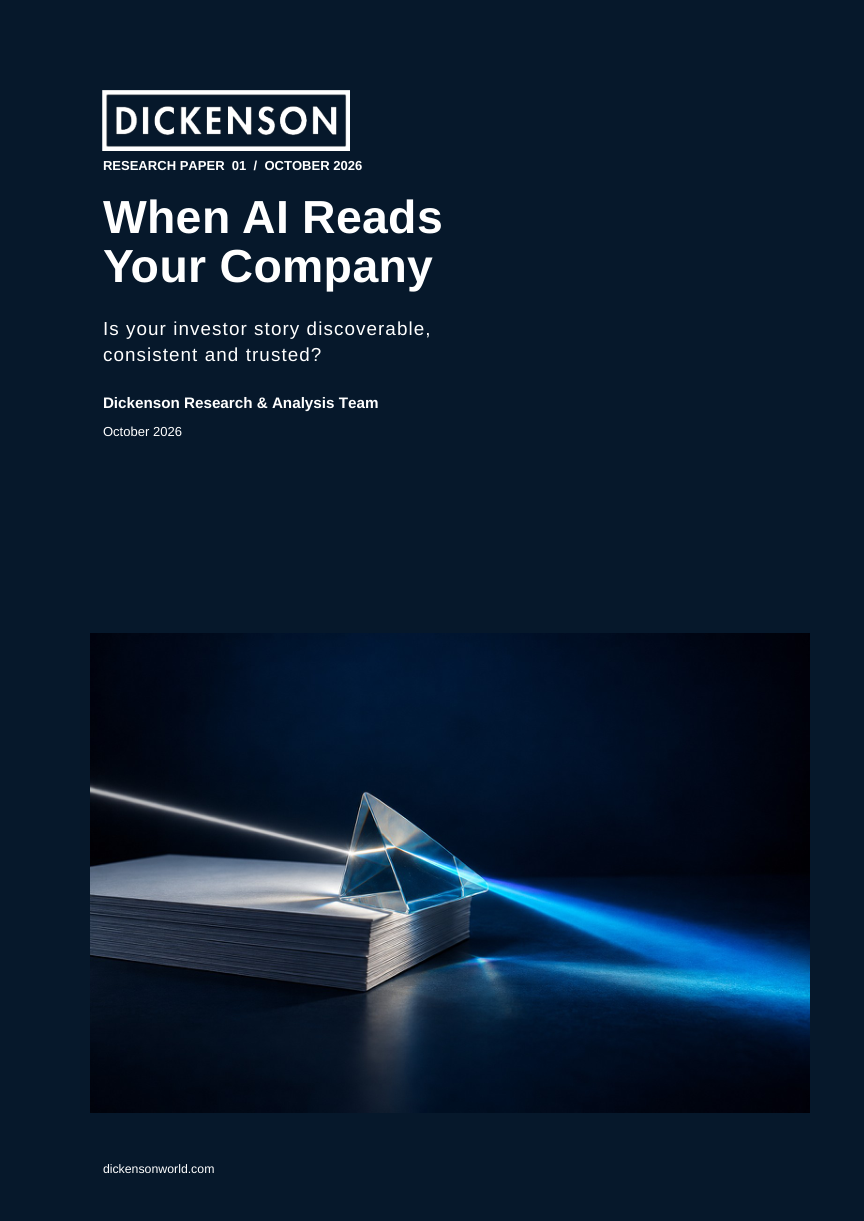
When AI Reads Your Company
Is your investor story discoverable, consistent and trusted?
Understand how AI-enabled search and research tools interpret your Company’s public disclosures, and where fragmented information can distort the investor story. This paper gives reporting and IR teams a practical framework for making approved information easier to find, reconcile and verify.
Applicable taxes calculated at checkout. PDF available after payment confirmation.
Research to inform your next reporting brief.
Why this paper
See your disclosure through a new reader’s eyes
An investor may encounter your Company through an AI-generated answer before opening the annual report. That answer can draw on results releases, presentations, transcripts, sustainability disclosures and older website pages. This paper explains how those sources become an interpreted answer, where context can be lost and which controls sit within the issuer’s reach. It connects accessible documents, clear KPI definitions and consistent language with the wider governance of the investor narrative.
- Can a reader identify the current, authoritative version of a disclosure?
- Do the annual report, results presentation and IR website tell a consistent story?
- Are periods, units, boundaries and qualifiers clear enough to survive extraction?
Written for practitioners
Who will find this useful
For the people who commission, prepare, review and publish the Company’s reporting.
CFOs and finance directors
Assess whether financial explanations, adjusted measures and comparatives remain coherent when information is extracted from different sources.
Company Secretaries and legal teams
Clarify ownership, approval trails, corrections and the status of information carried across public channels.
Investor Relations officers
Review how the equity story is represented outside the Company’s own publications and prioritise inconsistencies that deserve attention.
Annual report writers and editors
Apply clearer headings, definitions, local context and evidence links to narrative, tables and repeated disclosures.
Digital and website teams
Connect crawlable IR pages, accessible documents, source identity and publication dates with the reporting process.
Sustainability and language teams
Preserve reporting boundaries, qualifications and meaning across sustainability information and language editions.
Inside the paper
A clear view of what you will read
Research, analysis and practical working tools in one 32-page publication.
Dickenson Research & Analysis Team
October 2026 edition
- 01
How public disclosure becomes an AI answer
Follow the information chain from discovery and extraction through retrieval, reasoning and the answer presented to an investor.
Sections 1–2 · pages 6–9 - 02
Discoverability, consistency and trust
Examine authoritative sources, stable definitions, provenance and the practical consequences of conflicting or outdated information.
Sections 3–5 · pages 10–13 - 03
Documents and digital reporting
Understand difficult tables, long documents, numerical context and the connection between readable narrative and structured reporting.
Sections 6–7 · pages 14–18 - 04
Twelve design principles
Apply practical principles covering identity, investment logic, KPI governance, accessible evidence, multilingual parity, corrections and external testing.
Section 8 · pages 19–20 - 05
Accountability and failure scenarios
Explore functional responsibilities and five scenarios involving stale identity, KPI drift, language qualifiers, sustainability boundaries and unsupported AI claims.
Sections 9–10 · pages 21–23 - 06
Diagnosis and implementation
Use the maturity model, diagnostic scorecard, responsibility matrix, disclosure checklist and phased action plan to structure an issuer work programme.
Sections 11–14 · pages 24–29
View the full contents
- Abstract3
- Executive summary4
- 1. The emergence of an AI-mediated capital market6
- 2. How AI reads a Company: the information chain8
- 3. Discoverability: can the authoritative source be found?10
- 4. Consistency: can the market reconcile the story?11
- 5. Trust: provenance, evidence and accountability12
- 6. Why financial documents remain difficult for AI14
- 7. The regulatory and digital reporting landscape16
- 8. Design principles for an AI-readable investor disclosure system19
- 9. Governance and operating model21
- 10. Scenarios: how small disclosure defects become larger AI errors23
- 11. Maturity model and diagnostic scorecard24
- 12. A 90-day issuer action plan26
- Governance responsibility matrix27
- 13. AI-readable investor disclosure checklist28
- 14. Conclusion29
- References30
Practical tools included
Bring structure to the work
The paper includes:
- Five-level maturity model and diagnostic scorecard
- Twelve principles for AI-readable investor disclosure
- Governance responsibility matrix
- AI-readable investor disclosure checklist
- 90-day issuer action plan
Frameworks, checklists and template fields are presented within the PDF.

Put it to work
How your team can use it
Before the reporting brief
Use the diagnostic to identify weaknesses across the existing annual report, results materials and IR website before setting the next reporting priorities.
During drafting and design
Check that material disclosures retain their definitions, periods, units and context when read separately from the surrounding report.
After publication
Test external answers against approved evidence, record discrepancies and route corrections to accountable owners.
Read before you buy
Explore the opening five pages
The free preview includes the cover, contents, abstract and executive summary. Read it to assess the paper’s focus and approach.
Read the free previewPDF · 5 pages · No registration required
 OPEN PREVIEW ↗
Before you purchase
Your questions answered
What will I receive?
The complete 32-page English-language white paper as a downloadable PDF, including the frameworks, diagnostic scorecard, checklist, action plan and references. The practical tools are presented within the PDF.
Is it useful without a dedicated AI team?
Yes. The paper focuses on issuer responsibilities across Finance, IR, Legal, reporting, digital and language teams. Its starting point is the quality and governance of public information.
Which markets does it discuss?
The paper discusses the United States, United Kingdom, European Union, India, Singapore and Gulf markets. Its operating principles can inform other markets; local obligations and platform behaviour need to be checked separately.
How current is the research?
This is the October 2026 edition, with source research and references dated October 2026. AI interfaces and reporting requirements can change, so the paper encourages validation at the time of use.
How do I access the paper after buying?
Your PDF download will be available after payment confirmation. A download link will also be sent to the email address used at checkout.
Can I share it with colleagues?
The purchase permits use within your organisation’s reporting team. Please do not post the PDF publicly, resell it or distribute it outside the purchasing organisation.
This publication provides general research and practical frameworks. It does not constitute legal, regulatory, investment or assurance advice.
Research paper 01
When AI Reads Your Company
Give your reporting team a common framework for reviewing the information that reaches investors through AI-enabled tools.