
Dickenson Corporate Reporting Research Series
RESEARCH PAPER 03
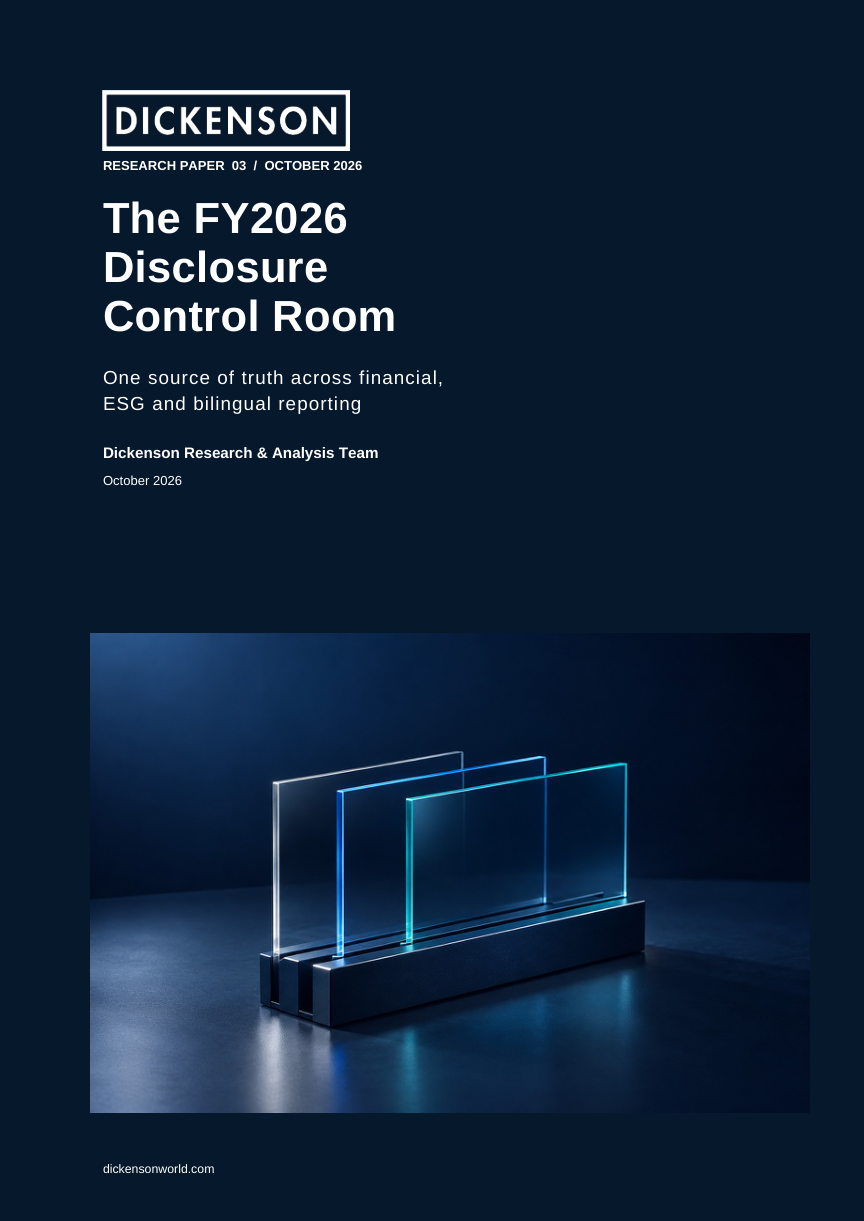
The FY2026 Disclosure Control Room
One source of truth across financial, ESG and bilingual reporting
Build a more controlled reporting process across financial information, sustainability disclosures and language editions. This paper sets out the ownership, evidence, definitions and approval disciplines needed to keep material disclosures consistent from source to publication.
Applicable taxes calculated at checkout. PDF available after payment confirmation.
Research to inform your next reporting brief.
Why this paper
Give every material disclosure a controlled path to publication
Annual reports, sustainability reports, results presentations and language editions can draw on the same information while following separate production workflows. The paper examines what happens when definitions drift, evidence is incomplete or a late change reaches only one output. It develops the Disclosure Control Room as a practical governance model, connecting source ownership, KPI definitions, claims, reconciliation and approvals across the reporting cycle. The model can be adapted to an organisation’s existing systems and responsibilities.
- Who owns each material number, definition and claim?
- Can the published disclosure be reproduced from approved evidence?
- Do changes reach every publication, language edition and digital output?
Written for practitioners
Who will find this useful
For the people who commission, prepare, review and publish the Company’s reporting.
CFOs and finance leaders
Connect financial and sustainability information with a common control calendar, reconciliation process and evidence standards.
Company Secretaries and legal teams
Map obligations, committee approvals, filing sequence, release authority and the treatment of late changes.
Investor Relations officers
Keep the annual report, results materials, website and investor narrative aligned around controlled facts and definitions.
Sustainability and ESG teams
Strengthen ownership of boundaries, methodologies, baselines, estimates and the evidence needed for review and assurance.
Writers and reporting project leads
Build source and change controls into briefing, drafting and design, so that approved meaning survives the production process.
Language and assurance coordinators
Plan bilingual reconciliation and evidence review alongside the master reporting workflow, with clear ownership of exceptions.
Inside the paper
A clear view of what you will read
Research, analysis and practical working tools in one 35-page publication.
Dickenson Research & Analysis Team
October 2026 edition
- 01
The reporting system and its changing demands
Examine the relationship between annual reporting, sustainability standards, assurance and digital disclosure, with selected jurisdictional context.
Sections 1–3 · pages 6–13 - 02
One source of truth and nine control objects
Define authority through source ownership, KPI dictionaries, claim-evidence records, publication maps, close calendars, change logs, terminology and approval archives.
Section 4 · pages 14–15 - 03
The five-layer operating model
Connect the regulatory perimeter, evidence ownership, definitions, publication reconciliation and final approval within an accountable reporting process.
Section 5 · pages 16–18 - 04
Seven failure scenarios
Work through acquisitions, adjusted KPI drift, uncontrolled baselines, language divergence, estimate status, digital tags and disconnected risk language.
Section 6 · pages 19–21 - 05
Governance, technology and year-round control
Clarify management and oversight roles, the language editorial lead, the reporting cadence, minimum technology capabilities and controlled use of AI.
Sections 7–9 · pages 21–24 - 06
Diagnosis and implementation tools
Apply the maturity model, diagnostic questions, 90-day programme, governance map and pre-publication checklist, supported by sample register fields.
Sections 10–13 and Appendices A–B · pages 24–32
View the full contents
- Abstract3
- Executive summary4
- 1. The annual report is now part of a disclosure system6
- 2. Why FY2026 is the operating inflection point7
- 3. Global convergence, local implementation11
- 4. What “one source of truth” should mean14
- 5. The Disclosure Control Room operating model16
- 6. Failure modes and scenario analysis19
- 7. Governance, accountability and the three lines21
- 8. The year-round operating cadence22
- 9. Technology, digital reporting and controlled AI23
- 10. Maturity model and diagnostic questions24
- 11. A 90-day implementation programme26
- 12. FY2026 Disclosure Governance Map28
- 13. Pre-publication control checklist29
- Conclusion: control is the foundation of investor usefulness30
- Appendix A - Sample KPI dictionary fields31
- Appendix B - Sample claim-evidence register fields32
- References33
Practical tools included
Bring structure to the work
The paper includes:
- Nine disclosure control objects and a five-layer operating model
- Five-level maturity model and management diagnostic questions
- 90-day implementation programme and governance responsibility map
- Pre-publication control checklist
- Sample KPI dictionary and claim-evidence register fields
Frameworks, checklists and template fields are presented within the PDF.

Put it to work
How your team can use it
Map the reporting process
Use the nine control objects to identify where authoritative sources, definitions, evidence or approval records are missing.
Test a difficult disclosure
Trace a KPI or material claim through the annual report, sustainability information, results materials and language editions.
Organise a 90-day programme
Use the phased implementation plan and governance map to allocate responsibilities, test controls and embed recurring review.
Read before you buy
Explore the opening five pages
The free preview includes the cover, contents, abstract and executive summary. Read it to assess the paper’s focus and approach.
Read the free previewPDF · 5 pages · No registration required
 OPEN PREVIEW ↗
Before you purchase
Your questions answered
What will I receive?
The complete 35-page English-language white paper as a downloadable PDF, including the operating model, diagnostic questions, implementation programme, checklists, sample register fields and references.
Is the Disclosure Control Room a software product?
It is a research publication setting out a governance and operating model. The paper explains how responsibilities and controls can be organised using existing systems or lightweight registers.
Which markets does it discuss?
The paper covers selected developments in India, UAE and the wider GCC, Singapore, the United Kingdom and European Union, alongside international sustainability and reporting frameworks. It distinguishes local context from recommended operating practice.
How current is the research?
This is the October 2026 edition, with research current to 4 October 2026. Requirements should be checked for the issuer’s listing venue, sector, group structure and reporting period.
How do I access the paper after buying?
Your PDF download will be available after payment confirmation. A download link will also be sent to the email address used at checkout.
Can I share it with colleagues?
The purchase permits use within your organisation’s reporting team. Please do not post the PDF publicly, resell it or distribute it outside the purchasing organisation.
This publication provides general research and practical frameworks. It does not constitute legal, regulatory, investment or assurance advice.
Research paper 03
The FY2026 Disclosure Control Room
Give your reporting team a practical model for controlling evidence, definitions and changes across every material disclosure.