

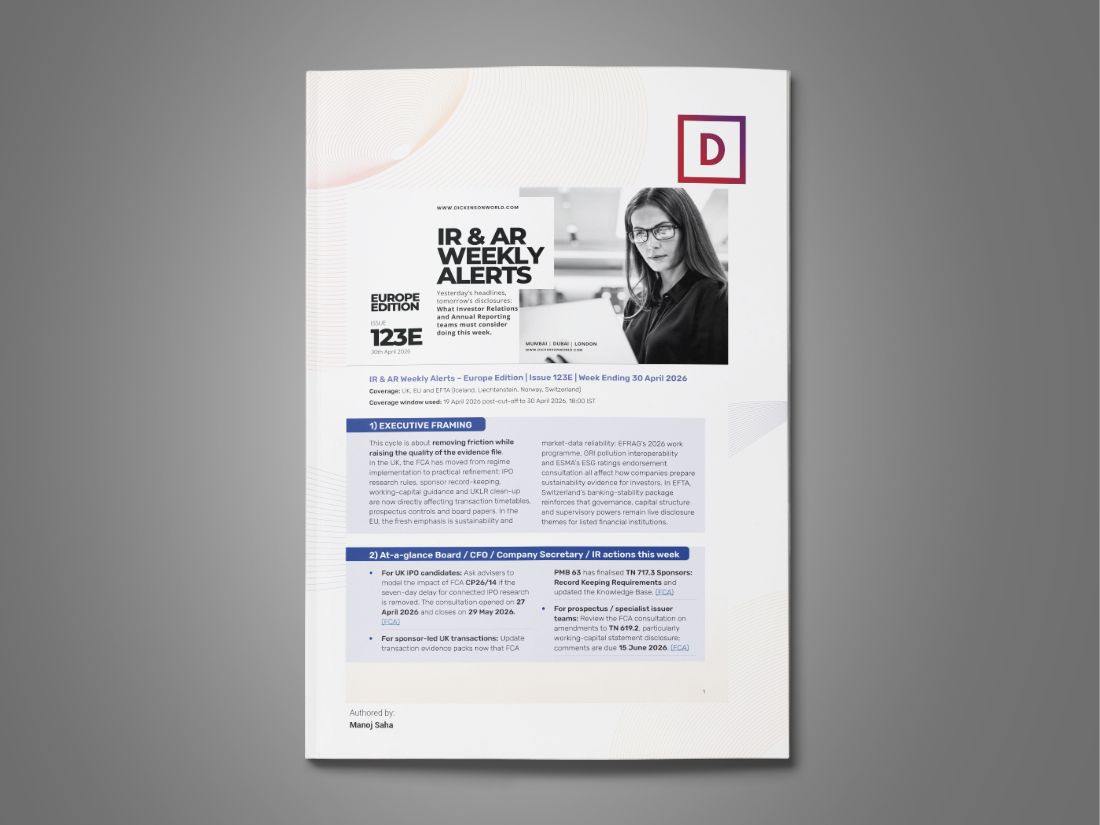
IR & AR WEEKLY ALERTS — ISSUE 123E
Coverage: UK, EU and EFTA (Iceland, Liechtenstein, Norway, Switzerland)
Coverage window used: 19 April 2026 post-cut-off to 30 April 2026, 18:00 IST
A. UNITED KINGDOM
A1. FCA PMB 63 finalises sponsor record-keeping and opens new working-capital guidance consultation
Publication date / deadline: 27 April 2026 / comments on TN 619.2 due 15 June 2026.
What happened
The FCA published Primary Market Bulletin 63. It finalises Technical Note 717.3, Sponsors: Record Keeping Requirements, following PMB 61, and updates the FCA Knowledge Base. PMB 63 also consults on proposed amendments to TN 619.2, covering PRM disclosure requirements and specialist issuer guidance, with the changes focused on working-capital statement disclosures. (FCA)
Why it matters to issuers and IR
Although sponsor record-keeping is formally a sponsor obligation, issuers will feel the effect through more disciplined requests for board papers, verification notes, eligibility evidence, materiality judgements and management challenge records. For specialist issuers, working-capital statements can become high-friction disclosure areas if assumptions, scenarios and internal approvals are not documented early.
Action for CFO/Company Secretary/IR
-
Create a single transaction evidence pack for sponsor-led workstreams: board minutes, diligence records, verification notes, assumptions and sign-off trails.
-
Ask advisers to map any live prospectus drafting against the proposed TN 619.2 working-capital guidance.
-
For specialist issuers, pre-clear the owner of each working-capital assumption before drafting reaches board stage.
-
Add “sponsor file readiness” to the disclosure committee checklist.
What investors will ask next
Is the working-capital statement supported by current stress-tested evidence, or is it only a legal comfort exercise?
Source link(s): FCA PMB 63 / FG26/2 / GC26/3. (FCA)
A2. FCA consults on simplifying IPO research information flows
Publication date / deadline: 27 April 2026 / consultation closes 29 May 2026.
What happened
The FCA opened CP26/14: Changes to information flows for UK equity IPOs. The FCA proposes removing the seven-day waiting period before connected research can be published after an approved registration document or prospectus. It also proposes removing rules requiring syndicate banks to provide unconnected analysts the same information as their own connected analysts. (FCA)
Why it matters to issuers and IR
This could materially simplify the UK IPO timetable and reduce sequencing risk. The FCA says the 2018 IPO information-flow rules have not always achieved their intended objective and have added market risk and issuer cost. For IPO candidates, the change would affect analyst education, research publication, investor education windows, management presentation discipline and legal review sequencing. (FCA)
Action for CFO/Company Secretary/IR
-
Ask IPO advisers to produce two timetable scenarios: current rules and proposed CP26/14 approach.
-
Re-check analyst education decks for consistency with registration document / prospectus language.
-
Ensure internal “connected research” governance records who briefed whom, when, and on what information.
-
Consider responding by 29 May 2026 if your sector is research-dependent during IPO marketing.
What investors will ask next
Will faster connected research improve price discovery, or does it risk reducing comparability with independent research?
Source link(s): FCA CP26/14 and FCA press release. (FCA)
A3. April 2026 FCA Handbook Notice 140 cleans up UKLR and admission-process requirements
Publication / effective date: April 2026 / instruments came into force 24 April 2026.
What happened
The FCA’s Handbook Notice 140 records UKLR and admission-process amendments, including the UK Listing Rules Miscellaneous Amendments Instrument 2026, UK Listing Rules Admission to Listing: Processes and Procedures Instrument 2026, and UK Listing Rules Amendment Instrument 2026. The FCA says these instruments make minor changes to simplify or clarify listing requirements and remove unnecessary regulatory burden and complexity for issuers. (FCA)
PMB 63 further explains that one March 2026 QCP change removes overlapping notification obligations for certain issuers following the introduction of the PRM, after market participants identified overlap between PRM 1.6.4R and UKLR notification requirements. (FCA)
Why it matters to issuers and IR
This is a checklist hygiene issue. Transaction teams may still be using pre-POATRs or early-2026 checklists that require duplicative notifications or cite superseded listing-process provisions. The risk is not regulatory breach alone; it is timetable confusion, adviser friction and inconsistent investor communication during issuance or admission work.
Action for CFO/Company Secretary/IR
-
Refresh UKLR / PRM transaction checklists to remove superseded or overlapping notification steps.
-
Ask counsel to mark which April 2026 Handbook Notice 140 changes affect repeat issuance or further-admission workflows.
-
Ensure internal regulatory calendars distinguish “RIS notification”, “admission to trading” and “listing / PRM” steps accurately.
-
Where old precedents are reused, add a mandatory “post-April 2026 UKLR check” before board approval.
What investors will ask next
Do the new UKLR clean-ups reduce transaction friction, and have issuer-side processes actually been updated?
Source link(s): FCA Handbook Notice 140 and PMB 63. (FCA)
A4. FRC audit consultations now move into a 21 May deadline window
Publication / deadline: Published 26 March 2026; responses due 21 May 2026.
What happened
The FRC has two open audit-policy consultations with 21 May 2026 response deadlines: a call for views on the International Standard on Auditing for Less Complex Entities, and a re-consultation on ISA (UK) 250 and ISA (UK) 270. The FRC states that the ISA for LCE call is intended to inform its engagement with the IAASB, while the ISA 250 / 270 re-consultation is focused on proportionate audit work relating to laws, regulations and reporting to appropriate authorities. (FRC (Financial Reporting Council))
Why it matters to issuers and IR
This is especially relevant to smaller listed companies, AIM-style issuers, investment companies and groups where audit cost and proportionality are live board topics. The ISA 250 / 270 work also matters for audit committee narratives because it affects how auditors consider laws and regulations, non-compliance risk, and reporting obligations to authorities. (FRC (Financial Reporting Council))
Action for CFO/Company Secretary/IR
-
Ask your audit partner whether either consultation could affect audit approach, evidence requests or audit timetable.
-
For smaller or less complex listed issuers, decide whether to submit practical feedback by 21 May 2026.
-
Ensure audit committee papers separate “audit efficiency” from “reduced assurance”; do not imply lower evidence standards.
-
Refresh governance drafting where laws and regulations are a significant audit-risk or compliance-risk theme.
What investors will ask next
Can audit become more proportionate without weakening assurance, legal compliance testing or reporting discipline?
Source link(s): FRC consultation pages. (FRC (Financial Reporting Council))

B. EUROPEAN UNION (EU)
B1. EFRAG submits Sustainability Reporting Work Programme 2026 to the European Commission
Publication date: 24 April 2026.
What happened
EFRAG submitted its Sustainability Reporting Work Programme 2026 to the European Commission. The programme sets out key workstreams including non-EU group ESRS, SME ecosystem support, implementation support, interoperability with ISSB / GRI / GHG Protocol, XBRL taxonomy updates and the ESRS Knowledge Hub. (EFRAG)
Why it matters to issuers and IR
This tells issuers where the ESRS implementation agenda is heading. The practical message is that simplification does not mean sustainability reporting can be parked; preparers still need architecture that can adapt to non-EU group standards, taxonomy updates and interoperability demands. EFRAG also emphasises usability, simplification and burden reduction while preserving robustness and comparability. (EFRAG)
Action for CFO/Company Secretary/IR
-
Map which EFRAG 2026 workstreams affect your group: non-EU group reporting, SME value-chain data, XBRL taxonomy, or interoperability.
-
Keep sustainability reporting data models flexible enough to respond to taxonomy and standard-setting updates.
-
Maintain a “single claims register” across annual report, ESG report, website and investor deck.
-
Avoid reducing useful investor metrics merely because the policy direction includes simplification.
What investors will ask next
Will ESRS simplification improve usability, or will it reduce comparability and decision-usefulness?
Source link(s): EFRAG Work Programme 2026. (EFRAG)
B2. ESMA consults on endorsement of non-EU ESG ratings under the ESG Ratings Regulation
Publication / deadline: 29 April 2026 / comments due 29 May 2026.
What happened
ESMA launched a consultation on draft guidelines for endorsement under Article 11 of the ESG Ratings Regulation. The consultation sets out ESMA’s proposed approach to the endorsement of non-EU ESG ratings and the information ESG rating providers should submit when applying to endorse ratings from outside the EU. (ESMA)
The ESG Ratings Regulation entered into force on 3 January 2025 and will apply from 2 July 2026; entities will then have one month to notify ESMA of their intention to apply for authorisation, registration or recognition. (ESMA)
Why it matters to issuers and IR
The rule is aimed at ESG rating providers, but the issuer consequence is real. If ESG ratings become more formally regulated, endorsed, documented and supervised, companies will face sharper questions on data quality, rating-agency engagement, corrections, methodology understanding and consistency between voluntary disclosures and rated information.
Action for CFO/Company Secretary/IR
-
Create a register of ESG rating providers currently rating the company, including whether any rating is EU, non-EU or endorsed.
-
Track methodology documents and data requests; keep a record of what information the company supplied.
-
Prepare an escalation route for factual errors in ESG rating inputs.
-
Align sustainability claims in investor materials with data already supplied to ESG rating agencies.
What investors will ask next
Are ESG ratings based on reliable issuer data, and does the company understand which ratings are regulated or endorsed in the EU?
Source link(s): ESMA consultation and consultation paper page. (ESMA)
B3. EFRAG opens GRI pollution standards consultation to strengthen ESRS interoperability
Publication / deadline: 21 April 2026 / feedback due 21 May 2026.
What happened
EFRAG launched a public consultation on its draft comment letter responding to GRI’s Pollution Exposure Drafts for Air Pollution, Soil Pollution and Critical Incidents. EFRAG says the objective is to support interoperability between GRI Standards and ESRS and reduce reporting complexity. (EFRAG)
Why it matters to issuers and IR
Pollution is a high-scrutiny sustainability topic for industrial, chemical, mining, construction, energy, transport and consumer-goods issuers. Interoperability between GRI and ESRS affects the disclosure map, KPI definitions, incident reporting, boundary-setting and how companies avoid producing multiple inconsistent versions of the same environmental narrative.
Action for CFO/Company Secretary/IR
-
Ask sustainability teams whether pollution disclosures rely on both ESRS and GRI frameworks.
-
Map existing air / soil / incident metrics against any proposed GRI changes where material.
-
Ensure incident language in sustainability reports matches risk-factor and operational-risk disclosures.
-
Consider responding by 21 May 2026 if pollution is material to the business model.
What investors will ask next
Can the company explain pollution impacts once across ESRS, GRI, investor decks and risk disclosures without contradiction?
Source link(s): EFRAG consultation announcement. (EFRAG)
B4. ESMA MAR delayed-disclosure consultation has now closed
Publication / deadline: Consultation ran from 19 February 2026 to 29 April 2026.
What happened
ESMA’s consultation on amendments to MAR guidelines on delay in disclosure of inside information closed on 29 April 2026. ESMA states that the consultation is of primary interest to issuers, including SMEs, and trading venues. ESMA’s proposal aligns guidelines with the Listing Act, including replacing the old “no misleading the public” framing with the requirement that delayed disclosure must not contradict the issuer’s latest public announcement on the same matter. (ESMA)
Why it matters to issuers and IR
This is now a “wait for final guidance but prepare templates” item. Disclosure committees should not wait until Q4 2026 to adapt internal practice. The proposed logic requires issuers to track public statements and delay decisions together, especially during long-running transactions, procurement processes, restructurings or negotiations. ESMA expects to publish a final report in Q4 2026. (ESMA)
Action for CFO/Company Secretary/IR
-
Add a “latest public announcement contradiction check” to delay-disclosure memo templates.
-
Keep a live chronology of internal knowledge, public statements and delay decisions.
-
Train transaction teams that early public wording can constrain later delay positions.
-
Prepare a board note once ESMA’s final guidance is published.
What investors will ask next
How does the company ensure that delayed disclosure remains consistent with what it has already told the market?
Source link(s): ESMA consultation page and ESMA news release. (ESMA)
C. EFTA
C1. Switzerland 1: Federal Council adopts Banking Act revision dispatch; FINMA backs stronger TBTF reforms
Publication date: 22 April 2026.
What happened
The Swiss Federal Council adopted the dispatch on revision of the Banking Act and amended the Capital Adequacy Ordinance. The Federal Council says systemically important banks will in future have to fully back participations in foreign subsidiaries with CET1 capital; Parliament can debate the legislative proposal from summer 2026, and certain Capital Adequacy Ordinance amendments come into force on 1 January 2027. (Federal Council)
FINMA welcomed the dispatch and said the bill is part of measures to strengthen banking stability. FINMA also highlighted the double-leverage risk from foreign subsidiaries of systemically important banks and advocated stronger preventive instruments, including an accountability regime, power to impose fines and earlier public communication about concluded proceedings. (Eidgenössische Finanzmarktaufsicht FINMA)
Why it matters to issuers and IR
For Swiss listed banks and financial groups, this is a capital, governance and investor-communication issue. The likely investor questions are not only about CET1 impact, but also about group structure, foreign subsidiary capitalisation, dividend capacity, resolution credibility and supervisory powers.
Action for CFO/Company Secretary/IR
-
Prepare a board / investor Q&A on potential CET1, subsidiary funding and group-structure implications.
-
Review whether capital-management and dividend-capacity narratives mention foreign-subsidiary capitalisation clearly enough.
-
Track the summer 2026 parliamentary debate as a disclosure and engagement milestone.
-
For investor decks, distinguish between adopted ordinance changes and legislative proposals still subject to parliamentary process.
What investors will ask next
How will full CET1 backing of foreign subsidiaries affect capital flexibility, returns and dividend policy for Swiss systemically important banks?
Source link(s): FINMA and Federal Council announcements. (Eidgenössische Finanzmarktaufsicht FINMA)
C2. Switzerland 2: FINMA annual media conference confirms more forward-looking, intervention-oriented supervision
Publication date: 21 April 2026.
What happened
At its annual media conference, FINMA published its 2025 Annual Report and said it had strengthened resilience among supervised institutions, focused on early detection of emerging risks and would conduct more of its own inspections while reducing reliance on external auditors and deploying them in a more risk-based manner. (Eidgenössische Finanzmarktaufsicht FINMA)
Why it matters to issuers and IR
For listed Swiss financial institutions, this signals a more direct supervisory posture. It can affect how boards describe governance, risk culture, remediation, internal audit, supervisory inspection readiness and reliance on external assurance. It also changes the tone of investor questions: “Are you inspection-ready?” becomes more relevant than “Are policies in place?”
Action for CFO/Company Secretary/IR
-
Ask risk and compliance teams whether direct-supervision readiness has changed since the annual report.
-
Re-check governance and risk-control language for evidence, not just policy description.
-
Prepare investor Q&A on internal audit, regulatory inspection readiness and remediation tracking.
-
Align board risk committee minutes with the supervisory themes most relevant to the institution.
What investors will ask next
Is the company’s governance file strong enough for a more direct, risk-based supervisory approach?
Source link(s): FINMA annual media conference. (Eidgenössische Finanzmarktaufsicht FINMA)
C3. Iceland and Liechtenstein
No fresh issuer-material official update was identified in the post-122E window that would justify inclusion without lowering the relevance threshold.


IR & AR WEEKLY ALERTS
To download and save this article.
Contact Us: To learn more or schedule a consultation, please reach out to us at www.dickensonworld.com
Email:enquiry@dickensonworld.com.
Leave A Comment