

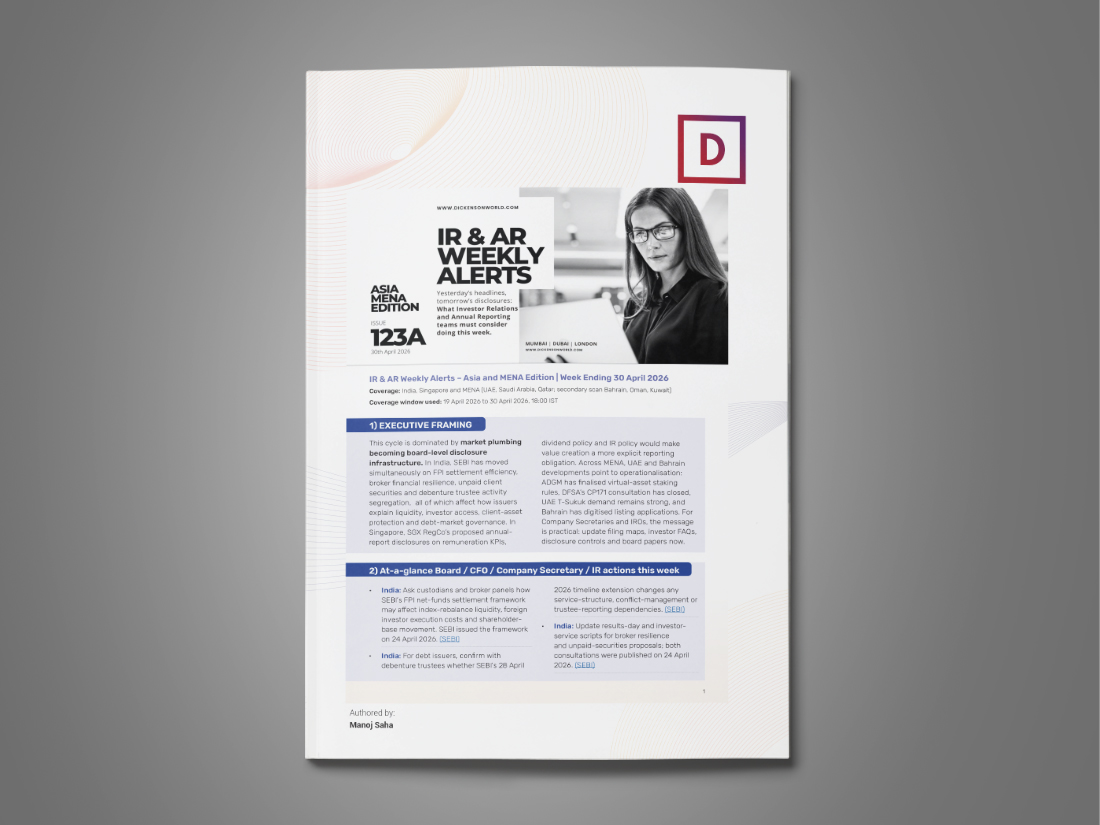
IR & AR WEEKLY ALERTS — ISSUE 123A (Asia and MENA Edition)
Coverage: India, Singapore and MENA (UAE, Saudi Arabia, Qatar; secondary scan Bahrain, Oman, Kuwait)
Coverage window used: 19 April 2026 to 30 April 2026, 18:00 IST
A. INDIA
1. SEBI permits net settlement of funds for FPI cash-market transactions
Publication date / implementation: 24 April 2026; implementation to be monitored through market infrastructure readiness.
What happened
SEBI issued a circular titled “Framework for net settlement of funds for transactions done by Foreign Portfolio Investors (FPIs) in cash market” on 24 April 2026. The framework is designed to reduce friction in FPI cash-market settlement by allowing net settlement of funds for eligible FPI transactions. (SEBI)
Why it matters to issuers, Company Secretaries and IR
For issuers with meaningful foreign institutional ownership, this is not merely a custodian operations change. Lower settlement friction can affect trading behaviour during index rebalancing, large blocks, QIP follow-on interest and results-day liquidity. It also gives IR teams a better answer when foreign investors ask whether operational barriers in India’s cash market are being reduced. Secondary summaries indicate that the framework is aimed at reducing liquidity pressure, FX-related costs and settlement inefficiency for FPIs. (The Economic Times)
Action for CFO/Company Secretary/IR
-
Ask custodians and broker coverage teams whether your stock’s FPI trading pattern could be affected during high-volume windows.
-
Update the “market access” slide in investor decks for foreign institutional meetings, with neutral wording on settlement efficiency.
-
Where index rebalancing is material, brief treasury and IR on whether settlement-cost reduction may alter trading depth.
-
Avoid implying that the rule guarantees higher FPI ownership; frame it as operational friction reduction.
What investors will ask next
Foreign investors may ask whether this reduces their execution cost in your stock, whether custodians are ready, and whether the company expects improved liquidity around rebalancing days.
Source link(s): SEBI circular listing and supporting summaries. (SEBI)
2. SEBI consults on revised variable net worth for stock brokers
Publication date / deadline: 24 April 2026; public comments invited through SEBI’s consultation mechanism.
What happened
SEBI published a consultation paper on review of variable net worth for stock brokers on 24 April 2026. The stated direction is to revisit how broker capital buffers are calculated, with the consultation linked to operational risk and client scale. (Securities and Exchange Board of India)
Why it matters to issuers, Company Secretaries and IR
Broker resilience is now part of market-quality infrastructure. For issuers, especially those with retail-heavy shareholder bases, broker failures or weak broker balance sheets can quickly become investor-confidence issues. The proposal also matters for buybacks, block trades, ESOP liquidity windows and large retail-facing campaigns, where issuer teams rely on broker infrastructure to operate smoothly. Public reporting of the proposal says SEBI is considering a risk-based approach tied to client balances and active-client counts. (The Economic Times)
Action for CFO/Company Secretary/IR
-
Ask your top brokers whether the proposed framework could affect their service model, coverage or execution capacity.
-
For retail-heavy issuers, include broker-resilience awareness in results-day trading-monitoring playbooks.
-
Where you appoint brokers for buybacks or liquidity programmes, refresh the broker due-diligence checklist to include capital and operational resilience.
-
Do not describe this as an issuer obligation; describe it as a market infrastructure resilience development.
What investors will ask next
Retail investors may ask whether their intermediary is adequately capitalised; institutions may ask whether issuer-selected broker panels are robust enough for high-volume events.
Source link(s): SEBI consultation paper and market summaries. (SEBI)
3. SEBI consults on handling unpaid securities of clients by trading and clearing members
Publication date: 24 April 2026.
What happened
SEBI published a consultation paper on Ease of Doing Investment and Ease of Doing Business, Handling of unpaid securities of clients by Trading Members / Clearing Members on 24 April 2026. The consultation addresses the operational treatment of securities purchased by clients but not fully paid for. (SEBI)
Why it matters to issuers, Company Secretaries and IR
This is a shareholder-servicing and investor-protection issue in disguise. If unpaid securities are released, pledged, liquidated or retained under clearer timelines, retail investors may experience fewer misunderstandings around demat holdings, saleability and broker communications. For issuers, this can reduce query noise around corporate actions, dividend entitlement, AGM eligibility and record-date misunderstandings. Secondary summaries indicate that SEBI is revisiting the Client Unpaid Securities Pledgee Account framework to reduce operational friction while preserving investor safeguards. (The Economic Times)
Action for CFO/Company Secretary/IR
-
Ask the RTA and depository-contact owner whether unpaid-securities treatment could affect record-date or entitlement queries.
-
Add a plain-English line in investor FAQs explaining that broker-level unpaid-securities treatment is governed separately from issuer entitlement records.
-
Ensure AGM and dividend helplines do not give legal advice on broker-client payment disputes.
-
For retail-heavy registers, prepare a scripted escalation route: broker → depository participant → exchange / SEBI framework, as appropriate.
What investors will ask next
Retail holders may ask why securities appear pledged, blocked or unavailable after purchase; issuers should be ready to redirect the query without assuming broker liability.
Source link(s): SEBI consultation paper and supporting summaries. (SEBI)
4. SEBI extends compliance timeline for debenture trustees’ non-SEBI-regulated activities
Publication date: 28 April 2026.
What happened
SEBI issued a circular on extension of timeline for compliance with terms and conditions by Debenture Trustees for carrying out activities outside the purview of SEBI on 28 April 2026. (SEBI)
Why it matters to issuers, Company Secretaries and IR
For debt issuers, trustee structure and trustee independence increasingly influence lender confidence and listed-debt disclosure discipline. Even though the circular is aimed at debenture trustees, issuers should check whether trustees are changing business-unit structures, engagement letters, service descriptions or conflict-control processes. A secondary regulatory summary states that the timeline has been extended by six months for transferring non-SEBI-regulated activities into separate business units, with implementation by 27 October 2026. (TaxTMI)
Action for CFO/Company Secretary/IR
-
Obtain written confirmation from debenture trustees on whether service arrangements or reporting lines will change.
-
Update the debt-disclosure calendar to capture any revised trustee deliverables.
-
For upcoming NCD or bond documentation, check whether trustee engagement letters refer correctly to SEBI-regulated and non-SEBI-regulated activities.
-
Add the issue to the Audit Committee or Treasury Committee tracker where listed debt is material.
What investors will ask next
Debt investors may ask whether trustee independence, information flows and conflict safeguards are robust enough where trustees provide multiple services.
Source link(s): SEBI circular and supporting implementation summary. (SEBI)

B. SINGAPORE
1. SGX RegCo proposes mandatory disclosures for dividend, remuneration and investor relations policies
Publication date / consultation deadline / proposed implementation: 22 April 2026; comments requested by 22 May 2026; phased implementation expected from 1 January 2027 if supported.
What happened
SGX RegCo is seeking feedback on proposed rule amendments requiring issuers to disclose remuneration KPIs linked to long-term shareholder value, maintain and describe a dividend policy, maintain an investor engagement website, publish an IR policy, and describe investor-engagement activities in the annual report. The consultation requests comments by 22 May 2026, with phased implementation from 1 January 2027 if supported. (SGX Links)
Why it matters to issuers, Company Secretaries and IR
This is a direct annual-report drafting change. It turns value creation, dividend discipline and IR infrastructure into explicit disclosure architecture. SGX RegCo also notes that around two-thirds of the largest Mainboard and Catalist issuers either do not disclose that they have an IR policy or do not publish it, and similarly do not disclose remuneration metrics tied to value creation. (SGX Links)
Action for CFO/Company Secretary/IR
-
Draft or refresh the dividend policy now, even if the company does not commit to a fixed payout ratio.
-
Prepare a board-level map linking remuneration KPIs to long-term shareholder value.
-
Build an investor engagement website checklist: announcements, financials, presentations, AGM materials, IR contact, FAQs and policies.
-
Prepare consultation feedback if current sector practice makes any requirement difficult or costly.
What investors will ask next
Investors will ask whether remuneration outcomes are actually aligned with value creation, whether the dividend policy is meaningful, and whether the IR policy supports two-way engagement rather than boilerplate communication.
Source link(s): SGX RegCo announcement and consultation summary. (SGX Links)

C. UAE
1. ADGM: FSRA finalises regulatory framework for staking of virtual assets
Publication date: 29 April 2026.
What happened
ADGM FSRA finalised a regulatory framework for the staking of virtual assets. The framework follows Consultation Paper No. 10 of 2025 and outlines which Authorised Persons may conduct staking activities using clients’ virtual assets and the requirements governing those activities. (adgm.com)
Why it matters to issuers, Company Secretaries and IR
For listed groups with digital-asset exposure, tokenisation projects, treasury pilots, or regulated ADGM entities, this is a governance and disclosure-control item. The framework includes targeted changes such as extending scope to non-proof-of-stake models with materially similar characteristics, limiting rewards to accepted virtual assets and accepted fiat-referenced tokens, and clarifying client disclosures and reporting requirements. (adgm.com)
Action for CFO/Company Secretary/IR
-
Map whether any group entity, fund, treasury activity or strategic partner touches staking services.
-
Update risk language to distinguish custody, staking, rewards, client assets and regulatory permissions.
-
For regulated entities, confirm client disclosure and reporting templates against the final FSRA framework.
-
Avoid promotional language on “yield” unless legal and compliance teams have approved it.
What investors will ask next
Investors may ask whether any digital-asset activity involves client assets, whether rewards are regulated, and whether governance controls are documented.
Source link(s): ADGM FSRA announcement. (adgm.com)
2. DIFC: DFSA CP171 consultation period has closed; implementation watch begins
Publication date / deadline: CP171 released 27 March 2026; comments closed 26 April 2026.
What happened
DFSA released Consultation Paper No. 171 on miscellaneous changes, with comments due by 26 April 2026. That consultation window has now closed during this cycle. (DFSA)
Why it matters to issuers, Company Secretaries and IR
The delta this period is not the release of CP171 itself, but the shift from consultation to implementation watch. DIFC-linked issuer groups should now monitor whether final rulemaking affects compliance calendars, governance descriptions, outsourcing controls, fees, prudential wording or regulated-entity disclosures in annual reports and board packs.
Action for CFO/Company Secretary/IR
-
Ask DIFC compliance owners whether any CP171 response was submitted and what issues were raised.
-
Put final DFSA rulemaking on the board compliance tracker.
-
For annual-report drafts, avoid locking DIFC-regulated-entity wording until the final DFSA amendments are reviewed.
-
If the group has DIFC regulated entities, prepare a one-page “pending rule change” note for audit/risk committees.
What investors will ask next
Investors may ask whether DIFC compliance cost, control ownership or regulated business descriptions will change after final amendments.
Source link(s): DFSA CP171 notice. (DFSA)
3. April 2026 T-Sukuk auction shows strong demand for AED-denominated sovereign sukuk
Publication date: 23 April 2026.
What happened
The UAE Ministry of Finance announced the April 2026 auction of UAE dirham-denominated Islamic Treasury Sukuk, with issuance of AED 1.1 billion and bids of AED 5.20 billion, representing 4.7x oversubscription. (وزارة المالية – الإمارات العربية المتحدة)
Why it matters to issuers, Company Secretaries and IR
This is not a direct issuer rule change, but it is useful debt-market context for UAE and GCC issuers. Strong sovereign sukuk demand supports benchmark-building, investor appetite calibration and pricing-reference discussion for corporates considering sukuk or Islamic debt issuance. It can also inform the “capital markets environment” paragraph in board treasury papers.
Action for CFO/Company Secretary/IR
-
For UAE or GCC debt issuers, update treasury market-context slides with the April T-Sukuk auction result.
-
Avoid implying that sovereign sukuk demand automatically translates into corporate demand; frame it as benchmark and appetite context.
-
For Islamic finance narratives, ensure investor decks distinguish sovereign issuance, corporate sukuk and entity-specific credit risk.
What investors will ask next
Debt investors may ask whether corporates plan to use local-currency sukuk markets and how they benchmark pricing against sovereign curves.
Source link(s): UAE Ministry of Finance announcement. (وزارة المالية – الإمارات العربية المتحدة)

D. Bahrain
1. Bahrain Bourse launches Listing Gateway Platform
Publication date: 20 April 2026.
What happened
Bahrain Bourse launched the Listing Gateway Platform, an online portal intended to streamline filing of listing applications and fully replace the current submission process. (bahrainbourse.com)
Why it matters to issuers, Company Secretaries and IR
This is a practical listing-process change. Issuers and advisers considering Bahrain listings should expect more digital evidence trails, clearer status visibility and potentially tighter document ownership discipline. The filing route itself becomes part of the transaction-readiness checklist.
Action for CFO/Company Secretary/IR
-
Update listing workplans to include Listing Gateway account access, upload responsibilities and version-control rules.
-
For board packs, identify who owns listing application status monitoring and regulator responses.
-
Ensure advisers do not continue using old submission assumptions.
-
For IPO or debt-listing timetables, build in portal-upload checks before formal submission milestones.
What investors will ask next
Investors may ask whether listing processes are becoming more transparent and whether application status or document completeness can be tracked more efficiently.
Source link(s): Bahrain Bourse announcement. (bahrainbourse.com)
E. Saudi Arabia and Qatar
No clearly new, issuer-material official update was identified within the post-122A scan that justified inclusion without lowering the relevance threshold. Qatar’s standing Q-Disclosure framework remains relevant for XBRL-based financial and non-financial disclosures, but no materially new post-122A update was identified for this issue. (Qatar Stock Exchange)

IR & AR WEEKLY ALERTS
To download and save this article.
Contact Us: To learn more or schedule a consultation, please reach out to us at www.dickensonworld.com
Email:enquiry@dickensonworld.com.
Leave A Comment