

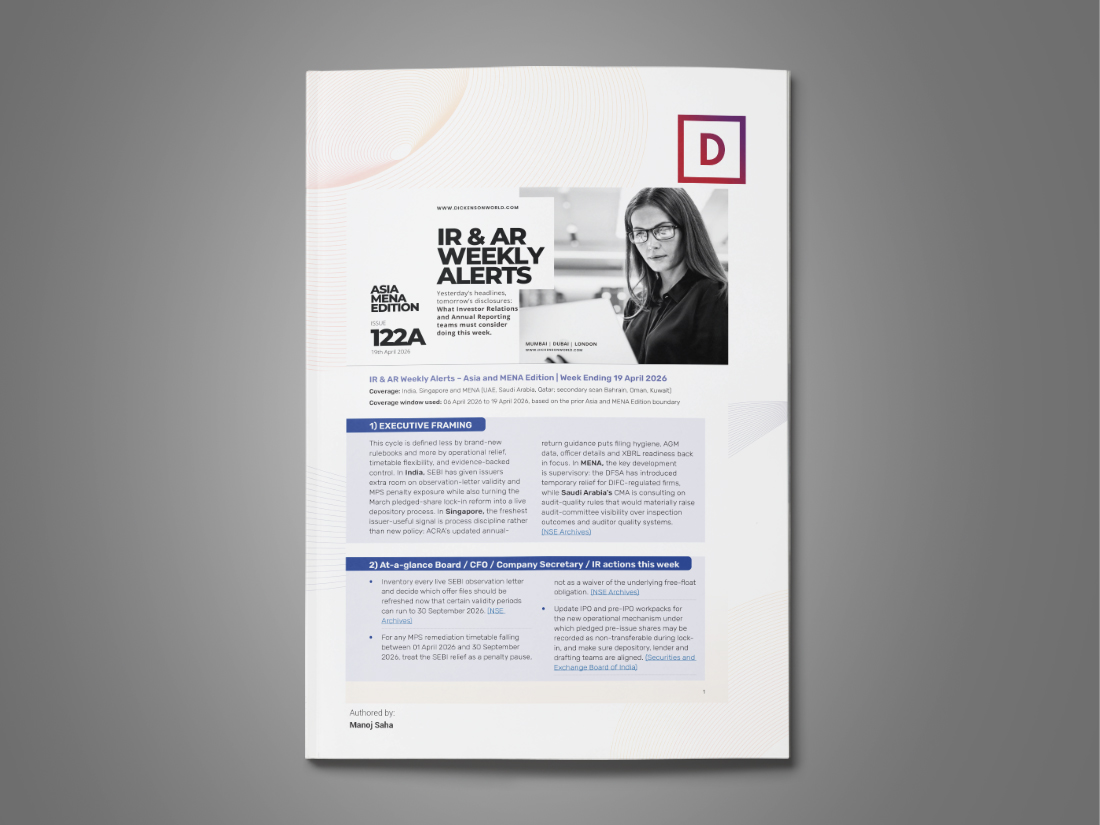
IR & AR WEEKLY ALERTS — ISSUE 122A (Asia and MENA Edition)
Coverage: India, Singapore and MENA (UAE, Saudi Arabia, Qatar; secondary scan Bahrain, Oman, Kuwait)
Coverage window used: 06 April 2026 to 19 April 2026, based on the prior Asia and MENA Edition boundary
A. INDIA
1. SEBI extends validity of certain observation letters to 30 September 2026
Publication date / effective date / deadline: 07 April 2026 / immediate / applies to observation letters expiring between 01 April 2026 and 30 September 2026. (Securities and Exchange Board of India)
What happened
SEBI published a one-time relaxation on the validity of certain SEBI observations. An official NSE circular summarising the measure states that observation letters expiring between 01 April 2026 and 30 September 2026 are extended to 30 September 2026, citing ongoing geopolitical tensions in the Middle East and subdued investor participation. The same circular says the relaxation is subject to an undertaking from the lead manager when submitting the updated offer document. (Securities and Exchange Board of India)
Why it matters to issuers, Company Secretaries and IR
This is a live transaction-readiness item for issuers with IPO, rights, QIP or other public-issue files already in process. It reduces near-term expiry pressure, but it does not remove the need to refresh diligence, update offer documents, preserve board approval sequencing, or keep investor messaging consistent with the revised timing. The risk is that teams treat the extension as a passive carry-forward when it is really a controlled timetable reset with documentation consequences. (NSE Archives)
Action for CFO/Company Secretary/IR
-
Build a list of all observation letters in force and identify which ones would otherwise have expired before 30 September 2026.
-
Ask lead managers for a short note on what updated document, comfort and internal approval steps are still needed before launch.
-
Re-check whether board and committee approvals, financial statements and use-of-proceeds language remain current enough for a deferred window.
-
Keep investor scripts disciplined: describe this as a regulatory validity extension, not as a fresh clearance or a signal that launch timing is fixed. (NSE Archives)
What investors will ask next
-
Are you using the extended validity because the original deal window weakened?
-
What still needs to be refreshed before the transaction can launch? (NSE Archives)
Source link(s): official SEBI and NSE materials. (Securities and Exchange Board of India)
2. SEBI grants one-time relief from MPS penalty mechanics for certain due dates
Publication date / effective date / deadline: 07 April 2026 / immediate / applies where the MPS compliance due date falls between 01 April 2026 and 30 September 2026. (Securities and Exchange Board of India)
What happened
SEBI issued a one-time relaxation from penal provisions under its Master Circular on non-compliance with minimum public shareholding. The official NSE circular says the relief applies where the due date for MPS compliance falls between 01 April 2026 and 30 September 2026, and that exchanges and depositories should not take penal action during that period; any penal action already initiated during the period is to be kept in abeyance. (Securities and Exchange Board of India)
Why it matters to issuers, Company Secretaries and IR
This changes the near-term governance and disclosure posture for issuers already on an MPS restoration timetable. It may reduce immediate exchange-enforcement pressure, but it does not remove the underlying obligation to restore free float. Boards and disclosure committees should therefore resist the temptation to let remediation plans drift. This is a sequencing and narrative issue: the company still needs a credible pathway, and investors will distinguish between penalty relief and actual float normalisation. (NSE Archives)
Action for CFO/Company Secretary/IR
-
Preserve the internal MPS restoration plan and do not remove it from the regulatory calendar merely because penalties are paused.
-
Re-check any pending board, shareholder or transaction steps that underpin free-float restoration.
-
Update governance and risk wording so that it distinguishes clearly between relief from penalty mechanics and compliance with the MPS requirement itself.
-
Prepare a neutral IR Q&A on timing, method and dependencies for restoring free float. (NSE Archives)
What investors will ask next
-
Does the relief change when your free float will actually be restored?
-
Are you still committed to the same remediation path? (NSE Archives)
Source link(s): official SEBI and NSE materials. (Securities and Exchange Board of India)
3. Pledged pre-issue lock-in mechanics are now operationalised at depository level
Publication date / effective date / deadline: 08 April 2026 SEBI circular / 10 April 2026 NSE circular / immediate. (Securities and Exchange Board of India)
What happened
New this period: the March 2026 ICDR amendment on pledged pre-issue shares has now moved from regulatory concept to operating mechanism. SEBI’s 08 April circular provides the mechanism under which specified securities on which lock-in cannot be created may instead be recorded as “non-transferable” by depositories for the duration of the applicable lock-in period. NSE followed on 10 April 2026 by telling listed entities to take necessary action in light of the SEBI circular. (Securities and Exchange Board of India)
Why it matters to issuers, Company Secretaries and IR
This is a direct IPO and pre-IPO execution item. Once the mechanism becomes operational, legal teams, depositories, lenders, company secretariat functions and DRHP drafters all need to work from the same playbook. The consequence is practical: prospectus language, cap-table mapping, lender notices, AoA readiness and depository instructions now need to reflect how the lock-in will actually be implemented in practice. (Securities and Exchange Board of India)
Action for CFO/Company Secretary/IR
-
Identify any pledged pre-issue holdings that may need the non-transferable treatment.
-
Confirm depository, lender and counsel workflows before finalising offer-document drafting.
-
Re-check capital-structure and lock-in disclosures so they describe the operational mechanism accurately.
-
Add a board-paper note on implementation dependencies, especially if the transaction timetable is tight. (Securities and Exchange Board of India)
What investors will ask next
-
Are any meaningful pre-issue holdings pledged, and if so, how will they remain effectively locked in?
-
Could this mechanism affect when the deal launches? (Securities and Exchange Board of India)
Source link(s): official SEBI and NSE materials. (Securities and Exchange Board of India)
4. RBI sets a faster operating standard for cross-border inward payments
Publication date / effective date / deadline: 09 April 2026 / effective six months from the circular date. (Reserve Bank of India)
What happened
RBI issued guidelines to facilitate faster cross-border inward payments. The circular says banks must inform customers immediately on receipt of inward cross-border transactions, reconcile nostro credits near real time or at intervals not exceeding one hour, and endeavour to credit inward payments received during foreign-exchange market hours on the same business day, or on the next business day if received after market hours. RBI also says banks may offer a digital interface for document submission and transaction monitoring. (Reserve Bank of India)
Why it matters to issuers, Company Secretaries and IR
This is relevant beyond banking operations. For listed issuers it touches dividend and refund expectations for overseas holders, subscription-money receipts, treasury remittances, and the credibility of shareholder-servicing language. The key drafting consequence is not to overpromise until house banks confirm their implementation model, but also not to leave shareholder FAQs and treasury workflows stuck on slower assumptions once banks move. (Reserve Bank of India)
Action for CFO/Company Secretary/IR
-
Ask relationship banks for an implementation note and expected service standard once the guidelines take effect.
-
Review cross-border dividend, refund and subscription-remittance workflows for documentation bottlenecks.
-
Update investor-service and treasury FAQs only after bank-side operating readiness is clear.
-
Keep website wording balanced: note the regulatory direction without promising issuer-controlled settlement speed. (Reserve Bank of India)
What investors will ask next
-
Will foreign investors see quicker crediting of dividends, refunds or other inward remittances?
-
Are your current banking processes ready for the new standard? (Reserve Bank of India)
Source link(s): official RBI circular. (Reserve Bank of India)

B. SINGAPORE
1. ACRA’s updated annual-return guidance is the key current filing reminder for listed companies
Publication date / effective date / deadline: ACRA pages updated 14 April 2026 and 17 April 2026 / ongoing statutory filing deadlines based on FYE. (ACRA)
What happened
No major new issuer-rule change stood out in the coverage window, but ACRA’s refreshed April guidance is a useful current process signal. ACRA reiterates that annual returns must be filed on time to avoid penalties of up to S$600, and its updated steps page restates the pre-filing checks around company details, officers, shareholder/share data, charges or loans, financial statements, XBRL where required, AGM details and director signatures. (ACRA)
Why it matters to issuers, Company Secretaries and IR
For listed companies, this is not routine admin. Annual-return filing is one of the points where public officer data, shareholder information, AGM mechanics and financial reporting discipline converge. The updated ACRA pages are a timely reminder that filing defects often arise from stale company-officer data, missing AGM declarations, or weak coordination between finance, company secretariat and filing agents. (ACRA)
Action for CFO/Company Secretary/IR
-
Run the ACRA pre-filing checklist before the formal filing window opens.
-
Make sure officer, shareholder/share and registered-charge information is updated before attempting the annual return.
-
Confirm whether financial statements must be filed in XBRL and validate those outputs early.
-
Re-check signature requirements and AGM data capture so the filing does not fail late in the process. (ACRA)
What investors will ask next
-
Does your public company data and AGM disclosure chain match the latest filed information?
-
Are there any governance or officer changes not yet reflected in public records? (ACRA)
Source link(s): official ACRA pages. (ACRA)
2. SGX derivatives rule amendments go live on 20 April 2026 and 30 April 2026
Publication date / effective date / deadline: SGX rulebook timeline visible 16 April 2026 / effective 20 April 2026 and 30 April 2026. (SGX Rulebook)
What happened
SGX’s rulebook timeline shows amendments to appendices of Regulatory Notice 4.1.11 taking effect on 20 April 2026 and 30 April 2026. The retrieved notices refer to revised minimum-volume thresholds and tick schedules for certain negotiated large trades in government-bond futures and related futures settings, including TWD/USD micro futures. (SGX Rulebook)
Why it matters to issuers, Company Secretaries and IR
This is a niche but real market-plumbing reminder for treasury teams and IR functions that speak about hedging, execution quality or macro-market conditions. Where brokers use SGX futures markets in rates or FX-related execution and risk management, small rule changes can affect the language treasury uses around hedge implementation and market-liquidity assumptions. (SGX Rulebook)
Action for CFO/Company Secretary/IR
-
Ask brokers whether the 20 April and 30 April changes alter any execution assumptions relevant to treasury hedging.
-
Avoid stale boilerplate in treasury or market-risk notes if brokers confirm changed market microstructure.
-
Keep results-day commentary evidence-based rather than assuming old spread or size norms still hold. (SGX Rulebook)
What investors will ask next
-
Do any exchange-rule changes alter how you hedge rates or FX exposure through intermediaries? (SGX Rulebook)
Source link(s): official SGX rulebook materials. (SGX Rulebook)

C. UAE
1. DFSA introduces temporary relief measures for the DIFC financial services community
Publication date / effective date / deadline: 09 April 2026 / immediate / temporary measures. (DFSA)
What happened
The DFSA announced temporary regulatory relief measures for new firms seeking authorisation and for existing regulated firms in the DIFC. The official notice says the relief covers authorisation, licensing and administrative requirements, governance and staffing arrangements, regulatory reporting and supervisory processes including extended timelines, and implementation timelines for selected regulatory initiatives. The same notice makes clear that regulatory standards and supervisory expectations remain unchanged. (DFSA)
Why it matters to issuers, Company Secretaries and IR
For listed groups with DIFC-regulated entities, this is immediately relevant to governance calendars, internal reporting timetables and how group narratives describe regulatory readiness. Relief measures can ease timing pressure, but they also raise a board-level question: which obligations are being deferred operationally, and which control standards still need to be evidenced exactly as before? That distinction belongs in risk and governance oversight, not just in the compliance team’s inbox. (DFSA)
Action for CFO/Company Secretary/IR
-
Identify which DIFC-regulated entities, if any, will rely on the relief package.
-
Re-map internal regulatory calendars and board reporting deadlines where extended timelines apply.
-
Keep controls language disciplined: a timeline extension is not a lowering of expected standards.
-
Prepare a brief board note separating temporary relief use from underlying control and compliance status. (DFSA)
What investors will ask next
-
Is any part of the group relying on temporary regulatory relief, and if so, why?
-
Does the relief change compliance risk or operating resilience? (DFSA)
Source link(s): official DFSA announcement. (DFSA)
2. CP171 is now inside the response window that matters
Publication date / effective date / deadline: 27 March 2026 / consultation deadline 26 April 2026. (DFSA)
What happened
New this period: DFSA Consultation Paper 171, “Miscellaneous Changes,” is no longer just background reading; its response deadline on 26 April 2026 is now inside the next week. (DFSA)
Why it matters to issuers, Company Secretaries and IR
“Miscellaneous” rulebook papers often look low drama but create real friction later in operational workflows, approvals, governance descriptions or regulated-entity processes. Groups with DIFC-regulated subsidiaries should decide now whether anything in the package warrants a targeted response or at least internal implementation triage. The main value is not theoretical consultation participation; it is making sure that quiet rulebook changes do not surprise annual-report drafting or compliance calendars later. (DFSA)
Action for CFO/Company Secretary/IR
-
Ask DIFC counsel or compliance owners for a short triage note on CP171 before 26 April 2026.
-
Submit feedback if any proposed change would affect governance language, reporting mechanics or regulated-entity workflows.
-
Add the deadline to the board and compliance action calendar now rather than leaving it to month-end. (DFSA)
What investors will ask next
-
Are your DIFC-regulated entities monitoring rulebook changes actively, or only after rules are final? (DFSA)
Source link(s): official DFSA consultation notice. (DFSA)

D. Saudi Arabia
1. CMA consultation would materially raise audit-quality and audit-committee visibility requirements
Publication date / effective date / deadline: 08 April 2026 / consultation deadline 08 May 2026. (Saudi Exchange)
What happened
The CMA has called for public consultation on draft amendments to the Rules for Registering Auditors of Entities Subject to the Authority’s Supervision. The official notice says the draft would require, among other things, a sufficient number of audit managers holding SOCPA fellowships or accepted equivalents, an appropriate quality-management system, corrective action plans following inspections where required, and enhanced transparency reporting. It also says a registered accounting firm would need to share the CMA’s final inspection results on a listed company’s audit file with that company’s audit committee where the CMA has conducted such an inspection. (Saudi Exchange)
Why it matters to issuers, Company Secretaries and IR
This is a high-value audit-committee item. It is not just about auditor registration; it changes the likely information flow between the regulator, the external auditor and the listed company’s audit committee. For issuers, that means more attention on auditor quality systems, the robustness of audit evidence, the committee’s challenge record and how audit quality is framed in governance reporting. (Saudi Exchange)
Action for CFO/Company Secretary/IR
-
Ask the external auditor for a short gap note against the consultation package.
-
Decide whether the company or audit committee should submit feedback before 08 May 2026.
-
Strengthen audit-committee minutes and annual-report drafting so they show real oversight of audit quality, not formulaic process.
-
Prepare for the possibility that inspection-related information may become more visible to the committee. (Saudi Exchange)
What investors will ask next
-
How does the audit committee assess external-audit quality and challenge the auditor?
-
Would any new CMA inspection visibility change how you describe audit oversight? (Saudi Exchange)
Source link(s): official CMA/Saudi Exchange publication trail. (Saudi Exchange)
2. Saudi Exchange market reports are becoming a more useful standing IR source pack
Publication date / effective date / deadline: April 2026 report updates visible on the Saudi Exchange market-reports page. (Saudi Exchange)
What happened
The Saudi Exchange market-reports page currently shows current-period files for substantial shareholders, aggregate net short positions, listed-company share buy-back ownership, SBL activity and foreign headroom. The retrieved page snippet shows mid-April 2026 updates across several of those data sets. (Saudi Exchange)
Why it matters to issuers, Company Secretaries and IR
For IR teams, these are useful operating dashboards rather than just public-reference pages. They help frame ownership, short-interest, buy-back and foreign-access discussions on results days, around placings or during unusual trading periods. The point is not to comment on every movement publicly, but to ensure the issuer is not surprised by data that investors, brokers and analysts can already see. (Saudi Exchange)
Action for CFO/Company Secretary/IR
-
Add the Saudi Exchange report set to the weekly IR monitoring pack.
-
Reconcile these data points with broker commentary before using them in internal board or management discussions.
-
Prepare a narrow internal protocol on who may reference such data externally and in what circumstances. (Saudi Exchange)
What investors will ask next
-
Are you seeing any change in short positioning, buy-back ownership or foreign headroom in your stock?
-
Do management and the board monitor these reports routinely? (Saudi Exchange)
Source link(s): official Saudi Exchange market-reports materials. (Saudi Exchange)

IR & AR WEEKLY ALERTS
To download and save this article.
Contact Us: To learn more or schedule a consultation, please reach out to us at www.dickensonworld.com
Email:enquiry@dickensonworld.com.
Leave A Comment