

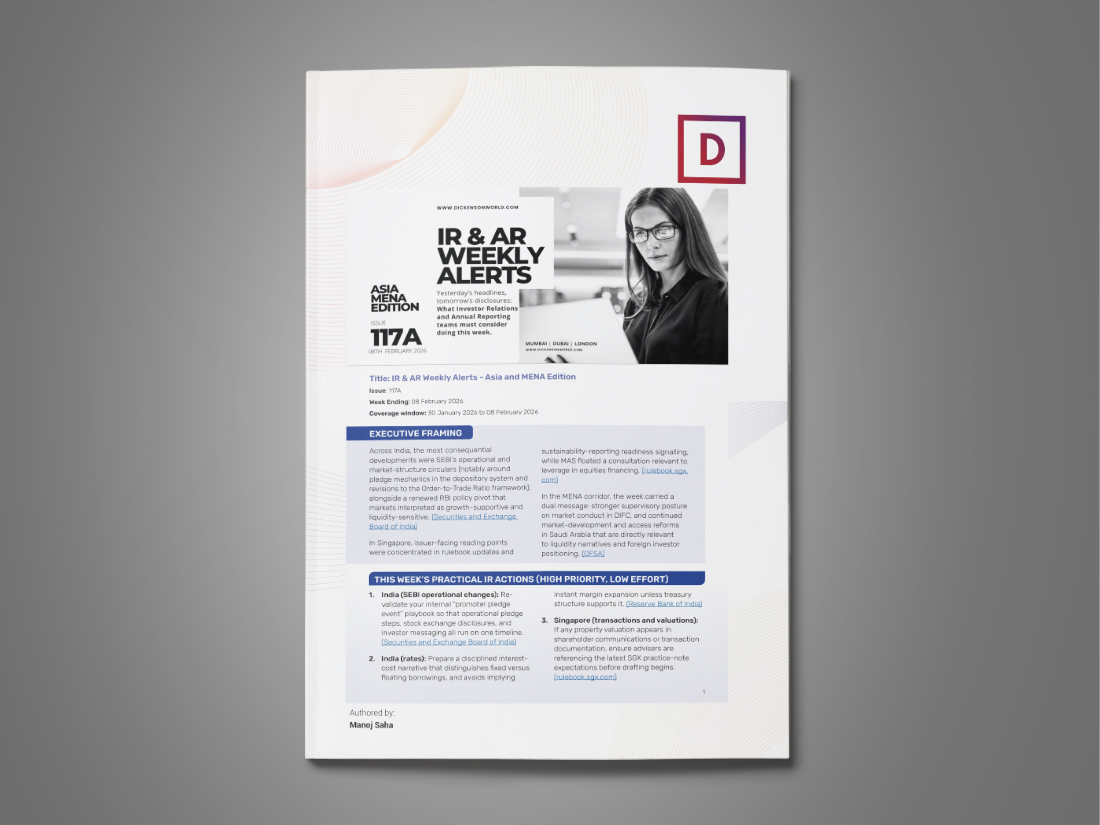
IR & AR WEEKLY ALERTS — ISSUE 117A (Asia and MENA Edition)
Week Ending: 08 February 2026
Coverage Window: 30 January 2026 to 08 February 2026
This week’s practical IR actions (high priority, low effort)
-
India (SEBI operational changes): Re-validate your internal “promoter pledge event” playbook so that operational pledge steps, stock exchange disclosures, and investor messaging all run on one timeline. (Securities and Exchange Board of India)
-
India (rates): Prepare a disciplined interest-cost narrative that distinguishes fixed versus floating borrowings, and avoids implying instant margin expansion unless treasury structure supports it. (Reserve Bank of India)
-
Singapore (transactions and valuations): If any property valuation appears in shareholder communications or transaction documentation, ensure advisers are referencing the latest SGX practice-note expectations before drafting begins. (rulebook.sgx.com)
-
MENA (governance credibility): For DIFC regulated entities, check that annual-report governance and compliance disclosures are evidence-based and traceable to specific systems and owners, consistent with DFSA’s enforcement posture. (DFSA)
-
Saudi (foreign ownership and liquidity story): Where relevant, refresh your investor targeting narrative to incorporate the widening foreign investor access and evolving market making framework. (FTA UAE)
A. INDIA
1. SEBI updates operational framework for creation and invocation of pledge through the depository system (06 Feb 2026)
What happened
SEBI issued a circular dealing with the process surrounding creation and invocation of pledge of securities through the depository mechanism. (Securities and Exchange Board of India)
Why it matters to issuers and IR
-
Promoter-pledge and lender-invocation events often become “trust moments” in the market. Any operational process change can affect timelines, documentation flows, and the quality of disclosures (especially when invocation coincides with price volatility). (Securities and Exchange Board of India)
IR and compliance actions
-
If your issuer has any promoter pledge (existing or contemplated), align the promoter, depository participant, and internal compliance team on the updated process so that disclosure drafting and stock-exchange filings do not lag the operational event. (Securities and Exchange Board of India)
-
Re-check internal trigger thresholds for Regulation 31 disclosures (pledge details), so that operational steps and disclosure steps remain synchronized. (Securities and Exchange Board of India)
Source link(s): SEBI circular page. (Securities and Exchange Board of India)
2. SEBI revises Order-to-Trade Ratio framework (04 Feb 2026)
What happened
SEBI issued a circular titled “Revision of Order-to-Trade Ratio (OTR) framework.” (Securities and Exchange Board of India)
Why it matters to issuers and IR
-
OTR regimes influence intraday liquidity conditions and trading behaviour in derivatives and related cash markets. For issuers with active derivatives, changes in member behaviour can affect spreads, depth, and volatility dynamics around results, corporate actions, or large block flows. (Securities and Exchange Board of India)
IR and compliance actions
-
If your stock is derivatives-active, ask your market-maker or broker coverage team whether the revised OTR framework changes their quoting posture around event windows (results, guidance updates, investor days). (Securities and Exchange Board of India)
-
Ensure your results-day communication plan assumes a wider distribution of liquidity outcomes (do not over-fit to historical spreads if microstructure rules change). (Securities and Exchange Board of India)
Source link(s): SEBI circular page. (Securities and Exchange Board of India)
3. RBI delivers a 25 bps rate cut and signals continued policy calibration (06 Feb 2026)
What happened
Reuters reported that RBI cut the repo rate by 25 bps to 6.25% and communicated a stance oriented around supporting growth while remaining attentive to inflation dynamics. (Reserve Bank of India)
Why it matters to issuers and IR
-
For rate-sensitive sectors (real estate, autos, capex-heavy industrials), even a modest easing cycle tends to re-open “forward demand” questions on earnings calls.
-
For leveraged balance sheets, this changes the investor conversation on interest-cost trajectory, refinancing windows, and duration management. (Reserve Bank of India)
IR actions
-
Prepare a one-slide “rate sensitivity” note for management and the IRO: debt mix, hedging posture, next 12-month maturities, and a conservative pass-through narrative (avoid implying immediate benefit if borrowing is fixed-rate). (Reserve Bank of India)
Source link(s): Reuters coverage of the policy decision. (Reserve Bank of India)
4. RBI indicates a framework to compensate customers for smaller digital-payment frauds (reported 06 Feb 2026)
What happened
Reuters reported that RBI is planning a framework to compensate customers for smaller digital-payment frauds. (Reserve Bank of India)
Why it matters (select issuers)
-
Direct relevance for banks, NBFCs with payment rails, fintechs, and consumer platforms with embedded payments: this can affect customer liability, provisioning assumptions, complaint-resolution KPIs, and disclosure risk around cyber and fraud. (Reserve Bank of India)
IR actions
-
For financial issuers: refresh risk-factor language, controls narrative, and customer grievance disclosures ahead of annual reporting, so that your position is robust if the framework lands quickly. (Reserve Bank of India)
Source link(s): Reuters coverage. (Reserve Bank of India)

B. SINGAPORE
1. SGX Rulebook: Practice Note 2.4 (Summary Property Valuation Report) amended (06 Feb 2026)
What happened
SGX Rulebook shows Practice Note 2.4 “Summary Property Valuation Report” updated with an amendment date of 06 Feb 2026. (rulebook.sgx.com)
Why it matters for issuers and transaction IR
-
Property valuations often surface in circulars, acquisitions, spin processes, and offer documentation. Even a targeted practice-note change can alter the structure or minimum content expected in summaries. (rulebook.sgx.com)
IR and transaction actions
-
If you have any property-heavy transaction, spin, REIT-related workstream, or material-asset acquisition planned, ensure counsel and valuers are working off the updated practice-note expectations before drafting starts. (rulebook.sgx.com)
Source link(s): SGX Rulebook practice notes page. (rulebook.sgx.com)
2. ACRA: sustainability reporting requirements readiness signalling (training and implementation support highlighted)
What happened
ACRA’s sustainability reporting requirements page references training programmes and readiness support, reflecting ongoing implementation focus. (beta.acra.gov.sg)
Why it matters for listed groups and Singapore-linked reporting
-
Even where the immediate requirement sits with Singapore entities, group reporting teams typically end up harmonising governance, data controls, and assurance pathways across jurisdictions to avoid fragmented disclosures. (beta.acra.gov.sg)
IR and annual report actions
-
Add a short “sustainability reporting readiness” internal checklist: governance ownership, scope mapping (entity and value chain), controls, and third-party assurance planning, especially if you are investor-facing on transition plans. (beta.acra.gov.sg)
Source link(s): ACRA sustainability reporting requirements page. (beta.acra.gov.sg)
3. MAS consultation: proposed change to share financing requirement (80% to 90%), consultation reference P002-2026
What happened
Search disclosures indicate MAS issued a consultation paper proposing to increase the share financing requirement from 80% to 90%, with consultation reference P002-2026 and a stated closing date of 16 March 2026. (Monetary Authority of Singapore)
Why it matters for issuers and market structure
-
If implemented, tighter financing margins can reduce leveraged equity exposures for some investors and may affect short-term trading intensity in certain names, especially around high-volatility windows. (Monetary Authority of Singapore)
IR actions
-
For issuers with a significant retail investor base, keep an eye on broker notes and trading commentary. Avoid over-interpreting daily volume changes, but be prepared for questions if leverage-driven flows moderate. (Monetary Authority of Singapore)
Source link(s): MAS consultation listing references (as visible in search disclosures). (Monetary Authority of Singapore)

C. UAE
1. DFSA fines Ark Capital Management for market-abuse systems and controls shortcomings and reporting failings (06 Feb 2026)
What happened
DFSA announced a fine on Ark Capital Management related to deficiencies in market abuse systems and controls and change-of-control reporting failings. (DFSA)
Why it matters (DIFC regulated firms, issuers with DIFC structures, and governance narratives)
-
The enforcement message is clear: supervisory expectations around surveillance, controls, and regulatory notifications remain high, and DFSA is willing to publicise outcomes. This also shapes board-level risk oversight language in annual reports for regulated groups. (DFSA)
IR and governance actions
-
DIFC regulated entities should re-check governance disclosures on compliance monitoring, incident management, and regulatory engagement, ensuring they map to actual control owners and escalation pathways. (DFSA)
Source link(s): DFSA public statement. (DFSA)
D. Saudi Arabia
1. Saudi Exchange approves amended market making regulations and procedures; ETF market making framework launch effective 08 Feb 2026
What happened
Saudi Exchange announced approval of amended market making regulations and procedures, and separately noted the market making framework for ETFs launching effective 08 Feb 2026. (saudiexchange.sa)
Why it matters for issuers and liquidity narrative
-
Market making reforms can alter liquidity quality, spreads, and the “tradability story” for institutions. This is directly relevant to IR messaging around foreign investor accessibility and trading resilience, especially for names that rely on sustained liquidity to support valuation. (saudiexchange.sa)
IR actions
-
If you are Saudi-listed or actively courting KSA institutional capital, refresh your liquidity slide: average daily value traded, free float, top shareholders, and the evolving market microstructure that supports tighter spreads. (saudiexchange.sa)
Source link(s): Saudi Exchange announcement. (saudiexchange.sa)
2. Saudi CMA: opening the capital market to all categories of foreign investors becomes effective 01 Feb 2026
What happened
CMA material indicates that opening the capital market to all categories of foreign investors was set to take effect from 01 Feb 2026. (FTA UAE)
Why it matters for issuers and capital access
-
Broader foreign investor access changes the medium-term buyer universe and can reshape the investor targeting map, especially for mid-caps seeking incremental institutional ownership. (FTA UAE)
IR actions
-
Consider updating the “investor access” section in your IR website and presentations: eligibility, settlement, and any practical onboarding pathways used by international investors. (FTA UAE)
Source link(s): CMA information page. (FTA UAE)


IR & AR WEEKLY ALERTS
To download and save this article.
Contact Us: To learn more or schedule a consultation, please reach out to us at www.dickensonworld.com
Email:enquiry@dickensonworld.com.
Leave A Comment