

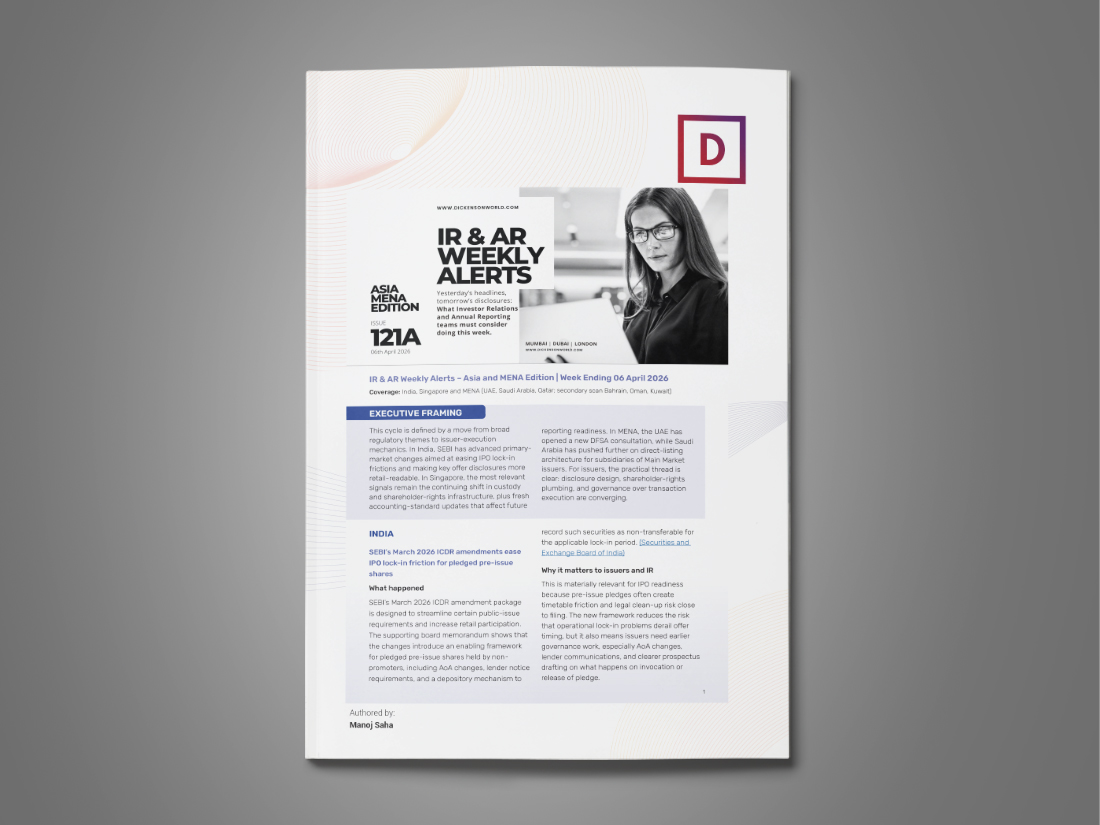
IR & AR WEEKLY ALERTS — ISSUE 121A (Asia and MENA Edition)
Coverage: India, Singapore and MENA (UAE, Saudi Arabia, Qatar; secondary scan Bahrain, Oman, Kuwait)
Week Ending: 06 April 2026
A. INDIA
1. SEBI’s March 2026 ICDR amendments ease IPO lock-in friction for pledged pre-issue shares
What happened
SEBI’s March 2026 ICDR amendment package is designed to streamline certain public-issue requirements and increase retail participation. The supporting board memorandum shows that the changes introduce an enabling framework for pledged pre-issue shares held by non-promoters, including AoA changes, lender notice requirements, and a depository mechanism to record such securities as non-transferable for the applicable lock-in period. (Securities and Exchange Board of India)
Why it matters to issuers and IR
This is materially relevant for IPO readiness because pre-issue pledges often create timetable friction and legal clean-up risk close to filing. The new framework reduces the risk that operational lock-in problems derail offer timing, but it also means issuers need earlier governance work, especially AoA changes, lender communications, and clearer prospectus drafting on what happens on invocation or release of pledge.
Action for CFO/Company Secretary/IR
-
Check whether any non-promoter pre-issue holdings are pledged and would need the new lock-in treatment.
-
Build AoA amendments and lender notifications into the IPO critical path much earlier.
-
Ensure risk factors and capital-structure drafting explain invocation and residual lock-in mechanics clearly.
-
Align legal, depository, and IR teams so operational treatment and disclosure language match.
Source link(s): SEBI ICDR Amendment Regulations, 21 March 2026; SEBI board memorandum on ICDR amendments. (Securities and Exchange Board of India)
2. SEBI pushes draft abridged prospectus into the IPO process earlier
What happened
The same SEBI package proposes that a draft abridged prospectus be filed alongside the draft offer document and hosted on the relevant websites, while the offer-document summary is proposed to be dispensed with in favour of a more focused abridged prospectus format. The board memorandum states that the aim is to improve investor comprehension and retail engagement.
Why it matters to issuers and IR
This is more than a drafting tweak. It raises the importance of early-stage investor-facing summarisation, which means the plain-language framing of risk factors, issue objects, financial highlights and KPIs will now be tested earlier and more visibly. For IR teams, that makes the “retail readability” of offer disclosure a live workstream rather than a late formatting exercise.
Action for CFO/Company Secretary/IR
-
Start preparing the concise investor-facing summary at the DRHP stage, not only near launch.
-
Ensure risk, KPI and proceeds language is consistent across DRHP, abridged prospectus and roadshow materials.
-
Review whether internal review processes are robust enough for earlier publication of simplified disclosure.
-
Treat the draft abridged prospectus as a reputational document, not a compliance annexure.
Source link(s): SEBI board memorandum on ICDR amendments; SEBI ICDR Regulations as amended on 21 March 2026.

B. SINGAPORE
1. SGX RegCo’s broker custody consultation remains one of the most consequential issuer-servicing proposals in play, with the consultation closing on 27 March 2026
What happened
SGX RegCo’s consultation on wider adoption of broker custody accounts proposes omnibus broker custody accounts, stronger duties on brokers and depository agents to facilitate shareholder rights, and more robust oversight of depository agents. SGX stated that operators of broker custody accounts would need to disseminate meeting notices and corporate-action events, assist with requisitioning meetings, and provide sufficient time for instructions. (SGX Links)
Why it matters to issuers and IR
This remains highly relevant because it affects how issuers reach beneficial holders, how AGM and corporate-action instructions flow through intermediaries, and how visible shareholder rights remain in a more omnibus-style environment. It also has consequences for shareholder identification, register analytics, and the design of notice periods and investor-education materials. (SGX Links)
Action for CFO/Company Secretary/IR
-
Obtain a registrar note on how omnibus custody could affect AGM notices, voting, and corporate-action timetables.
-
Reassess whether current shareholder-identification methods remain adequate under a more intermediated model.
-
Strengthen investor communications so meeting and election deadlines remain clear across custody chains.
-
Keep retail-investor FAQs ready if the consultation proceeds to implementation. (SGX Links)
Source link(s): SGX RegCo announcement on broker custody consultation. (SGX Links)
2. ACRA’s Accounting Standards Committee has issued amendments on translation to a hyperinflationary presentation currency, effective from 01 January 2027
What happened
ACRA’s ASC announced on 19 March 2026 amendments to SFRS(I) 1-21 and FRS 21 on translation to a hyperinflationary presentation currency, effective for annual reporting periods beginning on or after 1 January 2027. (ACRA)
Why it matters to issuers and IR
For most issuers this will not create immediate FY2026 disruption, but it is relevant for groups with hyperinflation exposure, multinational reporting complexity, or long-dated accounting-policy planning. It is also the kind of technical change that becomes material late if treasury, reporting and audit teams leave it to year-end policy review. (ACRA)
Action for CFO/Company Secretary/IR
-
Ask group finance whether any entity or reporting scenario could engage hyperinflationary presentation-currency issues.
-
Add the amendment to FY2027 accounting-policy planning and audit-committee briefings.
-
Ensure any future investor explanation distinguishes accounting translation effects from operating performance. (ACRA)
Source link(s): ACRA ASC News, 19 March 2026. (ACRA)

C. UAE
1. DFSA opens Consultation Paper 171 on miscellaneous changes
What happened
On 27 March 2026, the DFSA released Consultation Paper No. 171 titled “Miscellaneous Changes”, with comments due by 26 April 2026. (DFSA)
Why it matters to issuers and IR
“Miscellaneous” consultations in DIFC often carry operational consequences that appear later in listing, disclosure, control, or governance workflows. For groups using DIFC entities for financing, treasury, advisory or regulated activity, the practical significance lies in tracking whether apparently technical rule changes require updates to governance language, compliance calendars, or year-end drafting assumptions. (DFSA)
Action for CFO/Company Secretary/IR
-
Ask DIFC compliance owners for a short note on whether CP171 affects any group entity or workflow.
-
Add the 26 April 2026 response deadline to regulatory trackers.
-
Keep FY2026 report drafting instructions flexible if rule text may change in the near term. (DFSA)
Source link(s): DFSA CP171 consultation notice. (DFSA)

D. Saudi Arabia
1. Saudi Exchange and CMA have pushed direct-listing architecture further through consultation on subsidiary listings and related Listing Rules changes
What happened
The CMA’s consultation on listing subsidiaries of Main Market listed companies, announced on 25 February 2026, remained open until 27 March 2026. In parallel, Saudi Exchange published draft amendments to the Listing Rules aimed at enabling direct listing of subsidiaries of listed parents on the Main Market without an IPO, while also permitting pre-approval information sharing with selected potential investors and certain licensed institutions preparing research, subject to conditions. (Saudi Exchange)
Why it matters to issuers and IR
This is strategically important for groups considering value-unlock options, business separation, or parent-subsidiary market positioning. It could materially change how boards think about structure, investor segmentation, research preparation, pre-sounding discipline, minority protection, and the narrative logic for why a business should remain inside a listed parent or stand separately. (Saudi Exchange)
Action for CFO/Company Secretary/IR
-
Identify whether any group business could plausibly fit a future direct-listing route.
-
Revisit board materials on structure, control rationale, and minority-shareholder protections.
-
Tighten research and pre-sounding governance if the group may eventually pursue this route.
-
Prepare an investor narrative explaining strategic logic for any future separation or retained ownership model. (Saudi Exchange)
Source link(s): CMA consultation notice; Saudi Exchange draft Listing Rules consultation. (Saudi Exchange)
E. Qatar
1. No material new issuer-wide updates observed in the 23 March to 06 April 2026 window from QFMA or QSE
What happened
No primary-source item was identified in this window that materially altered issuer periodic reporting, continuing obligations, ESG reporting, or disclosure controls in Qatar. (DFSA)
Why it matters to issuers and IR
For now, this means issuers with Qatar relevance should maintain existing reporting and governance baselines while continuing to monitor official channels for any circulars, rulebook updates or issuer guidance. (DFSA)
Action for CFO/Company Secretary/IR
-
Maintain current disclosure and reporting assumptions.
-
Continue monitoring QFMA and QSE channels for any implementation or consultation developments. (DFSA)

IR & AR WEEKLY ALERTS
To download and save this article.
Contact Us: To learn more or schedule a consultation, please reach out to us at www.dickensonworld.com
Email:enquiry@dickensonworld.com.
Leave A Comment