

IR & AR WEEKLY ALERTS — ISSUE 120A (Asia and MENA Edition)
Coverage: India, Singapore and MENA (UAE, Saudi Arabia, Qatar; secondary scan Bahrain, Oman and Kuwait)
Time window: 08 February 2026 to 22 March 2026
A. INDIA
1. SEBI consolidates the capital-raising rulebook through the February 2026 ICDR Master Circular
What happened
SEBI issued its Master Circular for Issue of Capital and Disclosure Requirements on 9 February 2026. For issuers and advisers, this becomes the key consolidated reference point for public issues, rights issues, QIPs, preferential issues and related disclosure mechanics under the ICDR framework. (Securities and Exchange Board of India)
Why it matters to issuers and IR
A new master circular is not merely administrative housekeeping. It changes the operational “source of truth” used by legal teams, merchant bankers, CFO offices and company secretaries during live fund-raises. Any issuer relying on older circular chains, outdated checklists or legacy precedent language now faces a higher risk of inconsistency across board papers, offer documentation and investor communications. (Securities and Exchange Board of India)
Action for CFO/Company Secretary/IR
Refresh all capital-raising playbooks and precedent checklists against the February 2026 master circular. For any live or planned transaction, ensure internal teams and advisers are working from the same consolidated ICDR reference set. (Securities and Exchange Board of India)
2. SEBI tightens digital-identity expectations on social media for regulated market participants
What happened
On 26 February 2026, SEBI issued a circular requiring SEBI-regulated entities and their agents to disclose their registered name and registration number on social media platforms. (Securities and Exchange Board of India)
Why it matters to issuers and IR
Even where the circular is directed at regulated intermediaries rather than listed issuers directly, the regulatory message is wider: investor-facing digital communication must be attributable, verifiable and difficult to spoof. For issuers, this raises the standard for how official channels, agency-managed handles, investor education campaigns and announcement amplification are governed. In practice, channel authenticity is increasingly part of disclosure control. (Securities and Exchange Board of India)
Action for CFO/Company Secretary/IR
Maintain a single internal register of all official investor-facing handles, owners and approval authorities. Add a channel-authenticity step to results-day and corporate-action communication checklists. (Securities and Exchange Board of India)
3. SEBI revises norms for independent third-party reviewers or certifiers for green debt securities
What happened
SEBI issued a circular on 27 February 2026 revising the norms for appointment of an independent third-party reviewer or certifier for green debt securities. (Securities and Exchange Board of India)
Why it matters to issuers and IR
For any issuer contemplating green bonds or sustainability-linked debt narratives, reviewer quality is central to credibility. The change increases the importance of evidentiary alignment between financing frameworks, external review scope, use-of-proceeds claims and sustainability disclosures in annual reporting and investor materials. Weak reviewer architecture can quickly become a reputational and governance issue. (Securities and Exchange Board of India)
Action for CFO/Company Secretary/IR
Re-check reviewer selection criteria, scope letters and internal evidence trails before any green debt mandate. Ensure treasury, ESG and IR messaging use only claims that the external review process can support. (Securities and Exchange Board of India)

B. SINGAPORE
1. MAS issues guidance on transition planning under its environmental risk framework
What happened
MAS announced in early March 2026 that it had issued guidance on transition planning as part of its environmental risk management framework. The official MAS result indicates this was released as a 2026 media release on transition planning. (Monetary Authority of Singapore)
Why it matters to issuers and IR
For Singapore-linked issuers, transition planning is no longer just a sustainability narrative preference. It is becoming a supervisory-quality expectation around governance, implementation discipline and decision-usefulness. Investors are likely to distinguish more sharply between broad climate ambition and a board-owned transition pathway with ownership, milestones and risk framing. (Monetary Authority of Singapore)
Action for CFO/Company Secretary/IR
Stress-test whether your climate narrative is backed by a genuine transition roadmap, named governance owners and capital-allocation logic. Align sustainability wording across the annual report, investor deck and risk disclosures. (Monetary Authority of Singapore)
2. MAS moves toward lifecycle supervision of third-party risk
What happened
MAS also published a 2026 consultation on proposed Guidelines on Third-Party Risk Management. While the page itself was not fully retrievable in the browsing session, the official MAS consultation result identifies the consultation and its subject matter.
Why it matters to issuers and IR
This is important because listed issuers increasingly depend on third parties for registrars, IR websites, disclosure-production workflows, cloud infrastructure, cyber tools, ESG data systems and webcast services. Once supervisors frame third-party risk as lifecycle governance, vendor dependence becomes a board-quality and disclosure-controls issue rather than a procurement footnote.
Action for CFO/Company Secretary/IR
Prepare a disclosure-critical vendor map and identify which third parties could disrupt filings, shareholder servicing or investor communications. Revisit contracts for escalation, resilience, incident notification and audit-right provisions.

C. UAE
1. DFSA amends AML and Glossary modules to align with new UAE federal AML legislation
What happened
The DFSA issued a Notice of Amendments to Legislation on 26 February 2026, stating that amendments to the AML and Glossary modules would come into force on 2 March 2026 to align with new federal AML legislation. (DFSA)
Why it matters to issuers and IR
For issuer groups with DIFC-regulated entities, AML wording is no longer a generic compliance paragraph. It now needs to reflect updated legislative alignment, real control ownership and a current governance architecture. This affects annual-report drafting, board reporting, onboarding language, outsourcing oversight and risk-disclosure credibility. (DFSA)
Action for CFO/Company Secretary/IR
Update governance and compliance drafting notes for any DIFC-regulated entity references. Ensure annual-report language is tied to actual AML operating ownership and current rulebook architecture. (DFSA)
2. DFSA publishes AML FAQs covering governance, digital onboarding, outsourcing and internal audit
What happened
On 2 March 2026, the DFSA confirmed that its updated AML and Glossary modules had come into force and published supporting FAQs addressing governance, risk assessments, digital onboarding, outsourcing and internal audit expectations. (DFSA)
Why it matters to issuers and IR
This is especially relevant for financial groups and diversified listed groups with DIFC entities, because investors increasingly read AML architecture as a proxy for overall governance maturity. The FAQ themes also overlap directly with annual-report content areas that are often drafted too generically. (DFSA)
Action for CFO/Company Secretary/IR
Reconcile your governance disclosures with actual AML processes, especially where onboarding or outsourced functions are involved. Ensure the board or relevant committee receives an implementation note, not only a legal summary. (DFSA)
3. DFSA supports implementation of its updated crypto-token regime through FAQs
What happened
The DFSA published Crypto Token FAQs on 12 February 2026 to support implementation of the updated regime that had come into force on 12 January 2026. Earlier DFSA rule changes in December 2025 had already shifted responsibility toward firms making their own documented suitability assessments rather than relying on a DFSA-prescribed list of recognised tokens. (DFSA)
Why it matters to issuers and IR
For listed groups with any digital-asset adjacency, the emphasis has now moved from framework announcement to implementation discipline. That means suitability assessment, ongoing monitoring and business-model boundaries become more important in risk disclosures and investor messaging. Loose promotional language around tokenisation or crypto exposure is more dangerous in this environment. (DFSA)
Action for CFO/Company Secretary/IR
Review whether any business line, JV or treasury narrative touches crypto-token activity. Tighten the language used in public communications so it reflects control, suitability and governance rather than novelty. (DFSA)

D. Saudi Arabia
1. CMA opens consultation on listing subsidiaries of Main Market listed companies
What happened
On 25 February 2026, the Saudi market’s official news feed stated that the CMA called for public consultation on the mechanism for listing subsidiaries of Main Market listed companies subject to shareholders’ approval, with the consultation open until 27 March 2026. (Saudi Exchange)
Why it matters to issuers and IR
This is strategically significant. A clearer route for listing subsidiaries can alter how groups think about value unlock, restructuring, capital allocation, minority-protection framing and parent-subsidiary governance. For IR teams, it also affects how the group equity story is explained, especially where one business line may command a materially different valuation logic from the parent. (Saudi Exchange)
Action for CFO/Company Secretary/IR
Identify whether any business vertical in the group could plausibly fit a future subsidiary-listing structure. Refresh board materials and investor messaging on why each asset currently sits inside the parent group and what governance protections would matter if separation were ever pursued. (Saudi Exchange)

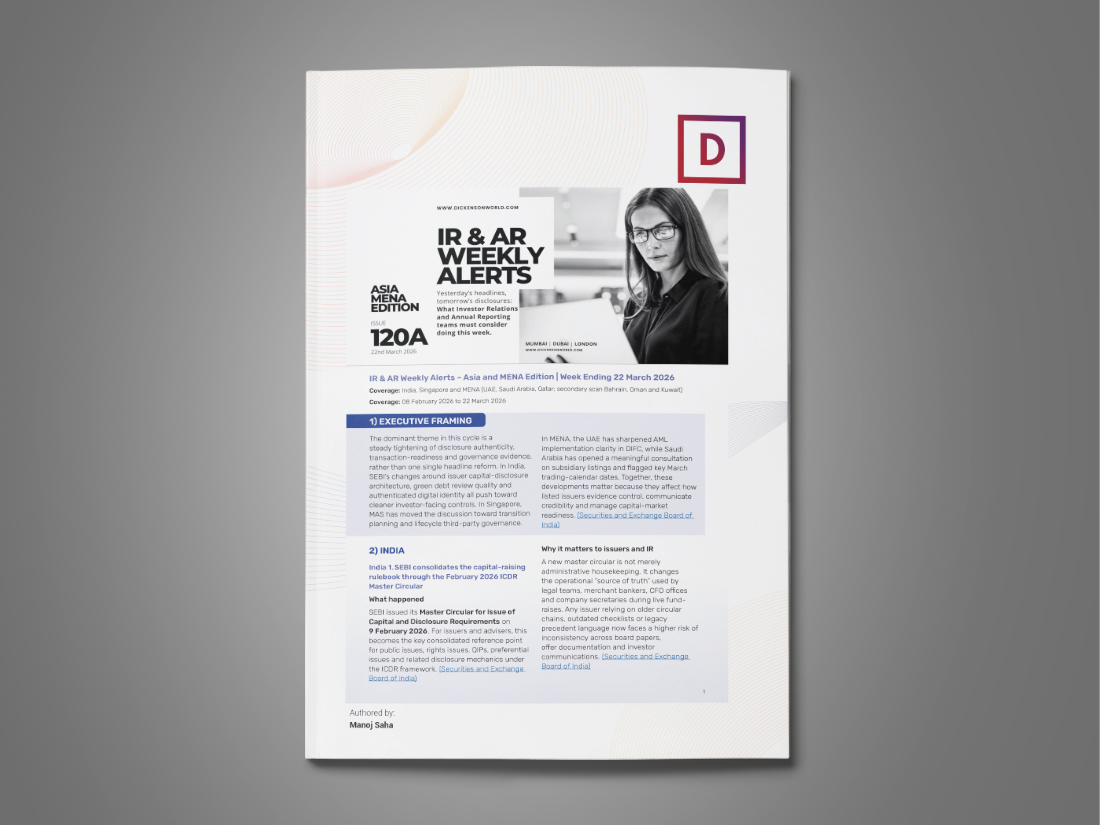
IR & AR WEEKLY ALERTS
To download and save this article.
Contact Us: To learn more or schedule a consultation, please reach out to us at www.dickensonworld.com
Email:enquiry@dickensonworld.com.
Leave A Comment