

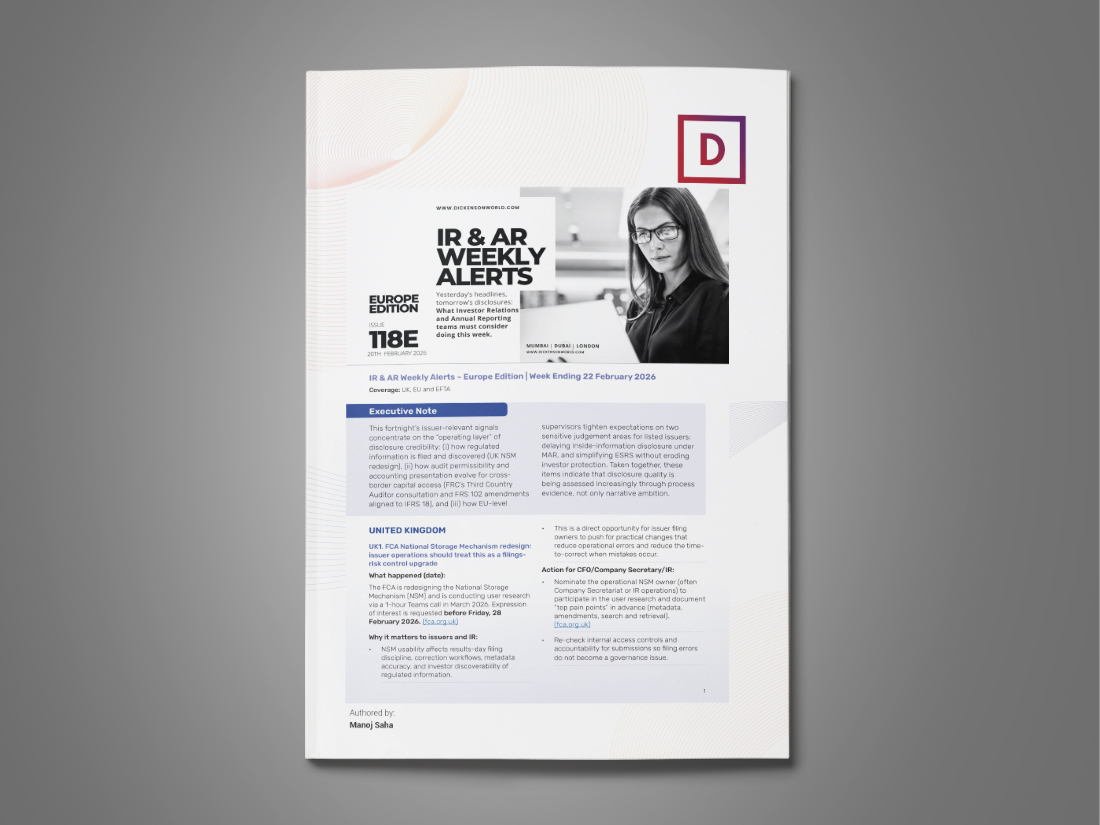
IR & AR WEEKLY ALERTS — ISSUE 118E
Coverage: UK, EU and EFTA
Week Ending: 22 February 2026
A. UNITED KINGDOM
A1. FCA National Storage Mechanism redesign: issuer operations should treat this as a filings-risk control upgrade
What happened
The FCA is redesigning the National Storage Mechanism (NSM) and is conducting user research via a 1-hour Teams call in March 2026. Expression of interest is requested before Friday, 28 February 2026. (fca.org.uk)
Why it matters to issuers and IR
-
NSM usability affects results-day filing discipline, correction workflows, metadata accuracy, and investor discoverability of regulated information.
-
This is a direct opportunity for issuer filing owners to push for practical changes that reduce operational errors and reduce the time-to-correct when mistakes occur.
Action for CFO/Company Secretary/IR
-
Nominate the operational NSM owner (often Company Secretariat or IR operations) to participate in the user research and document “top pain points” in advance (metadata, amendments, search and retrieval). (fca.org.uk)
-
Re-check internal access controls and accountability for submissions so filing errors do not become a governance issue.
A2. FRC consultation: temporary amendment to Third Country Auditor directions for Chinese-registered issuers listing GDRs in London (Stock Connect segment)
What happened (16 February 2026)
The FRC opened a consultation on a temporary amendment to its Third Country Auditor (TCA) policy that would temporarily permit auditors of Chinese-registered entities listing GDRs in London (Stock Connect segment) to use Chinese Standards on Auditing for UK listing purposes, subject to a narrowly scoped, time-limited approach with safeguards and explicit disclosure of the auditing standards used. (FRC (Financial Reporting Council))
Why it matters to issuers and IR
-
For London’s cross-border issuance ecosystem, this is an explicit “capital access facilitation” signal that may increase issuer interest in UK venues for specific structures.
-
For investors, the key sensitivity is audit standards comparability and transparency. Issuer disclosure posture and audit committee narratives must be precise on audit standards used, scope, and oversight.
Action for CFO/Company Secretary/IR
-
If you are advising a cross-border issuer or a sponsor on GDR pathways, update the due diligence checklist to include explicit audit-standards disclosure language, and stress-test investor Q&A on audit comparability. (FRC (Financial Reporting Council))
-
If relevant to your business model, consider responding to the consultation, focusing on investor protection safeguards, disclosure clarity, and operational feasibility.
A3. FRC issues amendments to FRS 102 and FRS 105 on adapted formats, aligned to IFRS 18, with an effective date of 1 January 2027
What happened (18 February 2026)
The FRC issued amendments to FRS 102 (and limited clarifications for FRS 102/FRS 105 periodic review amendments) to provide an updated framework for entities adapting balance sheet and profit and loss formats, explicitly to maintain alignment with presentation requirements following IFRS 18. The amendments are effective for accounting periods beginning on or after 1 January 2027. (FRC (Financial Reporting Council))
Why it matters to issuers and IR
-
The market is moving toward greater comparability in performance presentation. Even for groups not applying IFRS, alignment pressure increases because investors compare “performance constructs” across peers.
-
For reporting teams, this reduces the tolerance for idiosyncratic adapted formats that are difficult to reconcile with IFRS-driven norms, particularly as IFRS 18 becomes an investor baseline.
Action for CFO/Company Secretary/IR
-
For UK GAAP reporters using adapted formats, start a “2027 readiness” workstream: mapping current formats to amended requirements and documenting presentation decisions for audit committee sign-off. (FRC (Financial Reporting Council))
-
Align IR’s APM narrative with finance’s evolving presentation architecture to avoid “two versions of performance” across accounts and investor materials.

B. EUROPEAN UNION (EU)
B1. ESMA consultation: MAR Guidelines on delayed disclosure of inside information (issuer-facing, judgement-intensive)
What happened (19 February 2026)
ESMA launched a consultation on MAR Guidelines on delay in the disclosure of inside information, open 19 February 2026 to 29 April 2026, explicitly noting primary relevance to issuers (including SMEs) and trading venues. (esma.europa.eu)
Why it matters to issuers and IR
-
The consultation targets one of the highest-risk issuer judgement areas: when delay is legitimate, when it could mislead the public, and how confidentiality breakdowns (including sufficiently accurate rumours) should trigger disclosure.
-
Expect higher scrutiny of the “delay file” discipline: governance rationale, timing, containment measures, and internal escalation triggers.
Action for CFO/Company Secretary/IR
-
Re-validate your inside-information operating model: decision rights, documentation standards, and “rumour accuracy” escalation triggers, ensuring they are executable under time pressure. (esma.europa.eu)
-
Consider submitting consultation feedback focused on practical issuer constraints, especially around confidentiality management in extended deal windows and social media rumour dynamics. (esma.europa.eu)
B2. ESMA Opinion on revised ESRS: simplification supported, but investor protection conditions and quality guardrails emphasised
What happened (Opinion dated 17 February 2026; published 18 February 2026)
ESMA issued an Opinion to the European Commission on EFRAG’s technical advice on revised ESRS, acknowledging the simplification agenda while framing assessment through investor protection, orderly markets, and financial stability criteria.
Why it matters to issuers and IR
-
“Simplification” does not automatically mean lower challenge. It can shift enforcement from volume of datapoints to quality of materiality judgements, value chain estimation discipline, and governance evidence.
-
ESMA’s emphasis implies that issuers should prepare for scrutiny of how they use estimates, how they evidence practicability and reliability, and how they present materiality outcomes to investors.
Action for CFO/Company Secretary/IR
-
Build (or refresh) an ESRS “evidence register” that ties each material topic and KPI to data lineage, boundary, and governance ownership, including how estimates are produced and validated.
-
Treat materiality as a board-level discipline: ensure minutes, challenge logs, and rationale are audit-ready, not only narrative-ready.
B3. ESMA Public Statement on IFRS 18 implementation: comparability, MPM discipline, interim reporting, and pre-effective-date transparency
What happened (17 February 2026)
ESMA issued a public statement on implementing IFRS 18 (effective 1 January 2027), highlighting implementation focus areas (profit or loss structure, management-defined performance measures, aggregation and labelling) and expectations for disclosures of anticipated effects before 2027 under IAS 8, alongside interim reporting implications and ESEF remapping considerations. (esma.europa.eu)
Why it matters to issuers and IR
-
IFRS 18 formalises discipline around performance subtotals and management-defined measures, tightening the link between financial statements and external APM narratives.
-
Investors will increasingly expect earlier, more decision-useful transition disclosure (as implementation effects become “reasonably estimable”), and will penalise late or vague commentary. (esma.europa.eu)
Action for CFO/Company Secretary/IR
-
Start an IFRS 18 transition pack now: draft future profit or loss structure, identify “management-defined performance measures” candidates, and align IR’s APM definitions to the future accounting posture. (esma.europa.eu)
-
Ensure 2026 interim/annual disclosures evolve progressively as implementation choices crystallise, rather than deferring disclosure to the year of adoption. (esma.europa.eu)
B4. ESMA supervisory briefing: EMIR 3 active account requirement (AAR) representativeness obligation (derivatives users and governance narrative)
What happened (20 February 2026)
ESMA published a supervisory briefing on complying with and reporting on the AAR representativeness obligation linked to EMIR 3, including guidance on identifying relevant derivatives subcategories and reporting trades, aiming to promote supervisory convergence. (esma.europa.eu)
Why it matters to issuers and IR
-
For corporates with material derivatives programmes (hedging, treasury risk management), counterparties and banks may adjust documentation, clearing arrangements, and reporting expectations.
-
For financial institutions, this can become a visible operational resilience and regulatory compliance story that flows into risk and governance disclosures.
Action for CFO/Company Secretary/IR
-
If derivatives usage is material, ask Treasury and clearing brokers for a short “AAR impact note” (clearing venue impacts, operational steps, documentation changes) and ensure risk disclosures are consistent with actual practice. (esma.europa.eu)
-
Align IR and Treasury so investor messaging on hedging and derivatives does not ignore infrastructure constraints that may affect execution.

C. EFTA AND EEA PILLAR AND NATIONAL EFTA UPDATES
C1. Liechtenstein FMA: DORA information register submission window opens (vendor governance becomes auditable)
What happened (20 February 2026)
Liechtenstein’s FMA published a support update for the DORA information register (Art. 28(3) DORA) and confirmed the submission window from 18 February to 18 March 2026 via its e-service portal, with ongoing publication of implementation instructions and validation guidance. (Financial Market Authority Liechtenstein)
Why it matters to issuers and IR
-
DORA-style vendor governance is shifting from policy statements to structured reporting artefacts. Even for non-financial groups, financial-sector subsidiaries and counterparties will increasingly request evidence of ICT third-party control maturity.
-
This affects annual report credibility: operational resilience narratives must map to demonstrable registers, ownership, and escalation processes.
Action for CFO/Company Secretary/IR
-
If you have Liechtenstein-regulated entities (or rely on group-wide DORA-aligned controls), ensure ICT vendor inventories, contract metadata, and reporting owners are finalised and traceable ahead of submission. (Financial Market Authority Liechtenstein)
-
Update the risk governance narrative to describe how ICT third-party dependencies are monitored and reported to the board (avoid generic statements).
C2. Norway Finanstilsynet: prospectus approvals activity in 2025 signals continuing process intensity for capital-market actions
What happened (11 February 2026)
In its annual reporting on supervised sectors, Norway’s Finanstilsynet stated it approved 111 prospectuses in 2025 (compared with 108 in 2024) and included breakdowns by instrument type, reinforcing the ongoing cadence of prospectus control and approval work. (Finanstilsynet)
Why it matters to issuers and IR
-
For Nordic issuers and cross-border EEA offers, these figures reinforce that prospectus processes remain active and capacity-driven. Execution planning and file hygiene remain material to timelines.
-
For annual reports and transaction communications, it strengthens the case for tighter “capital actions governance” narratives, particularly around verification, approvals sequencing, and disclosure controls.
Action for CFO/Company Secretary/IR
-
Maintain an issuer-side “prospectus readiness pack” (verification notes, risk factor taxonomy, governance sign-offs) so that approval workflows do not become a last-minute constraint. (Finanstilsynet)
-
Align investor communications calendars with the actual approval and publication pathway to avoid premature statements.
EEA pillar institutions (ESA / EFTA Court / EFTA Secretariat): No issuer-material publications observed in this window that would change disclosure or reporting posture across EFTA states.

IR & AR WEEKLY ALERTS
To download and save this article.
Contact Us: To learn more or schedule a consultation, please reach out to us at www.dickensonworld.com
Email:enquiry@dickensonworld.com.
Leave A Comment