

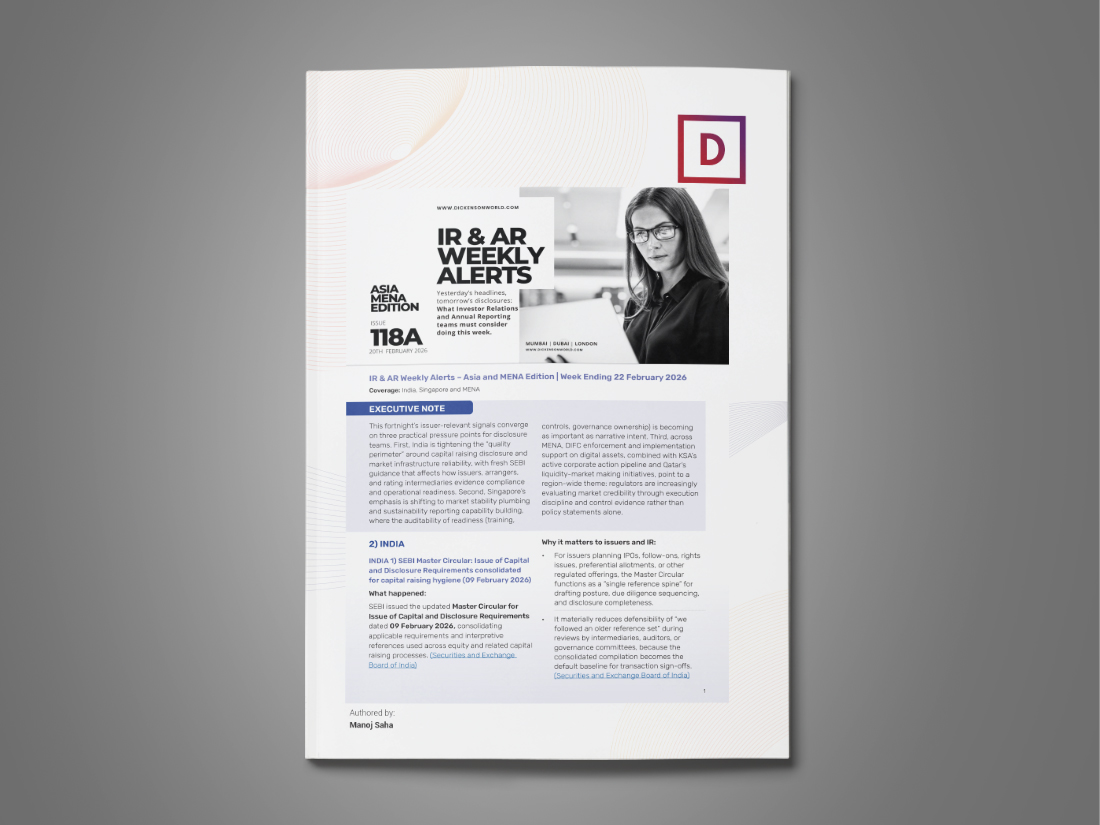
IR & AR WEEKLY ALERTS — ISSUE 118A (Asia and MENA Edition)
Week Ending: 22 February 2026
Coverage: India, Singapore and MENA
A. INDIA
1. SEBI Master Circular: Issue of Capital and Disclosure Requirements consolidated for capital raising hygiene (09 February 2026)
What happened
SEBI issued the updated Master Circular for Issue of Capital and Disclosure Requirements dated 09 February 2026, consolidating applicable requirements and interpretive references used across equity and related capital raising processes. (Securities and Exchange Board of India)
Why it matters to issuers and IR
-
For issuers planning IPOs, follow-ons, rights issues, preferential allotments, or other regulated offerings, the Master Circular functions as a “single reference spine” for drafting posture, due diligence sequencing, and disclosure completeness.
-
It materially reduces defensibility of “we followed an older reference set” during reviews by intermediaries, auditors, or governance committees, because the consolidated compilation becomes the default baseline for transaction sign-offs. (Securities and Exchange Board of India)
Action for CFO/Company Secretary/IR
-
Update the internal “capital raising playbook” to reference the 09 February 2026 Master Circular as the default source for drafting checklists and compliance mapping. (Securities and Exchange Board of India)
-
For any live transaction pipeline, align counsel and BRLMs on the exact circular version used for verification notes and board papers.
-
Ensure investor-facing timelines and “testing-the-waters” style engagements do not move ahead of what is defensible under the updated reference pack.
Source link(s): SEBI (Master Circular dated 09 February 2026). (Securities and Exchange Board of India)
2. SEBI imposes obligations on CRAs when rating instruments under other financial sector regulators (10 February 2026)
What happened
SEBI issued a circular titled “Obligations on CRAs while undertaking rating of financial instruments falling under the purview of any other Financial Sector Regulator” dated 10 February 2026. (Securities and Exchange Board of India)
Why it matters to issuers and IR
-
Issuers that depend on credit ratings for fundraising, covenant compliance, investor eligibility screens, or capital-market confidence are exposed when rating processes are inconsistent across regulatory perimeters.
-
A clearer “obligations framework” typically translates into more standardised information demands from CRAs, sharper questions on instrument structure, and tighter evidence expectations around disclosures used in rating rationale. This can affect disclosure calendars and the sequencing of announcements around fund-raising or refinancing. (Securities and Exchange Board of India)
Action for CFO/Company Secretary/IR
-
If you issue rated instruments or plan refinancing, pre-brief the rating workstream with a structured disclosure pack: instrument terms, regulatory classification, governance approvals, and updated risk factors consistent with public disclosures. (Securities and Exchange Board of India)
-
Align IR messaging so any “rating narrative” is factual, bounded, and consistent with what the CRA can support, avoiding interpretive statements that can later conflict with published rating actions.
-
Maintain a “ratings evidence file” to support audit committee oversight and reduce last-minute friction in rating surveillance cycles.
Source link(s): SEBI (Circular dated 10 February 2026). (Securities and Exchange Board of India)
3. SEBI framework for capacity planning and real-time performance monitoring for commodity-derivatives MIIs (11 February 2026)
What happened
SEBI issued a circular dated 11 February 2026 on “Capacity Planning and Real Time Performance Monitoring framework for Commodity Derivatives Segment of Market Infrastructure Institutions (MIIs)”. (Securities and Exchange Board of India)
Why it matters to issuers and IR
-
Issuers with commodity exposure increasingly use exchange-traded hedging markets and are sensitive to volatility around announcements and macro events. Infrastructure resilience in the commodity derivatives segment influences trading continuity, price discovery credibility, and the defensibility of hedge-performance narratives.
-
For issuers that explain hedging outcomes to investors, stronger monitoring expectations at MIIs reduce tolerance for “technical disruption” explanations and shift attention to preparedness and continuity governance. (Securities and Exchange Board of India)
Action for CFO/Company Secretary/IR
-
Ask treasury and your broker for a short note on whether the new monitoring framework changes incident transparency, escalation protocols, or reporting to market participants. (Securities and Exchange Board of India)
-
If hedging is material, ensure your risk disclosures clearly distinguish market risk, execution risk, and infrastructure dependency risk in a balanced manner.
-
Update results-day internal scripts for periods of commodity volatility so management commentary remains technically precise.
Source link(s): SEBI (Circular dated 11 February 2026). (Securities and Exchange Board of India)
4. SEBI constitutes Working Group to review ESG Rating Providers regulatory framework (18 February 2026)
What happened
SEBI announced (Press Release No. 13/2026, dated 18 February 2026) that it has constituted a Working Group to review the regulatory framework governing ESG Rating Providers (ERPs). (Securities and Exchange Board of India)
Why it matters to issuers and IR
-
ESG ratings increasingly affect cost of capital narratives, index eligibility discussions, and stewardship engagements. A regulatory review signals that ESG rating methodology transparency, consistency, and use-case reliability are now treated as market infrastructure issues rather than purely commercial analytics.
-
For issuers, this raises the importance of maintaining an internal “ESG evidence pack” so that engagement with ERPs and investor ESG queries remains consistent, traceable, and defensible across annual reports, sustainability disclosures, and investor presentations. (Securities and Exchange Board of India)
Action for CFO/Company Secretary/IR
-
Build a controlled ESG ratings engagement protocol: who responds, what documents are authoritative, and how updates are logged and approved. (Securities and Exchange Board of India)
-
Identify your top ESG rating drivers (data points and narratives) and validate that they match published disclosures, including boundary definitions and year-on-year comparability.
-
Consider proactive investor communication if rating-driven questions are frequent: publish a short ESG data book with consistent definitions and governance sign-off.
Source link(s): SEBI (Press Release dated 18 February 2026). (Securities and Exchange Board of India)
5. RBI updates MSME lending framework with an amendment direction (Updated as on 09 February 2026; applicability triggers from 01 April 2026 for specified loans)
What happened
RBI updated the Master Direction on Lending to MSME Sector “Updated as on 09 February 2026”, reflecting Lending to MSME Sector (Amendment) Directions, 2026, with stated applicability for MSE loans sanctioned or renewed on or after 01 April 2026 (as reflected in RBI-hosted amendment documentation). (Reserve Bank of India)
Why it matters to issuers and IR
-
This is directly relevant for bank and NBFC issuers (credit policy, priority sector narratives, portfolio growth strategies) and for non-financial issuers that depend on MSME channel partners and credit availability in supply chains.
-
Where MSME exposure is material, investor scrutiny typically focuses on underwriting discipline, portfolio quality controls, and the credibility of growth narratives. An RBI amendment increases expectations of demonstrable compliance readiness and governance oversight. (Reserve Bank of India)
Action for CFO/Company Secretary/IR
-
For financial issuers: map the amended direction into credit policy documentation and ensure annual report risk disclosures reflect how MSME lending governance and monitoring are executed. (Reserve Bank of India)
-
For industrial issuers with MSME supplier ecosystems: monitor credit tightening or easing signals through banker feedback, and avoid over-committing to supply-side assumptions in forward-looking statements.
-
Align Board-level reporting so any MSME initiatives are accompanied by measurable monitoring outcomes, not only intent.
Source link(s): RBI (updated Master Direction page; amendment documentation). (Reserve Bank of India)
6. RBI updates ECB and Trade Credits FAQ set (Updated as on 16 February 2026)
What happened
RBI updated the FAQs on External Commercial Borrowings (ECB) and Trade Credits dated 16 February 2026 (“Updated as on February 16, 2026”). (Reserve Bank of India)
Why it matters to issuers and IR
-
ECB frameworks and interpretive FAQ updates can influence how issuers structure offshore funding, document trade credit arrangements, and describe liquidity strategy and refinancing risk.
-
Investors tend to test FX risk posture, refinancing windows, and covenant headroom. FAQ updates are often treated by banks and advisers as a practical interpretive lens, so issuer disclosure and treasury narratives should align with current RBI articulation. (Reserve Bank of India)
Action for CFO/Company Secretary/IR
-
If you have ECB or trade credit exposure, instruct treasury to update the internal “ECB compliance note” and align it with the updated FAQ set. (Reserve Bank of India)
-
Ensure IR disclosures on offshore borrowing distinguish regulatory permissibility, hedging posture, maturity profile, and contingency liquidity, with no implication that policy changes automatically reduce risk.
-
Keep offering documents and investor decks consistent with current RBI FAQs to reduce diligence friction.
Source link(s): RBI (FAQs updated 16 February 2026). (Reserve Bank of India)

B. SINGAPORE
1. SGX CDP Clearing Rules: clarified cap on non-defaulting clearing members’ liability for multiple default events (11 February 2026)
What happened
SGX Rulebooks updated Practice Note 7.10.5 and 7.10.6 (effective 11 February 2026 onwards) describing how the aggregate amount of a non-defaulting clearing member’s contributions applied across events of default within a 30-day period is capped, including worked scenarios explaining the operation of the cap and adjustments. (SGX Rulebooks)
Why it matters to issuers and IR
-
While addressed to clearing members, this is a market stability control that influences settlement confidence and risk perception in stress periods. Issuers facing event-driven volatility should treat clearing and settlement resilience as part of market confidence, especially where derivatives-linked liquidity is important.
-
For financial issuers and market-adjacent groups, investors may increasingly expect clear disclosure of exposure to market infrastructure and counterparties during stress events. (SGX Rulebooks)
Action for CFO/Company Secretary/IR
-
For issuers with material derivatives activity or broker relationships, request a short broker note on whether the updated practice note changes stress-event handling or member risk posture. (SGX Rulebooks)
-
Ensure risk disclosures distinguish trading volatility from infrastructure stress and that governance language matches actual contingency planning.
-
Keep crisis communications protocols ready for market-wide dislocation scenarios where settlement confidence becomes a market narrative.
Source link(s): SGX Rulebooks (Practice Note 7.10.5 and 7.10.6, effective 11 February 2026). (SGX Rulebooks)
2. ACRA sustainability reporting readiness: governance and capability building signalled through updated public guidance and training availability (updated 16 February 2026)
What happened
ACRA’s sustainability reporting and assurance information hub indicates an implementation focus, with the page showing last updated 16 February 2026, and ACRA’s requirements timeline highlighting that SR BOK-aligned training programmes will be available in February 2026 to strengthen preparer capability. (ACRA)
Why it matters to issuers and IR
-
This reinforces that sustainability reporting is now treated as a competence-and-controls programme, not only a disclosure exercise. Investors will increasingly test whether Boards and management have built internal capability to produce consistent, auditable sustainability information.
-
For Singapore-linked groups, this signals that readiness can be evidenced through training, ownership mapping, and structured implementation planning, which should be reflected in annual report governance narratives. (ACRA)
Action for CFO/Company Secretary/IR
-
Establish a sustainability reporting readiness tracker: ownership, scope, data lineage, and assurance roadmap, with board oversight clearly documented. (ACRA)
-
Ensure management commentary in annual reports and investor decks uses consistent definitions and boundaries aligned to internal control capability, not marketing language.
-
If your issuer is subject to climate reporting requirements, confirm that training and capability building is scheduled early enough to avoid year-end quality failures.
Source link(s): ACRA (Sustainability reporting and assurance hub; requirements timeline). (ACRA)

C. UAE
1. DFSA publishes Crypto Token FAQs to support implementation of the updated regulatory framework (12 February 2026)
What happened
DFSA published Crypto Token FAQs to support firms in understanding and implementing the updated Crypto Token regulatory framework that came into force 12 January 2026, clarifying application of the DFSA Rulebook to crypto token financial services and activities in or from DIFC. (DFSA)
Why it matters to issuers and IR
-
For groups with DIFC-regulated entities or digital asset touchpoints, the FAQs function as an implementation interpretive layer. That interpretive layer can influence governance disclosures, risk factor framing, and the credibility of statements regarding digital asset exposure boundaries and controls.
-
Investors increasingly assess “control maturity” in digital asset adjacency, even when current financial materiality is limited. (DFSA)
Action for CFO/Company Secretary/IR
-
Ensure risk disclosures clearly define whether the group has crypto-token exposure, and if so, the governance controls and permitted activities, consistent with DIFC regulatory framing. (DFSA)
-
Align sustainability and technology narratives to avoid implying product or revenue exposure that is not supported by regulatory permissions.
-
For DIFC regulated entities, maintain an evidence file mapping relevant DFSA Rulebook requirements to internal control owners.
Source link(s): DFSA (Crypto Token FAQs publication announcement). (DFSA)
2. Financial Markets Tribunal upholds DFSA decision: fine for failure to immediately report suspicious transactions on Nasdaq Dubai (posted 10 February 2026; decision dated 03 February 2026)
What happened
DFSA reported that the Financial Markets Tribunal upheld DFSA’s decision to impose a USD 25,000 fine on Al Ramz Capital LLC for failure to immediately report suspicious transactions executed on Nasdaq Dubai (decision dated 03 February 2026, item posted 10 February 2026). (DFSA)
Why it matters to issuers and IR
-
This reinforces that suspicious transaction reporting discipline is treated as a core market integrity control. For issuers and DIFC-regulated groups, it elevates the importance of surveillance, escalation protocols, and documentation of compliance monitoring in governance disclosures.
-
It also increases reputational and stakeholder expectations: “market conduct controls” are judged by enforcement outcomes, not only policies. (DFSA)
Action for CFO/Company Secretary/IR
-
DIFC-regulated entities should review how market abuse monitoring, escalation, and reporting are described in annual reports and governance disclosures, ensuring they map to actual control owners and processes. (DFSA)
-
Confirm IR and compliance teams have a shared protocol for handling market rumours, unusual trading queries, and regulator-facing escalation, without selective disclosure risk.
Source link(s): DFSA (Tribunal decision report). (DFSA)
3. UAE Federal Tax Authority updates corporate tax operational guidance: Tasheel agent user manual published (17 February 2026)
What happened
The UAE Federal Tax Authority’s corporate tax guidance repository lists a new “Tax Registration and ReSubmission Tasheel Agent User Manual” with issue date 17 February 2026. (tax.gov.ae)
Why it matters to issuers and IR
-
Corporate tax compliance is increasingly scrutinised as a governance and control topic, particularly for groups with UAE operations, free-zone considerations, and multi-entity structures.
-
Operational guidance that formalises registration and resubmission processes can change timelines and documentation requirements, which can influence provisioning narratives, compliance risk disclosures, and audit committee oversight language. (tax.gov.ae)
Action for CFO/Company Secretary/IR
-
For UAE-operating issuers, ensure tax governance disclosures describe not only policy intent but also operational execution controls, including registration workflows and accountability. (tax.gov.ae)
-
Confirm that public statements on effective tax rate or tax compliance readiness are consistent with documented processes and current FTA operational guidance.
Source link(s): UAE FTA (Corporate Tax Guides and References listing, issue date 17 February 2026). (tax.gov.ae)

D. Saudi Arabia
1. KSA-CMA approvals for corporate actions (bonus issues and capital reduction) point to active execution cycle and disclosure discipline
What happened
CMA’s news releases during 09 to 16 February 2026 show multiple approvals including a listed-company capital reduction (Rabigh Refining and Petrochemical Company, 09 February 2026) and several capital increases through bonus shares (including Al Rajhi Bank, United International Holding Company, and others on 12 to 16 February 2026). (Capital Market Authority)
Why it matters to issuers and IR
-
A dense corporate action pipeline typically increases investor sensitivity to execution quality, clarity of rationale, and the credibility of capital allocation narratives.
-
It also raises the importance of disciplined disclosure sequencing: approvals, shareholder processes, eligibility mechanics, and timeline clarity must be communicated with minimal ambiguity to avoid trust erosion. (Capital Market Authority)
Action for CFO/Company Secretary/IR
-
If you are considering any KSA corporate action, prepare an investor-grade narrative pack: rationale, use of proceeds (if relevant), capital structure outcomes, and governance approvals, aligned to CMA’s approval-driven process discipline. (Capital Market Authority)
-
Ensure bilingual disclosure readiness (Arabic and English) for foreign investor comprehension, especially post market-opening reforms.
Source link(s): CMA (Market news releases listing corporate action approvals). (Capital Market Authority)
2. KSA-CMA approves public offering of “Namaa Waqf Fund” (16 February 2026): continued development of fund offerings and investor product shelf
What happened
CMA announced approval of the public offering of “Namaa Waqf Fund” on 16 February 2026. (Capital Market Authority)
Why it matters to issuers and IR
-
Expansion of regulated fund offerings influences the domestic institutional shelf and can affect the investor mix and liquidity dynamics for issuers.
-
For issuers, this reinforces the need to track local capital allocation channels and to position governance and disclosure standards to be investable across evolving institutional strategies. (Capital Market Authority)
Action for CFO/Company Secretary/IR
-
Monitor whether new fund products are relevant to your sector and shareholder targeting, and update investor outreach lists accordingly.
-
Maintain consistency in governance and disclosure narratives to meet institutional due diligence expectations, particularly if capital actions are contemplated.
Source link(s): CMA (announcement dated 16 February 2026). (Capital Market Authority)
E. QATAR
1. Qatar Securities to start market making activity on selected listed companies as of 22 February 2026
What happened
Qatar Exchange published an item stating that Qatar Securities will start market making activity on a set of listed companies as of 22 February 2026. (Qatar Energy)
Why it matters to issuers and IR
-
Market making is a liquidity infrastructure development. For issuers, it can influence spreads, depth, and the reliability of price discovery around disclosure events (results, corporate actions, index reviews).
-
Improved liquidity can increase the quality of investor engagement by reducing “trading friction” narratives and supporting more stable institutional participation. (Qatar Energy)
Action for CFO/Company Secretary/IR
-
If your stock is within the market making set, prepare a short IR explainer on what market making is and what it does and does not imply about valuation or guaranteed liquidity.
-
Monitor spreads and volume patterns before and after the effective date, and ensure any commentary remains factual and avoids causal claims not supported by data.
Source link(s): Qatar Exchange (market notice / news item). (Qatar Energy)
2. Qatar Exchange market notices include listing and trading of QNB bonds (11 February 2026)
What happened
Qatar Exchange market notices list “Listing and Trading of QNB Bonds at Qatar Stock Exchange” dated 11 February 2026. (Qatar Energy)
Why it matters to issuers and IR
-
Debt capital market development affects benchmark yield visibility, corporate funding narratives, and the sophistication of domestic institutional capital.
-
For issuers, it increases the importance of maintaining robust fixed-income style disclosure capability, even for equity-centric IR programmes, because investors increasingly compare credit quality signals and governance discipline across issuers and instruments. (Qatar Energy)
Action for CFO/Company Secretary/IR
-
If you have a bond programme or plan one, ensure your disclosure controls cover fixed-income investor expectations: covenants, use-of-proceeds discipline, and liquidity risk articulation.
-
Update annual report financing sections to present a coherent capital structure narrative that can be read by both equity and debt audiences.
Source link(s): Qatar Exchange (market notices page listing). (Qatar Energy)

IR & AR WEEKLY ALERTS
To download and save this article.
Contact Us: To learn more or schedule a consultation, please reach out to us at www.dickensonworld.com
Email:enquiry@dickensonworld.com.
Leave A Comment