

IR & AR WEEKLY ALERTS — ISSUE 117E
Coverage: UK, EU and EFTA (Iceland, Liechtenstein, Norway, Switzerland)
Week Ending: 08 February 2026 (cut-off: 18:00 IST)
Coverage window used: 30 January 2026 (18:00 IST) to 08 February 2026 (18:00 IST)
A. UNITED KINGDOM
A1. FCA consultation to align listed issuers’ sustainability disclosures with international standards (CP26/5)
What happened
The FCA opened CP26/5 (30 January 2026) proposing to replace existing climate disclosure rules (aligned to TCFD) with requirements aligned to UK Sustainability Reporting Standards (UK SRS), with the FCA indicating an intention to publish a policy statement in autumn 2026 and bring new rules into force from 1 January 2027 (subject to final UK SRS). (FCA)
Why it matters to issuers and IR
This is a structural change to the sustainability disclosure baseline for UK-listed companies, with direct consequences for annual report drafting, governance sign-offs, data ownership, and the consistency of sustainability statements across regulated disclosures and investor communications. The FCA is explicitly framing this as an investor decision-usefulness and comparability agenda, with proportionality via “comply or explain” for more challenging elements. (FCA)
Action for CFO/Company Secretary/IR
-
Run an immediate TCFD-to-ISSB (IFRS S1/S2) gap analysis aligned to the draft UK SRS direction, and identify governance and data gaps that will affect FY2027 reporting readiness. (FCA)
-
Decide whether to submit consultation feedback by 20 March 2026, focusing on practical implementation, costs, and phased readiness constraints specific to your sector and listing category. (FCA)
-
Establish a “single-source-of-truth” sustainability claims register spanning annual report, presentations and announcements to reduce inconsistency risk as rules transition. (FCA)
Source link(s) (FCA)
A2. FCA National Storage Mechanism redesign: issuer user research invitation (deadline 13 February 2026)
What happened
The FCA is redesigning the NSM and has invited users to participate in user research (1-hour Teams call in Q1 2026), with an expression-of-interest submission requested before Friday, 13 February 2026. (FCA)
Why it matters to issuers and IR
NSM usability and submission mechanics directly affect results-day execution, regulatory filing hygiene, and investor access to disclosed documents. Participating in redesign feedback is a practical opportunity to influence search, metadata flows, and operational friction points that affect disclosure teams and advisers. (FCA)
Action for CFO/Company Secretary/IR
-
Nominate the operational owner (usually Company Secretariat or IR operations) to participate and submit the expression of interest before 13 February 2026. (FCA)
-
Document recurring NSM pain-points (metadata, corrections workflow, discoverability, exportability) and provide structured feedback during the session. (FCA)
-
Reconfirm internal controls around ESS access rights and submission accountability to reduce last-minute filing risk. (FCA)
Source link(s) (FCA)

A3. FRC updates: internal controls reporting (Provision 29 mythbuster) and revised Guidance on the Strategic Report
What happened
The FRC issued a Provision 29 “mythbuster” to clarify expectations on internal controls reporting, including that companies are not expected to disclose every internal control, and emphasising the focus on describing how the board has monitored and reviewed the effectiveness of the risk management and internal control framework.
Separately, the FRC published a revised Guidance on the Strategic Report (February 2026), positioning it as practical support for reporting that meets statutory requirements and is consistent with broader FRC reporting expectations.
Why it matters to issuers and IR
Provision 29 reporting has shifted from generic process narrative to evidence-backed conclusions, requiring earlier testing calendars, stronger audit committee oversight documentation, and clearer articulation of what is “material” in the controls framework.
The Strategic Report guidance refresh should be treated as a drafting benchmark: it influences how regulators, investors and auditors evaluate narrative coherence, linkage to principal risks, and the quality of non-financial and sustainability-related discussion in annual reporting.
Action for CFO/Company Secretary/IR
-
For FYs beginning on/after 1 January 2026, lock an internal controls evidence plan (scope, testing, remediation tracking) early in the year, not at year-end.
-
Draft the Provision 29 disclosure using a “material controls” lens and ensure the board narrative aligns with what has actually been monitored, tested and challenged.
-
Refresh Strategic Report drafting instructions and reviewer checklists to align with the revised guidance, including the linkage between strategy, KPIs, principal risks and future prospects.
Source link(s) (FCA)
A4. Takeover Panel: amendments for dual class share structures and new disclosure-table tooling for Rule 8.3
What happened
The Takeover Panel implemented amendments to support companies with dual class share structures, including a new Note for IPOs describing how the Code applies and how share class “sunset” mechanics may be treated. The changes take effect from 4 February 2026.
The Panel also introduced a Disclosure Table (beta) to improve how market participants make and track disclosures under Rule 8.3, through Panel Statement 2026/2 (4 February 2026).
Why it matters to issuers and IR
IPO candidates considering founder-control structures now have clearer Code mapping, but will face scrutiny on governance optics and takeover-related mechanics.
During an offer period, disclosure execution becomes more standardised and observable, increasing the cost of poor process discipline for shareholder disclosure monitoring and IR response readiness.
Action for CFO/Company Secretary/IR
-
If an IPO or governance restructuring is being considered, stress-test dual-class proposals against Takeover Code treatment and update governance narratives and risk factors accordingly.
-
During any offer period, establish a Rule 8.3 disclosure operating rhythm (ownership monitoring, adviser coordination, internal escalation) consistent with the new Disclosure Table approach.
-
Update internal “offer period” playbooks so disclosure responsibilities are clear between Company Secretariat, brokers, legal counsel and IR.
Source link(s): The Takeover Panel
A5. UK Government response: sustainability assurance oversight regime
What happened
The UK Government published its response on the proposed sustainability assurance oversight regime, signalling the direction of travel for how sustainability assurance may be supervised and structured in the UK. (GOV.UK)
Why it matters to issuers and IR
As sustainability reporting standards harden, assurance becomes a core credibility layer. Changes in oversight expectations can affect assurance provider choice, scope design, timing and the language used in annual reports about assurance performed and limitations. (GOV.UK)
Action for CFO/Company Secretary/IR
-
If sustainability assurance is already in place or planned, review contracts and scope statements to ensure they remain fit for likely oversight expectations. (GOV.UK)
-
Align the annual report’s assurance narrative with what is actually assured (and what is not), including boundaries, methodologies and limitations. (GOV.UK)
-
Track follow-on implementation milestones and be prepared for higher investor scrutiny of assurance depth and independence. (GOV.UK)
Source link(s): UK Government (GOV.UK)

B. EUROPEAN UNION
B1. EFRAG: Conference report on Draft Simplified ESRS (SME and proportionality direction)
What happened
EFRAG released a conference report on the Draft Simplified ESRS, reflecting ongoing work on proportionality and practical implementation pathways for sustainability reporting. (EFRAG)
Why it matters to issuers and IR
Simplified ESRS signals continued pressure to reduce implementation friction and improve usability. Even if your current reporting scope is anchored in full ESRS, the proportionality debate influences what investors will accept as “decision-useful” and can shape peer benchmarks in Europe over time. (EFRAG)
Action for CFO/Company Secretary/IR
Source link(s) (EFRAG)
B2. ESMA: selection procedure for OTC derivatives consolidated tape provider (deadline 11 February 2026)
What happened
ESMA launched the first selection procedure for a Consolidated Tape Provider (CTP) for OTC derivatives, with requests to participate due by 11 February 2026, and a five-year operating period anticipated for the successful applicant. (ESMA)
Why it matters to issuers and IR
For issuers with material OTC derivatives usage, improved post-trade transparency and data consolidation can affect market analysis, counterparty discussions and risk narrative expectations over time. For listed financial entities and intermediaries, this directly intersects with market transparency and reporting infrastructure. (ESMA)
Action for CFO/Company Secretary/IR
-
If derivatives are material, ensure your risk disclosure language and sensitivities can withstand greater data-driven external scrutiny as tapes mature. (ESMA)
-
For financial sector issuers, brief Treasury/Risk and IR jointly on how consolidated tapes may change peer comparability and market interpretation. (ESMA)
Source link(s) (ESMA)

B3. EU settlement plumbing: EU T+1 Securities Settlement Handbook (implementation guidance)
What happened
The EU T+1 Industry Committee published the EU T+1 Securities Settlement Handbook (3 February 2026) as implementation-oriented guidance to translate roadmap recommendations into actionable steps. (Euroclear)
Why it matters to issuers and IR
Settlement-cycle changes affect how corporate actions, buybacks, and liquidity management interact with market infrastructure. For issuers, the practical exposure is operational rather than purely narrative, but operational changes often surface in risk disclosures and execution readiness during high-volume market events. (Euroclear)
Action for CFO/Company Secretary/IR
Source link(s) Euroclear (T+1 resources) (Euroclear)

C. EFTA (including Switzerland)
C1. Switzerland: SIX trading rules and issuer processes (fees and buyback mechanics)
What happened
SIX Swiss Exchange updated its Trading Rules “List of Charges” with an entry dated 2 February 2026, indicating an entry into force date of 2 March 2026, alongside a revised list of charges publication and related amendments. (SIX)
SIX Exchange Regulation also provides a declaration template for opening a separate trading line for the purpose of buying back own equity securities, relevant for issuers executing buybacks through a separate trading line structure. (SIX Exchange Regulation)
Why it matters to issuers and IR
For Swiss-listed issuers, exchange fee changes affect budgeting and transaction planning; for buybacks, correct process documentation reduces operational and market conduct risk. Buybacks are highly visible capital allocation events and are routinely interrogated by investors, so process hygiene supports credibility. (SIX)
Action for CFO/Company Secretary/IR
-
Update FY2026–FY2027 exchange-fee assumptions and confirm any impact on planned actions that involve separate trading lines or special trading arrangements. (SIX)
-
If a buyback is planned or active, ensure the separate trading line documentation pack is complete and aligned with SIX Exchange Regulation expectations. (SIX Exchange Regulation)
Source link(s) SIX / SIX Exchange Regulation (SIX)
Norway, Iceland, Liechtenstein: No material issuer-disclosure or annual-reporting updates observed in the coverage window from primary regulators/exchanges.

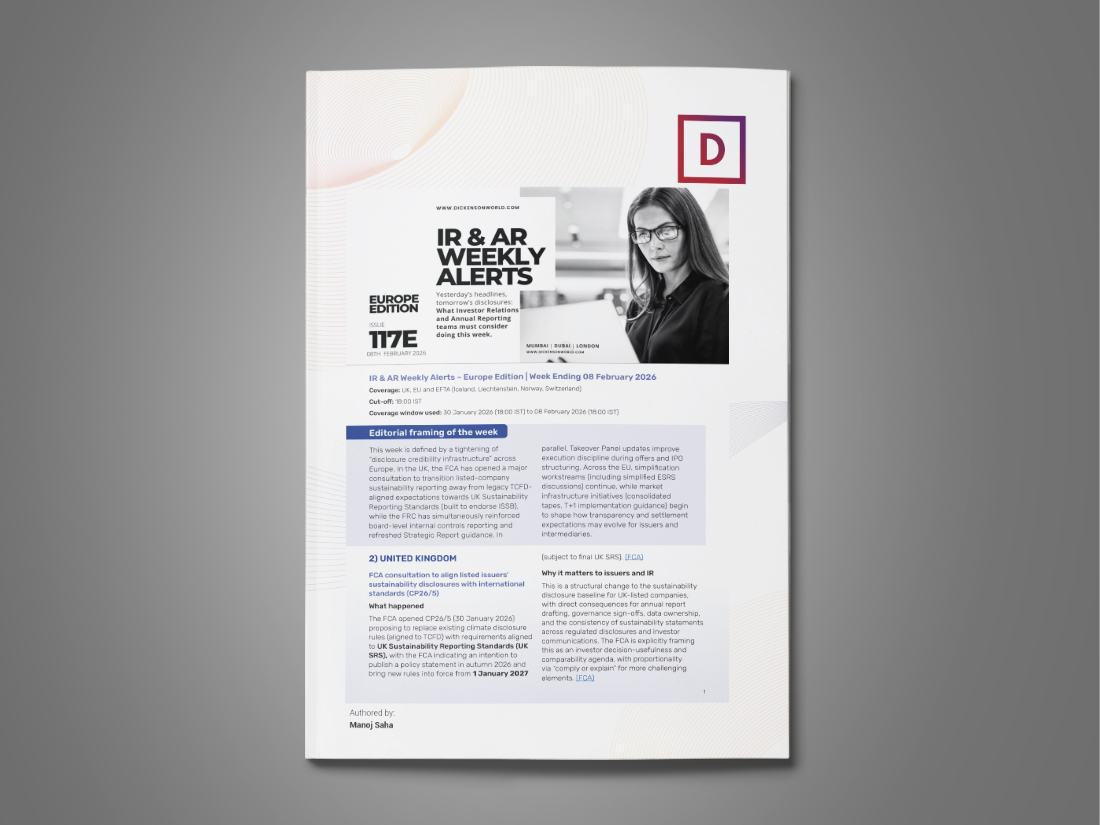
IR & AR WEEKLY ALERTS
To download and save this article.
Contact Us: To learn more or schedule a consultation, please reach out to us at www.dickensonworld.com
Email:enquiry@dickensonworld.com.
Leave A Comment