

IR & AR WEEKLY ALERTS — ISSUE 116A (Asia and MENA Edition)
Week Ending: 30 January 2026 (18:00 Asia/Kolkata)
Coverage: India, Singapore and MENA (UAE, Saudi Arabia, Qatar; secondary scan Bahrain, Oman, Kuwait)
A. INDIA
1. SEBI released “Investor Survey 2025” report and data (disclosure strategy input)
What happened
SEBI published the “Investor Survey 2025” main report and supporting data as part of its reports and statistics releases. (Securities and Exchange Board of India)
Why it matters to issuers and IR
Even where no rule change is introduced, SEBI-origin investor research can affect how intermediaries, analysts, and boards interpret “retail behaviour”, engagement channels, and disclosure comprehension. For IR teams, this is best treated as a regulator-published evidence base to stress-test messaging clarity, AGM participation levers, and digital communication choices. (Securities and Exchange Board of India)
Action for CFO/Company Secretary/IR
-
Assign IR and Company Secretariat to extract 5 to 10 survey insights that directly relate to your shareholder base and communication channels. (Securities and Exchange Board of India)
-
Map these insights to your FY2026 narrative priorities (results scripts, investor deck language, AGM Q&A preparedness). (Securities and Exchange Board of India)
-
Where gaps are identified, update your disclosure controls checklist for “plain-English interpretation risks” in periodic communications. (Securities and Exchange Board of India)
Source link(s): SEBI reports and statistics listing (Investor Survey 2025 entry). (Securities and Exchange Board of India)
2. SEBI Bulletin, January 2026: Annexure Tables published
What happened
SEBI published the January 2026 SEBI Bulletin annexure tables as part of its monthly bulletin series. (Securities and Exchange Board of India)
Why it matters to issuers and IR
The bulletin annexures provide regulator-published tabulations that can support issuer benchmarking (primary market activity context, market participation indicators, and other capital-market reference points). This can be useful for “market context” paragraphs in shareholder communications, investor decks, and board updates, provided you maintain strict attribution and do not over-infer causality. (Securities and Exchange Board of India)
Action for CFO/Company Secretary/IR
-
Maintain a standard “market context source pack” for disclosures and decks, and include the SEBI bulletin tables as one of the approved references. (Securities and Exchange Board of India)
-
Ensure any extracted indicators are used with correct period labels and exact SEBI wording for definitions. (Securities and Exchange Board of India)
Source link(s): SEBI Bulletin page (January 2026, annexure tables link). (Securities and Exchange Board of India)

B. SINGAPORE
1. SGX RegCo consults on changes in minimum board lot sizes and related stock market structure parameters
What happened
SGX RegCo issued a consultation paper on stock market structure, including proposed changes relating to minimum board lot sizes and associated market microstructure settings, with comments requested by 13 February 2026. (SGX Links)
Why it matters to issuers and IR
Board lot conventions can influence retail trading accessibility, odd-lot liquidity, and the practical experience of shareholders (particularly smaller holdings). Market-structure changes can also affect how issuers interpret trading patterns around announcements and corporate actions. For issuer servicing, the downstream impact can extend to investor education, shareholder communications during corporate actions, and expectation-setting with retail-heavy registers. (SGX Links)
Action for CFO/Company Secretary/IR
-
Ask your broker and registrar to outline potential shareholder experience impacts if minimum board lot sizes change (retail trading friction, odd-lot handling). (SGX Links)
-
If you have a retail-heavy register, prepare a short “investor education” explainer template that can be deployed if/when the proposals are adopted. (SGX Links)
-
Consider submitting issuer feedback if your investor base is sensitive to lot-size frictions or if corporate action execution could be affected. (SGX Links)
Source link(s): SGX consultation paper (links.sgx.com PDF) and SGX announcement landing page. (SGX Links)
2. SGX RegCo consults on enabling omnibus broker custody account options (custody model evolution)
What happened
SGX RegCo announced a consultation on enabling broker custody account options, described publicly as allowing broader use of omnibus-style broker custody arrangements and related custody account flexibility, with consultation running to 27 March 2026 (as reported by multiple market outlets). (The Edge Singapore)
Why it matters to issuers and IR
Custody model changes can affect shareholder servicing flows, beneficial ownership visibility, and the operational pathways for corporate action elections and communications. Even where legal ownership remains properly recorded, the practical distribution chain for notices and instructions can shift. Issuers with meaningful retail participation should be alert to how custody models influence meeting participation, dividend instructions, and communication reach. (The Edge Singapore)
Action for CFO/Company Secretary/IR
-
Seek an operational impact note from your share registrar on how omnibus custody models may affect corporate actions, AGM voting workflows, and notice delivery. (The Edge Singapore)
-
Refresh your shareholder communication controls to ensure key notices and corporate action timelines remain robust across intermediated holding structures. (The Edge Singapore)
-
If you rely on shareholder identification programmes, assess whether changes could reduce transparency and plan mitigants (targeted investor outreach, enhanced register analytics). (The Edge Singapore)
Source link(s): Market reporting summarising SGX RegCo consultation and timeline. (The Edge Singapore)

C. UAE (Federal and financial centres)
1. DFSA warns market participants about a fake notice impersonating DFSA and its CEO
What happened
DFSA issued an alert about a fake notice impersonating the DFSA and its CEO, warning stakeholders against fraudulent communications. (DFSA)
Why it matters to issuers and IR
Impersonation risk is a disclosure-control and reputational-risk issue, particularly for issuers using press releases, investor emails, and multi-channel dissemination. For listed issuers, the “authentication chain” of market-facing communications is now a governance control, not merely an IT concern. This is particularly important around results, corporate actions, fund-raising, and AGM notices, where spoofed communications can trigger investor harm and market confusion. (DFSA)
Action for CFO/Company Secretary/IR
-
Implement a public-facing verification protocol: a single authoritative page (or process) where investors can validate announcements and official sender domains. (DFSA)
-
Tighten controls on PDF signing, sender domain governance (SPF, DKIM, DMARC), and press-release distribution approvals. (DFSA)
-
Add an “anti-spoofing” line in sensitive investor communications, pointing stakeholders to official channels for validation. (DFSA)
Source link(s): DFSA alert (official DFSA website). (DFSA)
2. ADGM Registration Authority issued a discussion paper on proposed guidance on crypto mining activities
What happened
ADGM Registration Authority published Discussion Paper No. 1 of 2026 proposing guidance on crypto mining activities and invited stakeholder responses. (ADGM)
Why it matters to issuers and IR
For listed groups with digital assets exposure, data-centre strategies, or energy-intensity narratives, regulatory guidance on crypto mining can affect risk factor drafting, sustainability claims, and governance disclosures. It can also influence how boards articulate exposure boundaries and controls in annual reporting, especially where business lines or affiliates explore digital-asset-adjacent activities. (ADGM)
Action for CFO/Company Secretary/IR
-
Identify whether any group entity, JV, or supplier relationship touches crypto mining activities (directly or via hosting). (ADGM)
-
Ensure your risk disclosures and ESG narrative correctly reflect energy use, compliance posture, and governance oversight for any digital-asset-related activities. (ADGM)
-
If relevant, consider submitting comments to ADGM to ensure practical guidance for corporate and group structures. (ADGM)
Source link(s): ADGM announcement (official ADGM site). (ADGM)
3. UAE capital markets overhaul: issuer implications clarified through practitioner guidance (new federal decree-law framework)
What happened
Practitioner guidance published in this period summarised the new UAE capital markets decree-law framework (Federal Decree-Law No. 32 of 2025 on the Capital Market Authority and Federal Decree-Law No. 33 of 2025 on regulation of the capital market), referencing the official UAE legislation announcement. (Cleary Gottlieb)
Why it matters to issuers and IR
A new capital markets framework can alter supervisory expectations, rule-making pathways, enforcement posture, and the interpretive context for market conduct and disclosure controls. Even where implementing regulations follow later, issuers should treat “new framework in force” as a trigger to refresh disclosure governance and compliance mapping, especially if raising capital, pursuing cross-border offerings, or operating in/through UAE financial centres. (Cleary Gottlieb)
Action for CFO/Company Secretary/IR
-
Commission a targeted gap scan mapping your disclosure controls and market conduct policies to the new framework and expected implementing regulations. (Cleary Gottlieb)
-
Ensure board and audit committee are briefed on practical implications for disclosure governance, investor communications controls, and enforcement risk. (Cleary Gottlieb)
-
Where you have multi-jurisdiction listings or offerings, update the “jurisdictional compliance matrix” used for announcements and offering materials. (Cleary Gottlieb)
Source link(s): UAE legislation announcement and practitioner memo summarising the new laws. (Cleary Gottlieb)
D. Saudi Arabia
1. CMA issued “Controls on the Ownership of Real Estate” by listed companies, investment funds, and SPEs (including Makkah and Madinah conditions)
What happened
CMA published controls (Board Resolution (1-8-2026), dated 21 January 2026) governing real estate ownership in the Kingdom by listed companies, investment funds and special purpose entities, including specific conditions for property within Makkah and Madinah.
Why it matters to issuers and IR
The controls directly intersect with foreign ownership constraints and strategic investor limitations, shaping how listed entities and structures can hold or use real estate assets, particularly in sensitive geographies. This affects risk factor drafting, asset strategy disclosures, and corporate structuring for issuers with real estate holdings or fund-linked structures. It also matters for capital allocation narratives and investor Q&A around property strategy and foreign investor exposure.
Action for CFO/Company Secretary/IR
-
For any KSA-listed entity with real estate exposure, confirm whether holdings include Makkah/Madinah and assess compliance with the stated use and ownership conditions.
-
Review foreign ownership disclosures (including strategic investor holdings) for alignment with the conditions referenced in the controls.
-
Update board-level risk notes and investor FAQs for property strategy and foreign ownership constraints.
Source link(s): CMA controls document (official CMA PDF) and CMA regulation details page.
2. CMA circular on swap-agreement related depository accounts and transition under amended foreign investment framework
What happened
CMA issued a circular addressing accounts at the Securities Depository Center (Edaa) linked to swap agreement arrangements and transition steps under the amended foreign investment framework, including timeline-based operational requirements. (Capital Market Authority)
Why it matters to issuers and IR
Foreign investor access architecture affects shareholder base composition, liquidity profile, and the interpretive context for foreign ownership disclosures and investor targeting. Operational transition periods can also create temporary settlement or account-classification frictions, which may show up in trading behaviour around material announcements. For issuers courting foreign capital, understanding the mechanics helps set realistic expectations for investor onboarding and participation. (Capital Market Authority)
Action for CFO/Company Secretary/IR
-
Obtain an updated note from your lead broker on foreign investor onboarding and account reclassification timelines, and incorporate it into IR targeting plans. (Capital Market Authority)
-
Update internal Q&A for analysts on foreign ownership dynamics if the shareholder base is expected to evolve during the transition window. (Capital Market Authority)
-
Monitor liquidity and foreign investor flows around key announcements during transition periods, and be prepared to explain transient effects. (Capital Market Authority)
Source link(s): CMA circular PDF. (Capital Market Authority)
E. QATAR
No issuer-material primary-source updates were identified in this period from QFMA or QSE that would materially alter continuing obligations, periodic reporting, ESG reporting, or disclosure controls. (Continue monitoring official channels for circulars and issuer guidance.)


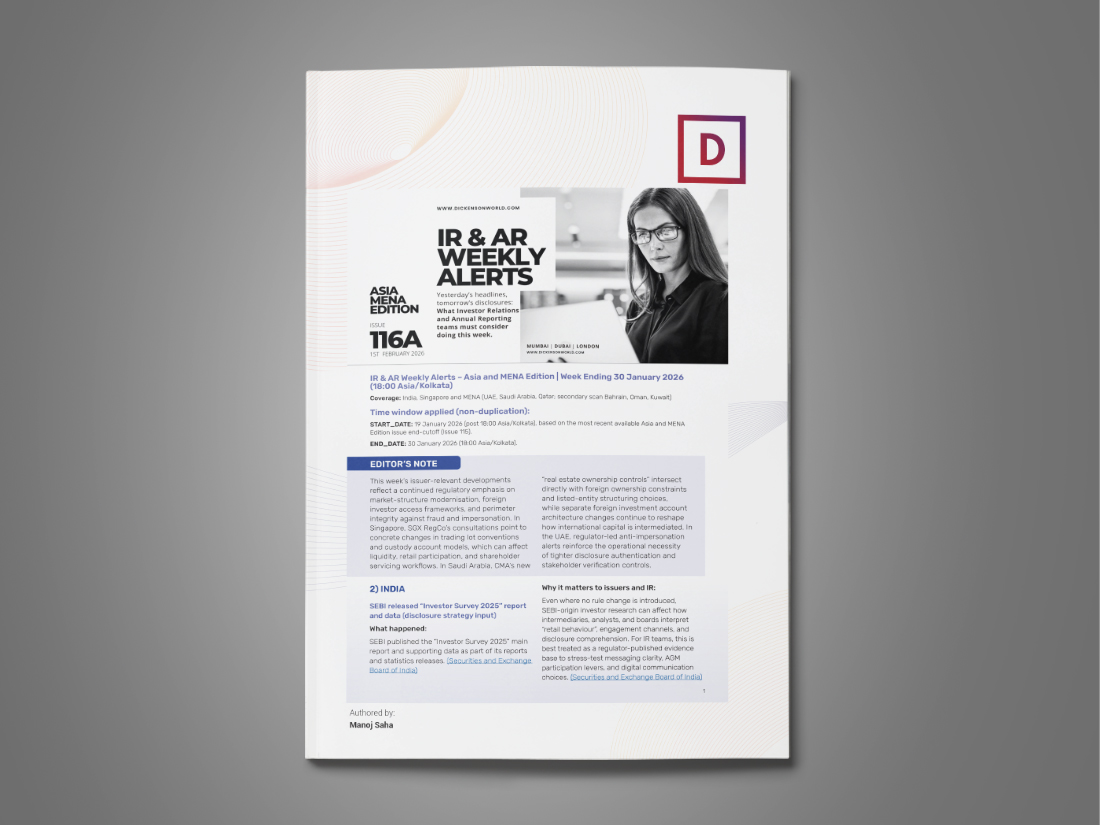
IR & AR WEEKLY ALERTS
To download and save this article.
Contact Us: To learn more or schedule a consultation, please reach out to us at www.dickensonworld.com
Email:enquiry@dickensonworld.com.
Leave A Comment