

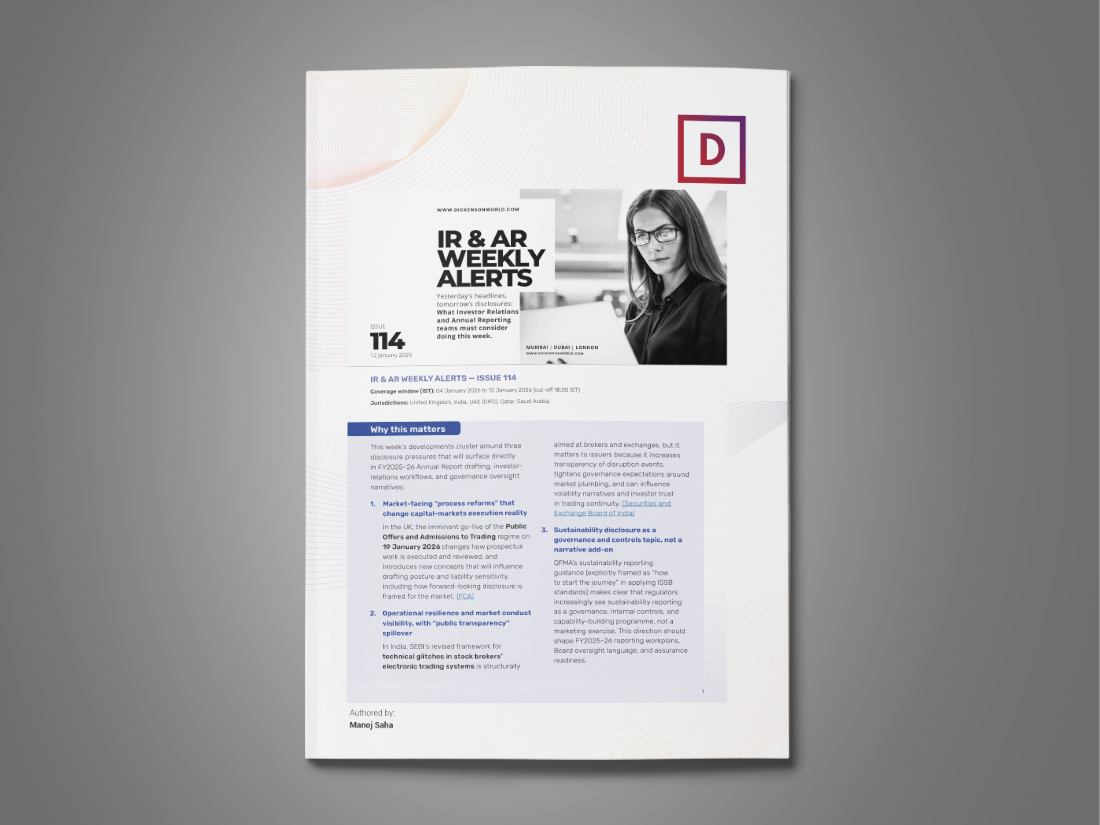
IR & AR WEEKLY ALERTS — ISSUE 114
Coverage window (IST): 04 January 2026 to 12 January 2026 (cut-off 18:00 IST)
Jurisdictions: United Kingdom, India, UAE (DIFC), Qatar, Saudi Arabia

A. United Kingdom — POATRs go-live and prospectus workflow implications (19 January 2026)
1. 19 January 2026 regime change for public offers and admissions to trading
What has happened
The FCA has confirmed that the UK’s new regime for public offerings and admissions to trading will fully come into force on 19 January 2026, alongside the FCA’s new PRM sourcebook and updated forms and cross-reference materials. (FCA)
Why this matters
This is not a technical compliance change only. It changes the operational pathway for prospectus submissions and approvals and, therefore, the timing risk, sign-off discipline, and drafting posture that issuers and sponsors follow. It also creates a near-term transition period where deals and disclosures may need to be structured around which regime applies. (FCA)
Practical IR & AR actions
-
Create a short internal “capital actions calendar note” flagging 19 January 2026 as a process inflection point for any offer/admission. (FCA)
-
Ask your sponsor/legal counsel for a one-page explainer: “What changes for us under PRM on 19 January 2026?” and retain it for Audit Committee and Board packs when approving future capital-market actions. (FCA)
-
Ensure your governance narrative and risk disclosures remain consistent with the new environment, particularly around market execution, disclosure controls and sign-off discipline. (FCA)
2. Forward-looking disclosure discipline and “protected forward-looking statements” concept under PRM
What has happened
PRM includes a framework for protected forward-looking statements (PRM 8), indicating a formalised approach to how certain forward-looking disclosure may be treated when conditions are met. (handbook.fca.org.uk)
Why this matters
Even if an issuer does not immediately adopt a “protected FLS” drafting approach, the presence of a formal framework will affect sponsor/legal review behaviour and the market’s expectations of disclosure controls and evidencing. This can influence how guidance, outlook and scenario language is drafted across prospectus-style documents and market announcements. (handbook.fca.org.uk)
Practical IR & AR actions
-
Refresh your internal sign-off checklist for any forward-looking guidance to ensure assumptions, governance approvals, and documentation are clearly recorded. (handbook.fca.org.uk)
-
In the Annual Report, ensure outlook language is consistent across Chair/CEO/CFO messaging, strategic report and risk sections (avoid internal contradictions that become visible under heightened scrutiny). (FCA)

B. India — Trading-system resilience transparency, accredited investor process, and fund reporting discipline
1. SEBI revised framework on technical glitches in stock brokers’ electronic trading systems
What has happened
SEBI issued a circular reviewing the framework for “technical glitches” in stock brokers’ electronic trading systems (Circular No. HO/38/44/12(1)2026-MIRSD-TPD1, dated 09 January 2026). (Securities and Exchange Board of India)
Key elements evidenced in the circular include:
-
A re-designed framework anchored on ease of compliance, exemptions, simplified reporting, rationalised technology requirements, and rationalised disincentives.
-
Reporting and governance steps including movement toward a single reporting platform (common reporting), and structured requirements such as incident reporting timelines and root cause analysis reporting.
-
Requirements for exchanges to issue further guidelines and to disseminate instances of glitches on their websites. (caalley.com)
Why this matters (for issuers, not just intermediaries)
-
Greater transparency around incidents can become a visible contributor to market confidence and trading continuity during results and high-volume corporate actions.
-
A more formalised incident trail can affect how investors interpret unusual price action, liquidity gaps, and execution outcomes, which in turn impacts issuer IR handling of volatility questions.
Practical IR & AR actions
-
Ask your primary brokers for a short operational note: (a) what events qualify, (b) what gets reported publicly by exchanges, and (c) how escalation works when disruptions occur during results windows.
-
Update your IR “market disruption response” script for earnings day: who monitors trading continuity, what is escalated to the exchange, and how investor queries are handled.
-
Consider whether your Annual Report risk narrative sufficiently covers “market infrastructure dependency” and “trading continuity” in a balanced manner, particularly if your stock has a high retail footprint.
2. SEBI simplification of requirements for grant of accreditation to investors (AIF context)
What has happened
SEBI issued a circular on Simplification of requirements for grant of accreditation to investors (Circular No. HO/19/34/11(9)2025-AFD-POD1/I/2286/2026, dated 09 January 2026). (Securities and Exchange Board of India)
The circular evidences two practical simplifications that matter for fundraising workflows:
-
Pre-certificate operational readiness: Pending receipt of the formal certificate, the investment manager may execute the contribution agreement and initiate operational procedures, but commitments cannot be counted in scheme corpus and funds can be received only after the certificate is obtained.
-
Net worth documentation simplification: The requirement for a detailed break-up of net worth as an annexure is removed, and it is clarified that it is optional for the chartered accountant to specify the actual net worth while certifying threshold compliance.
Why this matters
Issuers tapping AIF capital, and IR teams marketing placements to sophisticated pools, often face onboarding friction driven by documentation and timing. The changes reduce administrative load without diluting the principle that funds should flow only after accreditation certification is complete.
Practical IR & AR actions
-
If you are running a private market outreach, update your investor onboarding checklist to reflect what can be progressed pre-certificate versus what must wait for certification.
-
If you maintain an investor FAQ for private placements or sophisticated investor programmes, align language to these procedural realities to reduce last-minute friction.
3. SEBI compliance reporting formats for Specialized Investment Funds (SIFs)
What has happened
SEBI issued a circular on Compliance Reporting Formats for Specialized Investment Funds (SIFs) (Circular No. HO/24/13/12(4)2025-IMD-POD-1/I/2062/2026, dated 08 January 2026). (Securities and Exchange Board of India)
The circular text, as reproduced in public regulatory summaries, indicates that reporting requirements applicable to mutual funds also apply to SIFs, and that the Compliance Test Report format is modified to include an additional part for SIF compliance reporting. (TaxGuru)
Why this matters (issuer lens)
A more standardised reporting environment for SIFs increases institutional comfort and comparability, which can influence demand patterns for issuers in certain sectors (especially where specialised strategies become relevant). (TaxGuru)
Practical IR & AR actions
-
Track whether your shareholding or trading patterns reflect increased participation from specialised strategies, and align your shareholder engagement messaging accordingly. (TaxGuru)
4. SEBI extends timeline for additional distributor incentives (B-30 and women investors)
What has happened
SEBI extended the implementation timeline for the additional incentives structure for distributors onboarding new individual investors from B-30 cities and women investors. The public text indicates the effective date shift from 01 February 2026 to 01 March 2026 while other provisions remain unchanged. (Securities and Exchange Board of India)
Why this matters
This is primarily a mutual-fund distribution ecosystem measure, but it affects the pace of new investor mobilisation, which can influence retail participation flows and, in some cases, market sentiment around equity inflows. (TaxGuru)
Practical IR & AR actions
-
Treat this as a “flow timing” monitor rather than a direct issuer compliance item, but keep it on the IR radar if your investor base is retail-flow sensitive. (TaxGuru)

C. UAE (DIFC) — DFSA crypto token regime update and compliance readiness
1. DFSA Crypto Token Regime Update (effective 12 January 2026)
What has happened
The DFSA issued a Crypto Token Regime Update noting enhancements to be implemented on 12 January 2026. (DFSA)
Why this matters
For DIFC-regulated entities and groups with digital-asset touchpoints (treasury experimentation, tokenised products, fintech partnerships), regulatory refinements can translate into disclosure and risk-control adjustments that should be reflected consistently in governance reporting and risk narratives. (DFSA)
Practical IR & AR actions
-
Confirm whether any DIFC-regulated subsidiary disclosures, risk statements, or policy summaries in the Annual Report need to be refreshed to align with the updated DFSA regime. (DFSA)
-
Ensure your governance documentation clearly evidences oversight over any token-related initiative, even if immaterial financially, as investor scrutiny often targets control maturity rather than size. (DFSA)

D. Qatar — QFMA guidance on corporate sustainability reporting for Main Market listed companies (ISSB pathway)
1. QFMA publishes ISSB-oriented sustainability reporting guidance for listed companies
What has happened
QFMA published “Guidance on Corporate Sustainability Reporting for Companies Listed on the Main Market”, framed explicitly as “How to start the journey in applying the ISSB Standards”.
The guidance’s structure makes the regulator’s emphasis clear:
-
Establish governance arrangements and internal controls for high-quality sustainability reporting, including gap analysis, business integration, and assigning responsibilities.
-
Ensure disclosure strategy and practices align to the standards across governance, strategy, risk management, and metrics and targets.
-
Put in place processes that support preparation of disclosures required by the standards, including identification of sustainability-related risks and opportunities.
Why this matters
This is an explicit shift from “ESG content” to “reporting system”. It raises expectations that Boards can evidence who owns sustainability reporting, how controls operate, and how sustainability-related risks and opportunities are integrated into core strategy and risk frameworks.
Practical IR & AR actions
-
Run a formal ISSB readiness diagnostic using the guidance’s chapter logic: governance controls, disclosure architecture, preparation processes.
-
Document ownership: which functions own data, which committee challenges, and which Board forum approves sustainability disclosures.
-
Align your Annual Report workplan so sustainability disclosures are not built at the end of the cycle; the guidance implies an integrated, controls-led workflow.
E. Saudi Arabia — Opening of the Nomu Parallel Market to all categories of foreign investors
1. CMA moves to open Nomu to all categories of foreign investors (effective 01 February 2026)
What has happened
Saudi Arabia’s Capital Market Authority announced that it will allow all categories of foreign investors to invest directly in the Nomu Parallel Market, effective 01 February 2026. The CMA notes the historical pathway from restricted access to gradual liberalisation and states the reform supports market development and liquidity. (Capital Market Authority)
Why this matters
-
Expect a broader investor mix and potentially higher trading sensitivity to disclosure quality, English-language availability, and governance credibility.
-
Boards and IR teams should anticipate more sophisticated diligence expectations, including around risk governance, related-party discipline, and forward-looking execution credibility. (Capital Market Authority)
Practical IR & AR actions
-
Ensure your investor materials and Annual Report sections that signal governance quality (Board oversight, controls, risk management) are “export-ready” for foreign institutional review. (Capital Market Authority)
-
Prepare an IR “Nomu foreign access” briefing note for leadership: likely investor questions, disclosure pressure points, and which metrics will be scrutinised first. (Capital Market Authority)
Triage grid


IR & AR WEEKLY ALERTS
To download and save this article.
Contact Us: To learn more or schedule a consultation, please reach out to us at www.dickensonworld.com
Email:enquiry@dickensonworld.com.
Leave A Comment