

IR & AR WEEKLY ALERTS — ISSUE 113
Coverage window: 28 December 2025 – 03 January 2026
Jurisdictions: United Kingdom, India, UAE (DIFC), Qatar, Saudi Arabia
A. India – SEBI: consequential requirements for amended Merchant Bankers Regulations
What has happened
SEBI issued a circular on 02 January 2026 specifying consequential requirements linked to amendments in the SEBI (Merchant Bankers) Regulations, 1992. Independent reporting indicates the circular operationalises phased compliance timelines for revised minimum net worth and liquid net worth expectations for existing merchant bankers.
Why this matters for IR and Annual Reporting
Issuers’ ability to execute IPOs, rights issues, QIPs and other capital-market transactions depends on the regulatory status and financial resilience of lead managers and advisors. As SEBI tightens intermediary fitness and liquidity requirements, issuers should expect more stringent documentation, eligibility confirmations and ongoing compliance attestations during live transactions. This also strengthens the case for clearer Board-level narratives on selection and oversight of capital-market counterparties.
Practical IR & AR actions
-
For any live or planned fund-raise, obtain a dated, written confirmation from the lead merchant banker covering its category under the new regime and its compliance pathway for minimum net worth and liquidity expectations, along with a named point of contact for compliance escalations.
-
Update mandate letters and RFP templates to require ongoing compliance confirmations at agreed milestones (for example, filing, pre-issue, allotment).
-
In the Annual Report, consider adding a short governance note on how Treasury and IR oversee material capital-market transactions, including the selection and monitoring of intermediaries.

B. India – IBBI: formats for beneficial ownership statement and section 32A affidavit in resolution plans
What has happened
On 29 December 2025, the Insolvency and Bankruptcy Board of India issued a circular specifying formats for (i) a statement of beneficial ownership and (ii) an affidavit on eligibility or ineligibility to claim benefit under section 32A, to be included in resolution plans under Regulation 38(3A) of the CIRP Regulations.
Why this matters for IR and Annual Reporting
This strengthens transparency on who ultimately owns or controls a prospective resolution applicant and ties that disclosure to the resolution-plan record submitted to the Committee of Creditors and the adjudicating authority. For listed companies, this affects acquisition diligence for stressed assets, the quality of disclosures around related-party and control considerations in such acquisitions, and risk and contingent-liability narratives where group entities are in or near IBC processes.
Practical IR & AR actions
-
If you participate in stressed-asset acquisitions, update your diligence checklist to compile beneficial ownership evidence and to align internal approvals to the prescribed formats.
-
Ensure Legal and Finance teams maintain an IBC case tracker that captures these documentation requirements so Board updates and investor responses remain consistent and evidence-based.
-
In MD&A, when discussing recoveries or stressed-asset strategies, emphasise process discipline and compliance transparency alongside financial outcomes.

C. India – IBBI: liquidation forms filing on the IBBI electronic platform
What has happened
On 02 January 2026, IBBI notified amendments to the Liquidation Process Regulations requiring liquidators to file prescribed forms and their enclosures on the Board’s electronic platform as per timelines stipulated for each form.
Why this matters for IR and Annual Reporting
A stronger electronic filing regime increases the availability, standardisation and timeliness of insolvency-process data. For issuers with exposure to liquidation processes, this can influence monitoring practices, evidence trails for recoverability assessments, and the robustness of disclosures around litigation, recoveries and expected timelines.
Practical IR & AR actions
-
Where material, add IBC monitoring to your internal-controls narrative, specifying which team tracks filings and how exceptions are escalated.
-
For issuers with meaningful receivables or investments tied to insolvency proceedings, ensure impairment and ECL narratives reference the process stage and evidence available, not only management expectations.

D. Saudi Arabia – CMA: IPO approvals, consultation on real-estate ownership controls, and capital structure actions
What has happened
Between 29 and 31 December 2025, the Saudi Capital Market Authority published multiple announcements including approvals of proposed IPOs, approval of a draft set of controls for real-estate ownership by listed companies, investment funds and special purpose entities for public consultation, approvals relating to debt-instrument programmes, and approvals for capital increases through debt conversion. The CMA also published enforcement-related outcomes in the same period.
Why this matters for IR and Annual Reporting
For issuers, these announcements provide both a pipeline signal and a governance direction signal. IPO approvals can shift sector comparables and investor attention. Consultation on real-estate ownership controls can affect structuring, disclosure language on asset ownership and SPV governance, and risk-factor wording for groups with property-heavy strategies. Capital structure approvals reinforce the need for clear disclosure on rationale, stakeholder impacts and regulatory steps.
Practical IR & AR actions
-
If you operate in sectors adjacent to newly approved IPO candidates, update peer benchmarking and your IR narrative to reflect valuation and capital-market sentiment shifts.
-
For groups that hold real estate via complex structures, prepare an internal map of ownership vehicles and controls so you are ready to respond to the consultation direction and to explain governance clearly in annual reporting.
-
When executing debt conversions or capital increases, expand your disclosure checklist to include regulator-approval references, rationale for structure choice and stakeholder impacts.

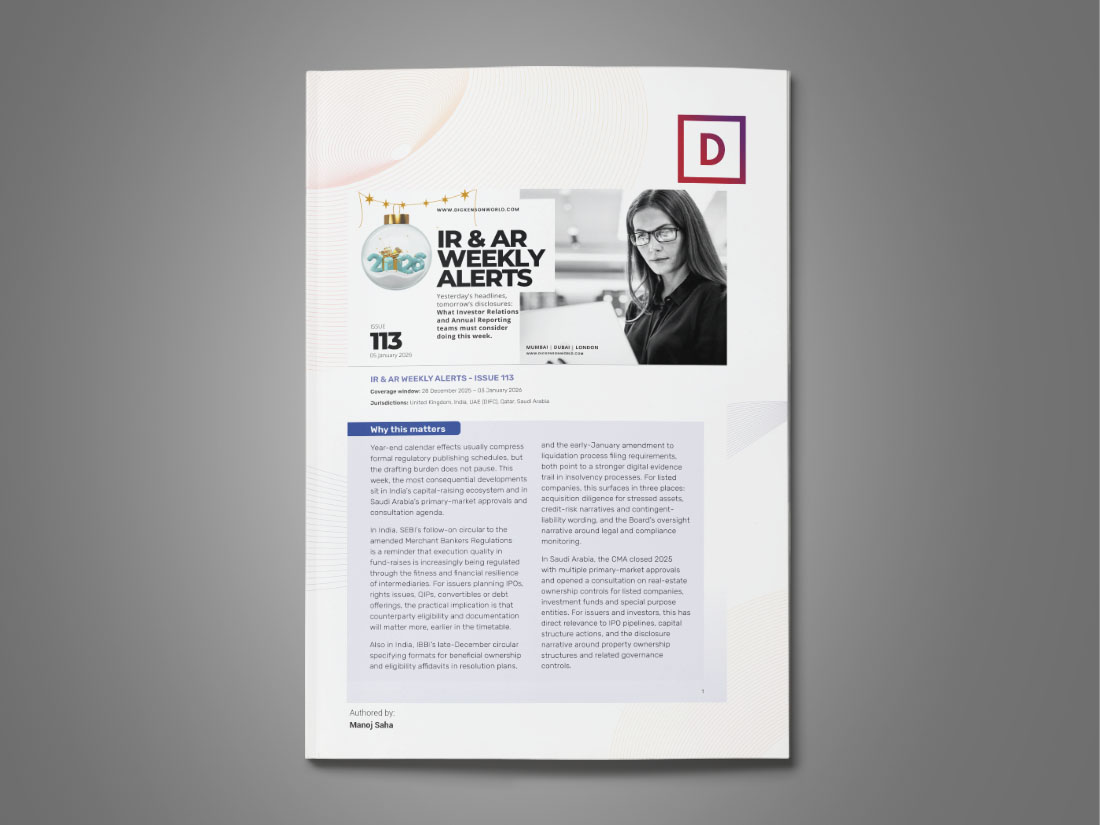
IR & AR WEEKLY ALERTS
To download and save this article.
Contact Us: To learn more or schedule a consultation, please reach out to us at www.dickensonworld.com
Email:enquiry@dickensonworld.com.
Leave A Comment