

IR & AR WEEKLY ALERTS — ISSUE 111
Coverage window: 14 December 2025 to 21 December 2025 (run-time cut-off: 18:00 IST), India Standard Time.
Jurisdictions: United Kingdom, India, United Arab Emirates (Dubai and DIFC), Qatar, Saudi Arabia.
A. United Kingdom
Headlines
-
FCA updates PRM forms and checklists ahead of the 19 January 2026 cutover to the new public offers and admissions regime (PRM and POATR). Effective date: 19 January 2026.
-
FCA Primary Market Bulletin 58 reiterates the additional submission form requirement (1 December 2025 to 16 January 2026) and confirms Listings review turnaround suspension from 22 December 2025 to 2 January 2026 (inclusive).
-
FCA Handbook Notice 136 (December 2025) finalises amendments in the ESG sourcebook, including deletion of ESG 5.4.8R and related consequential changes.
What changes for issuers
UK issuers and advisers face a near-term operational risk: prospectus submissions and listing documentation need to match the new PRM cross-reference checklists and accompanying short-form submission during the transition window, with realistic timelines around the FCA’s holiday pause and pre-cutover congestion. Issuers with group entities in scope of FCA sustainability disclosure requirements should also note that Handbook Notice 136 finalises technical amendments within the ESG sourcebook, which may alter how reporting periods and related references are handled in sustainability reporting workflows.
IR actions this week
-
Confirm whether any equity or debt issuance, further issue, or prospectus refresh is planned before 19 January 2026 and reconcile transaction timelines with the FCA’s stated holiday processing pause.
-
Update internal issuance checklists to incorporate the FCA’s PRM cross-reference lists and ensure advisers submit the additional short form during the 1 December 2025 to 16 January 2026 transition period.
-
Where the group has UK regulated entities, ask the sustainability reporting owner to assess whether ESG-sourcebook cross-references in governance narratives or policies need adjustment following Handbook Notice 136.
-
Add a short cutover risk note to the Board treasury calendar for January 2026, covering submission lead times, documentation formats, and contingency for approval scheduling.
What to change in drafts already in circulation
-
Governance Report: Insert or update a paragraph describing oversight of capital-markets transactions, explicitly referencing controls around external adviser selection, document review sign-offs, and timetable governance in light of the January 2026 cutover.
-
Risk Factors and Liquidity: If the group relies on UK issuance flexibility, add an execution risk line reflecting regulatory process cutovers and seasonal processing pauses as potential timing constraints.
-
Offer Document readiness pack: Refresh issuer-side checklists so that the PRM cross-reference checklists are the default for documents intended for approval on or after 19 January 2026.
Sources (UK)

B. India
Headlines
-
SEBI notifies the Securities and Exchange Board of India (Registrars to an Issue and Share Transfer Agents) Regulations, 2025. Date: 16 December 2025.
-
SEBI notifies the Securities and Exchange Board of India (Listing Obligations and Disclosure Requirements) (Sixth Amendment) Regulations, 2025. Date: 16 December 2025.
-
SEBI issues debt-market circulars on periodic disclosure requirements for securitised debt instruments and on conditions for reduction in denomination of debt securities and non-convertible redeemable preference shares. Dates: 16 December 2025 and 18 December 2025.
What changes for issuers
SEBI’s December 2025 changes should be treated as an issuer governance matter, not merely an intermediary update. The combination of a refreshed RTA regulatory framework and LODR terminology updates increases the expectation that issuers can evidence robust share registry controls, investor grievance handling workflows, and the quality of registrar oversight within governance and stakeholder engagement narratives. The contemporaneous debt-market circulars signal continued tightening of disclosure discipline in listed fixed income and securitised instruments. For issuers with any listed debt or structured instruments, treasury disclosure calendars and internal data owners should be re-validated against these circulars.
IR actions this week
-
Ask the Company Secretary and RTA relationship owner to map any immediate contract, SLA, and oversight implications of the new RTA regulations and reflect any changes in governance documentation.
-
Update the Annual Report ‘Share Capital’, ‘Investor Services’, and ‘Stakeholder Relationship’ narratives to use the updated terminology and to describe RTA oversight as a control framework (roles, monitoring, escalation, audit).
-
For issuers with listed debt, confirm with treasury and debenture trustee teams whether the new SEBI circulars trigger changes to the periodic disclosure timetable or data templates.
-
Review investor grievance disclosures and website investor helpdesk content for consistency with strengthened registrar and debt-market discipline.
What to change in drafts already in circulation
-
Corporate Governance Report: Strengthen the ‘stakeholder relationships’ and ‘investor servicing’ sub-section by describing registrar oversight, investor grievance ageing controls, and Board-level monitoring.
-
MD&A and Liquidity: If the issuer has listed debt, insert a brief disclosure-management paragraph explaining how periodic debt disclosures are governed and quality-checked.
-
Notes to Accounts and Share Capital: Ensure consistent terminology for registrar references and cross-references to investor grievance mechanisms.
Sources (India)

C. United Arab Emirates (Dubai and DIFC)
Headlines
-
DFSA issues a Notice of Amendments to Legislation (December 2025), confirming rule-making instruments following consultation papers and setting effective dates of 12 January 2026 and 1 July 2026 for different packages.
-
UAE Sustainable Finance Working Group publishes its fourth statement during Abu Dhabi Finance Week 2025, highlighting progress on governance, sustainability disclosures, taxonomy design, and climate transition planning principles. Date: 19 December 2025 (statement issued 18 December 2025).
What changes for issuers
In DIFC, the DFSA notice converts consultation outputs into concrete rule-making instruments with staged effective dates, which matters for DIFC-incorporated issuers and regulated group entities planning compliance and disclosure updates. Separately, the UAE Sustainable Finance Working Group’s fourth statement signals that sustainable finance has entered an execution phase. The statement explicitly anchors disclosure principles to ISSB alignment and emphasises Board and senior management accountability for transition planning. For issuers raising capital in UAE markets or positioning as transition-aligned, this increases investor expectations for consistent sustainability governance, metrics readiness, and credible transition narrative.
IR actions this week
-
If the group has DIFC entities, request a concise memo from compliance on which DFSA rule-making instruments apply and what needs to be updated ahead of 12 January 2026.
-
Align sustainability reporting owners on whether the UAE transition planning principles create new investor expectations for transition plans, scenario analysis, and governance disclosures in FY2025–26 reports.
-
Update investor presentation sustainability slides to clearly distinguish targets, strategy, governance, and data readiness, with a focus on credible transition pathways.
-
Add a cross-functional ‘UAE sustainability disclosure readiness’ checkpoint to the reporting calendar for Q4 FY2025–26.
What to change in drafts already in circulation
-
Sustainability and Governance sections: Add or refine a transition planning paragraph that states governance ownership, scenario analysis approach, and how transition actions are monitored.
-
Risk section: Consider adding a climate transition execution risk line describing dependencies on data quality, supply chain, and financing conditions, with Board oversight.
-
Digital finance disclosures (where relevant): If the issuer references tokenisation or digital assets, ensure disclosures are framed with controls, risk management, and regulatory boundary clarity.
Sources (UAE and DIFC)

D. Qatar
Headlines
-
QFMA publishes guidance on applying IFRS Sustainability Disclosure Standards (ISSB-aligned sustainability reporting guidance for reporting entities).
What changes for issuers
QFMA’s sustainability guidance is a signal that ISSB-aligned disclosure expectations are being operationalised for reporting entities. For issuers with Qatar exposure, cross-listings, financing, or investor targeting in the region, this is a prompt to ensure the group’s sustainability disclosures are internally consistent across markets and that governance and data-control narratives can support ISSB-aligned metrics and transition disclosures.
IR actions this week
-
Inventory where IFRS S1 and IFRS S2 information is already produced internally and identify gaps in governance, scenario analysis, and metrics traceability.
-
Ensure the Annual Report sustainability narrative, risk disclosures, and any standalone ESG report use consistent definitions and boundaries across jurisdictions.
-
Prepare an investor Q&A note on transition plans and climate metrics, anticipating ISSB-aligned questions.
Sources (Qatar)
E. Saudi Arabia
Headlines
-
CMA announces permission of a FinTech experiment to test robo-advisory services (Siolla Digital Financial Technology). Date: 18 December 2025.
What changes for issuers
The CMA’s continued approvals for FinTech experimentation, including robo-advisory, are relevant for issuers because they change the distribution and behaviour of the retail investor base. Over time, algorithmic advice can influence trading patterns, risk appetites, and the speed of sentiment changes. Issuers should treat this as a shareholder-base evolution factor when drafting market risk language, liquidity narratives, and retail investor communications.
IR actions this week
-
Add a ‘retail distribution and digital advice channels’ note to the IR stakeholder map for Saudi investors.
-
Ensure earnings communication materials have clear, plain-language explanations of key drivers and risks, anticipating digital re-packaging by robo-advisory channels.
-
Review risk disclosures for market volatility and retail sentiment drivers in any Saudi-facing offering or investor deck.
Sources (Saudi Arabia)

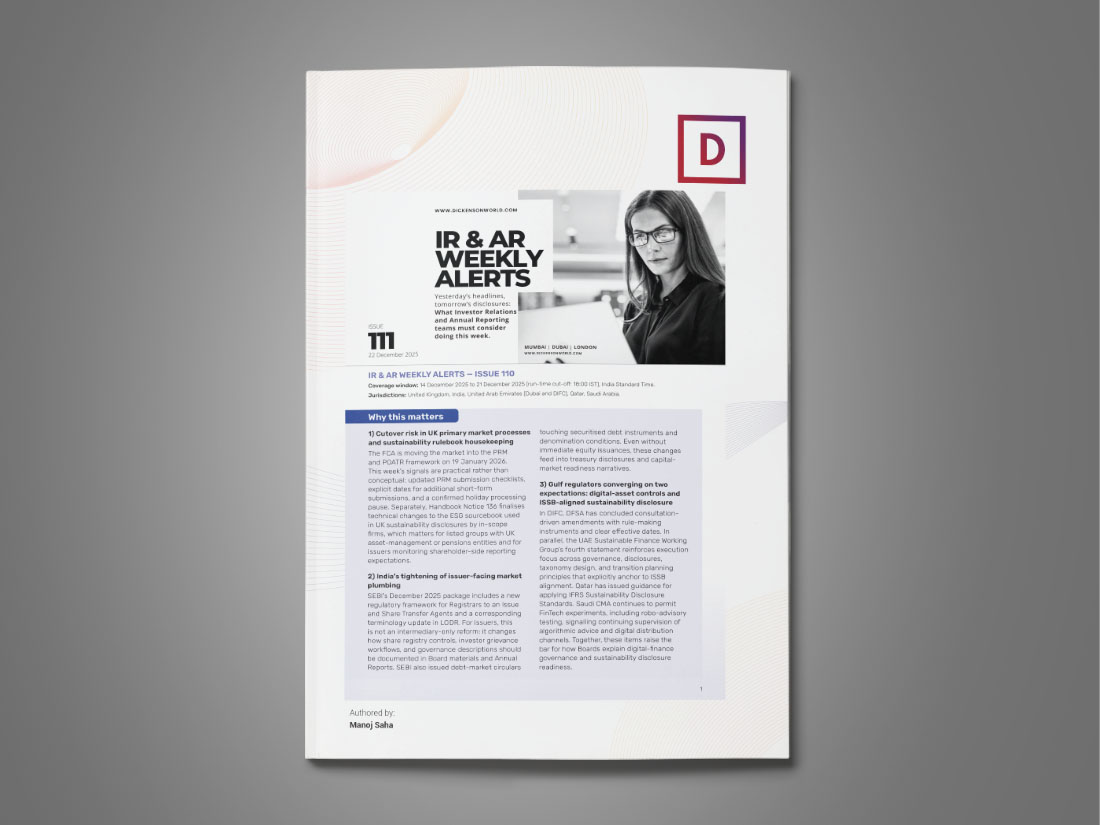
IR & AR WEEKLY ALERTS
To download and save this article.
Contact Us: To learn more or schedule a consultation, please reach out to us at www.dickensonworld.com
Email:enquiry@dickensonworld.com.
Leave A Comment