

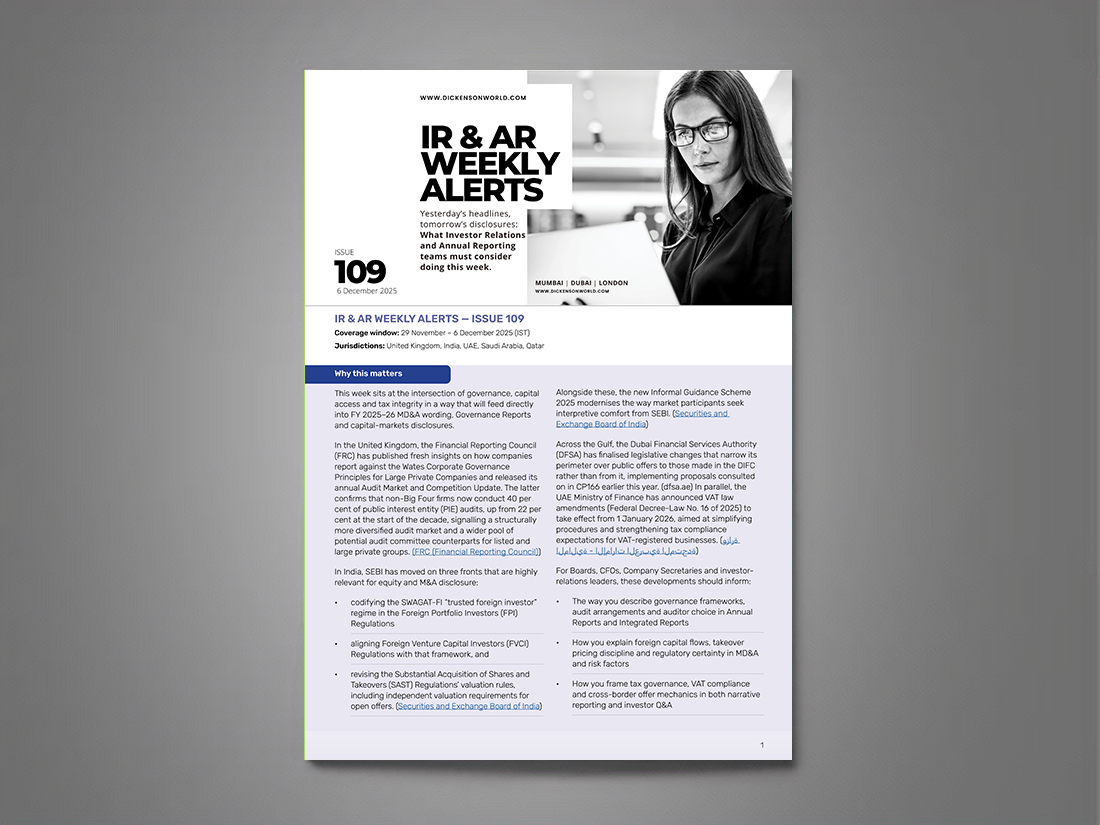
IR & AR WEEKLY ALERTS — ISSUE 109
Coverage window: 29 November – 6 December 2025 (IST)
Jurisdictions: United Kingdom, India, UAE, Saudi Arabia, Qatar
At-a-glance IR & AR actions for the next fortnight
UK-listed / London-traded groups and UK-anchored private groups
-
Ask the audit committee chair and CFO to review the FRC’s Audit Market and Competition Update and consider whether your narrative on auditor appointments and tendering reflects a market where non-Big Four firms now hold 40 per cent of PIE audit engagements. (FRC (Financial Reporting Council))
-
For large UK private subsidiaries or holding companies reporting under the Wates Principles, benchmark your governance report against the FRC’s new reporting insights and examples, especially on purpose, board composition and remuneration. (FRC (Financial Reporting Council))
-
Ensure your “External audit” and “Corporate governance framework” sections explain clearly why your chosen auditor (Big Four or challenger) is appropriate, in light of these market developments.
Indian issuers and promoter groups
-
For companies with significant FPI holdings or that court foreign institutional investors, request a short note from legal counsel or your custodian summarising the SWAGAT-FI framework and how it may affect your foreign ownership profile over the next 12–24 months. (Securities and Exchange Board of India)
-
For companies that are plausible takeover targets or active acquirers, ask merchant bankers to map the new SAST valuation provisions and independent valuer expectations into your Board’s M&A playbook and disclosure templates. (TeamLease RegTech)
-
For SEBI-registered entities within your group, ensure the compliance team understands the new Informal Guidance Scheme 2025 and identifies any “grey-area” positions where a future no-action or interpretive letter might be warranted. (Securities and Exchange Board of India)
UAE / DIFC financials, holding companies and issuers targeting GCC investors
-
If you use DIFC entities as holding or issuing vehicles, ask counsel to explain how the DFSA’s decision to drop offers from the DIFC from its perimeter may affect future capital-raising structures and prospectus responsibilities. (dfsa.ae)
-
For VAT-registered businesses in the UAE, instruct tax and finance teams to map the VAT law amendments effective 1 January 2026 to your internal controls, invoicing processes and tax-governance disclosures. (وزارة المالية – الإمارات العربية المتحدة)
Qatar / Saudi Arabia-facing issuers
-
For Qatar- or Saudi-exposed groups, continue tracking the strong IPO and sukuk activity across the region and consider whether your MD&A should more explicitly link your capital-markets strategy to regional liquidity and listing options. (mosanada.qa)
-
Groups with DIFC or UAE operating hubs should integrate DFSA and UAE VAT changes into their broader GCC regulatory map used for Board briefings and risk dashboards. (dfsa.ae)
A. United Kingdom – Governance reporting and a more diversified audit market
1. FRC insights on Wates Principles reporting
What has happened
The FRC has published its first reporting insights on how companies are applying and explaining the Wates Corporate Governance Principles for Large Private Companies since it assumed oversight of the framework earlier this year. (FRC (Financial Reporting Council)) The review highlights:
-
generally strong reporting on risk management and stakeholder engagement
-
weaker, more variable disclosures on purpose, board composition and remuneration
-
examples of positive disclosures drawn from companies of different sizes and complexity, and
-
guidance encouraging clearer, outcome-focused, cross-referenced reporting rather than repetitive boilerplate. (FRC (Financial Reporting Council))
The FRC also released an explainer on the “Apply and Explain” approach used in the Wates Principles and how it differs from the UK Corporate Governance Code framework for listed companies. (FRC (Financial Reporting Council))
Why this matters
The Wates Principles formally apply to large UK private companies, but many listed groups have significant private subsidiaries that report under the Companies (Miscellaneous Reporting) Regulations. For such groups:
-
Governance reporting at subsidiary level increasingly influences credit assessments, ESG ratings and lender perceptions
-
Investors are scrutinising group-wide governance, not only the plc-level disclosures
The FRC’s review signals that regulators and stakeholders expect more than formal compliance:
-
A clear articulation of corporate purpose and how it informs strategy and oversight
-
Transparent board-composition narratives, including skills, diversity and succession planning
-
Remuneration disclosures that explain alignment with long-term value creation, even in private entities where pay ratios and votes are not mandatory. (FRC (Financial Reporting Council))
For groups with both listed and large private entities, inconsistent quality between Corporate Governance Code reporting at the top and Wates-based reporting lower in the structure may attract attention from investors, proxy advisers and lenders.
Practical IR & AR actions
-
Map your group’s footprint of Wates-reporting entities and benchmark their latest governance statements against the FRC’s examples, especially on purpose, composition and remuneration. (FRC (Financial Reporting Council))
-
Where a large subsidiary is strategic to the group story (for instance a major UK operating company), consider summarising its key Wates-aligned governance practices in the main Annual Report, or at least cross-referencing clearly to subsidiary reporting.
-
Ask your governance and legal teams whether the “Apply and Explain” narrative discipline from Wates can enhance explanations in your main Corporate Governance Report and s.172 / stakeholder sections, rather than relying on checklists.
2. Audit Market and Competition Update – non-Big Four at 40 per cent of PIE audits
What has happened
The FRC’s annual Audit Market and Competition Update shows that non-Big Four firms now conduct 40 per cent of public interest entity (PIE) audit engagements, compared with 22 per cent at the start of the decade. (FRC (Financial Reporting Council))
The report attributes this change to a combination of:
-
regulatory initiatives to support challenger firms (for example the System of Quality Management Scalebox Programme)
-
efforts to improve access to audit services for SMEs
-
a broader strategy to promote proportionate, growth-supportive regulation. (FRC (Financial Reporting Council))
Why this matters
For listed issuers and large private groups, this development has three concrete implications:
-
Auditor choice and narrative:
With challenger firms playing a larger role in the PIE segment, audit committees will increasingly be asked why they have selected a Big Four firm or a challenger, and how that choice aligns with audit quality, resilience and cost considerations. -
Tendering and rotation:
Regulatory and investor expectations around auditor rotation and tendering are now framed against a market where credible alternatives exist beyond the Big Four. An Annual Report that simply states historic reliance on a major firm, without explaining periodic re-tendering or consideration of challengers, may appear out of step with the FRC’s competition objectives. (FRC (Financial Reporting Council)) -
Risk disclosures:
Risk factors around “audit quality”, “financial reporting misstatement” and “third-party resilience” should reflect the reality that both global networks and challenger firms are subject to evolving FRC supervision and market dynamics, including quality reviews and capacity-building programmes.
Practical IR & AR actions
-
In the Corporate Governance Report, ensure the audit committee section explicitly addresses how the committee considered auditor choice, including whether challenger firms were evaluated and how the final decision supports audit quality and resilience.
-
Where your group uses different audit firms across subsidiaries (including challenger PIE auditors), consider adding a short “audit firm landscape” overview, highlighting how the group manages consistency, quality and independence.
-
In MD&A and risk sections, check that references to “our external auditor” reflect the possibility of change over the medium term and acknowledge the regulatory emphasis on competition and proportionality. (FRC (Financial Reporting Council))

B. India – Foreign capital access and takeover valuations under SWAGAT-FI and revised SAST rules
1. SWAGAT-FI and trusted foreign investors in the FPI and FVCI regimes
What has happened
SEBI has notified amendments to the Foreign Portfolio Investors Regulations introducing the concept of Single Window Automatic and Generalised Access for Trusted Foreign Investors (SWAGAT-FI). (Securities and Exchange Board of India) Broadly:
-
SWAGAT-FI is a streamlined channel for “trusted” long-term foreign investors, such as sovereign wealth funds, central banks, multilateral institutions, regulated public retail funds, insurance companies and pension funds
-
The regime aims to reduce duplicative KYC and registration steps across FPI and Foreign Venture Capital Investor (FVCI) categories
-
The Foreign Venture Capital Investors (Amendment) Regulations 2025 now reference SWAGAT-FI, aligning FVCI rules with the trusted-investor concept defined in the FPI Regulations. (Securities and Exchange Board of India)
Commentaries indicate that these trusted investors already account for a large majority of FPI assets under management, so the regime is designed more to rationalise and clarify entry / monitoring than to shift the investor mix overnight. (The Times of India)
Why this matters
Although SWAGAT-FI is an intermediaries-facing framework, its implications for issuers are tangible:
-
Foreign ownership and flows:
A smoother onboarding and monitoring regime for large, low-risk foreign institutions should support continued participation in Indian equity and debt markets, including as anchor investors in public offerings and block trades. -
Transparency expectations:
The “trusted” designation does not relax disclosure obligations for issuers; if anything, it underscores that high-quality, predictable reporting is part of the ecosystem that attracts such investors. -
Narrative around foreign capital:
In MD&A and shareholder-information sections, issuers often discuss the role of foreign institutions in their shareholder base. References to SWAGAT-FI, where relevant, can demonstrate awareness of the evolving regulatory architecture and its link to stable capital.
Practical IR & AR actions
-
Work with your registrars, custodians and investor-relations advisers to understand whether key shareholders qualify, or may in future qualify, under SWAGAT-FI and how that might affect your foreign shareholding profile.
-
For companies preparing equity or debt raises, invite your bookrunners to brief the Board on whether SWAGAT-FI is expected to facilitate participation by certain sovereign, pension or public funds.
-
Where you have a substantial long-only foreign institutional base, consider including a short paragraph in MD&A or shareholder-information explaining how regulatory initiatives such as SWAGAT-FI support India’s attractiveness for long-term foreign capital, while emphasising your own disclosure discipline. (Securities and Exchange Board of India)
2. SAST (Amendment) Regulations 2025 – independent valuation in takeovers and open offers
What has happened
SEBI has notified the Securities and Exchange Board of India (Substantial Acquisition of Shares and Takeovers) (Amendment) Regulations, 2025, which adjust the valuation framework for open offers and certain acquisitions. (TeamLease RegTech) Among other changes, commentaries highlight:
-
a requirement for at least two independent valuers in specified valuation scenarios relating to open offers
-
defined timelines within which such valuations must be completed
-
an explicit power for SEBI to require an independent valuation at the acquirer’s cost
-
transitional provisions allowing valuation assignments already underway before the amendments take effect to be completed within set time limits. (TeamLease RegTech)
The amendments come into force 30 days after publication in the Official Gazette. (TaxTMI)
Why this matters
For listed companies that may be acquisition targets or that regularly execute inorganic transactions:
-
Board duties and pricing discipline:
Independent valuations are central to how Boards discharge their fiduciary duties in M&A. Codified expectations around the number of valuers and timelines elevate the evidentiary standard for Board deliberations and for disclosures in letters of offer and public announcements. -
Dispute risk:
A more structured valuation framework may reduce disputes over pricing, but it also means that any deviation from process or disclosure gaps will be judged against clearer regulatory benchmarks. -
Disclosure language:
Offer documents, MD&A sections discussing completed acquisitions and risk factors around “M&A execution” should reflect the heightened expectation that independent valuations will be obtained and summarised transparently.
Practical IR & AR actions
-
Ask your legal and investment-banking advisers to summarise the new SAST valuation requirements for the Board and update your internal M&A and takeover response playbooks accordingly. (TeamLease RegTech)
-
Ensure that future letters of offer, public announcements and shareholder communications around open offers contain clear, non-technical explanations of the valuation basis and the role of independent valuers.
-
In the Annual Report, consider tightening the language in sections dealing with “Business combinations”, “Related-party transactions” and “Critical accounting estimates” to show how independent valuations are used to support fair value assessments and shareholder protection.
3. SEBI Informal Guidance Scheme 2025 – modernised route to regulatory clarity
What has happened
SEBI has introduced the Securities and Exchange Board of India (Informal Guidance) Scheme, 2025, replacing the 2003 scheme with effect from 1 December 2025. (Securities and Exchange Board of India)
Key features include:
-
broadened eligibility, allowing not just listed companies but also stock exchanges, clearing corporations, depositories and managers of pooled investment vehicles to seek informal guidance
-
a more standardised, centralised application process and updated fee structure
-
codified confidentiality provisions and clarified treatment of prior guidance
-
continued availability of both interpretive letters and no-action letters. (Economic Laws Practice)
Why this matters
While in practice most applications will be channelled through legal advisers, the scheme underpins regulatory certainty in several areas that are highly relevant for IR and reporting:
-
complex group reorganisations and restructuring
-
novel instruments or offer structures under the ICDR, LODR, SAST or other regulations
-
questions around continuous disclosure obligations in unusual fact patterns.
A clearer informal guidance framework supports better-grounded disclosure judgements and reduces the risk of divergent practice on issues important to investors.
Practical IR & AR actions
-
Ask your Company Secretary and lead securities counsel to map areas in your current disclosure and capital-markets practices that rely on grey interpretive positions; consider whether any warrant an informal guidance application under the new scheme.
-
For material transactions or restructuring that you expect to repeat (for example in a multi-year capital-recycling plan), explore whether a one-time interpretive or no-action letter could provide a clearer foundation for consistent disclosures across years.
-
In the Corporate Governance Report or MD&A, you may, where relevant, reference that certain practices are “consistent with informal guidance obtained from SEBI” (without disclosing confidential details), signalling proactive engagement with the regulator. (Securities and Exchange Board of India)

C. UAE / DIFC – Cross-border offers and VAT amendments
1. DFSA legislative amendments implementing CP166 – offers “from” the DIFC
What has happened
Following Consultation Paper No. 166 on offers of securities to the public from the DIFC, the DFSA has now announced final legislative amendments: (dfsa.ae)
-
His Highness the Ruler of Dubai enacted the Markets Law Amendment Law, DIFC Law No. 3 of 2025 on 17 November 2025, to come into force on the 30th business day after enactment (31 December 2025). (dfsa.ae)
-
The DFSA Board has made accompanying rule-making instruments for the Markets Rules (MKT), General Module (GEN) and Islamic Finance Rules (IFR), also effective on that date. (dfsa.ae)
As consulted in CP166, the key policy change is that DFSA will no longer regulate offers of securities to the public “from” the DIFC (that is, where a DIFC issuer targets investors outside the DIFC). Instead, DFSA will focus on offers in the DIFC, aligning with international practice in Singapore, Hong Kong, the EU, UK and others.
Why this matters
For issuers and groups that use DIFC entities in their capital-raising structures:
-
Reduced duplication:
An offer from a DIFC company into another jurisdiction (for example London, Riyadh or Mumbai) will primarily be governed by the rules of the target market, without a parallel DFSA prospectus regime. This may simplify transaction planning and documentation. -
Reporting-entity status:
Under the old framework, certain offers “from” the DIFC could trigger DFSA “Reporting Entity” status, with ongoing governance and disclosure obligations. The amendments remove this trigger, concentrating reporting-entity obligations on offers in the DIFC. -
Continuing conduct standards:
The DFSA’s general prohibition on misleading, deceptive or fraudulent conduct continues to apply, so offering documents aimed at non-DIFC markets must still avoid misleading content and may need appropriate disclaimers regarding the DFSA’s non-involvement.
Practical IR & AR actions
-
If your group has, or is planning, structures where a DIFC holding company conducts equity or debt offerings abroad, ask counsel to revisit whether those offerings will still attract DFSA reporting-entity status after 31 December 2025.
-
For existing prospectuses or programme documentation that assume DFSA involvement for “from DIFC” offerings, plan updates to reflect the new perimeter and ensure disclaimers properly describe the regulatory position.
-
In risk and governance sections of your Annual Report, where you describe “Regulatory environment – DIFC / DFSA”, refine the narrative to differentiate clearly between obligations attached to DIFC-listed instruments and those attached to offshore listings by DIFC entities. (dfsa.ae)
2. UAE VAT amendments from 1 January 2026
What has happened
The UAE Ministry of Finance has announced Federal Decree-Law No. 16 of 2025, which amends several provisions of Federal Decree-Law No. 8 of 2017 on Value Added Tax. The amendments will come into effect on 1 January 2026. (وزارة المالية – الإمارات العربية المتحدة)
According to the MoF and secondary analyses, the changes aim to:
-
simplify and clarify certain VAT procedures
-
enhance administrative and regulatory efficiency
-
reinforce tax-compliance expectations for VAT-registered businesses. (وزارة المالية – الإمارات العربية المتحدة)
Details emerging from technical commentaries indicate that key areas likely include adjustments to:
-
conditions under which input VAT can be denied where a supply is linked to tax evasion or non-compliance by counterparties
-
procedural rules around corrections, voluntary disclosures and penalties
-
supporting provisions for the roll-out of e-invoicing and data-driven VAT oversight. (Global VAT Compliance)
Why this matters
For issuers and groups with UAE operations or listings:
-
Tax-governance narrative:
Investors are increasingly attentive to how companies manage tax risk and compliance. Amendments that tighten or clarify VAT rules should feed into the “Tax governance” or “Regulatory compliance” sections of your report, particularly if the UAE is a significant profit centre. -
Counterparty risk:
If the Federal Tax Authority has stronger tools to deny input VAT in cases involving non-compliant suppliers or avoidance schemes, your procurement and finance teams must demonstrate robust vetting and monitoring of counterparties. This is as much a governance and controls issue as a technical tax topic. -
Systems and data:
Where e-invoicing or enhanced electronic reporting is envisaged, system readiness, data integrity and reconciliations become Board-level concerns with operational and reputational implications.
Practical IR & AR actions
-
Commission a short internal briefing for the Audit Committee explaining how the UAE VAT law amendments apply to your business model, and any required changes in controls, processes or documentation. (وزارة المالية – الإمارات العربية المتحدة)
-
Ensure that disclosures in the notes to the financial statements and MD&A dealing with tax risks reflect the evolving VAT environment, particularly where VAT assessments or disputes could be material.
-
If the UAE is a key market, consider enhancing your “Responsible tax” or “Regulatory compliance” narrative to describe how you are preparing for the 1 January 2026 VAT changes and any related e-invoicing or digital reporting initiatives. (وزارة المالية – الإمارات العربية المتحدة)

D. Qatar and Saudi Arabia – continuing market depth backdrop
While there have been no major new listing-rules changes in Qatar or Saudi Arabia during this specific window comparable to the DFSA and SEBI moves above, the broader capital-markets context remains important for issuers considering regional strategies.
-
In Qatar, the Qatar Stock Exchange continues to support both corporate listings and sovereign / quasi-sovereign funding initiatives, including sukuk and bond programmes, reinforcing its role as a regional venue for debt and equity capital. (mosanada.qa)
-
In Saudi Arabia, recent coverage by regional financial press continues to underline the strength of the IPO pipeline on Tadawul and Nomu, with billions of dollars raised in 2025 and a healthy pipeline of prospective offerings, underscoring the depth of local capital available for growth-oriented companies. (Bloomberg)
For cross-listed issuers, or for Indian and UK groups exploring dual-listing or depository-receipt options, this environment frames conversations with Boards around jurisdiction choice, investor targeting and disclosure alignment.
Practical IR & AR actions
-
When discussing “Strategic priorities” and “Capital allocation” in MD&A, consider whether references to Middle East capital-markets access (including Tadawul, QSE, ADX, DFM and Nasdaq Dubai) are framed against up-to-date facts on market depth and regulatory expectations. (Bloomberg)
-
For Boards weighing regional fundraising, ensure they receive a concise comparison of governance, disclosure and tax regimes across their shortlisted venues, including DIFC / DFSA and UAE VAT developments alongside Qatari and Saudi regulatory frameworks. (dfsa.ae)

IR & AR WEEKLY ALERTS
To download and save this article.
Contact Us: To learn more or schedule a consultation, please reach out to us at www.dickensonworld.com
Email:enquiry@dickensonworld.com.
Leave A Comment