

From FX Swings to Sector Shocks:
Making FY26 Risk Disclosures More Market Specific
Making FY26 Risk Disclosures More Market Specific
1. Why FY26 risk language needs to move beyond boilerplate
Investors and regulators have become more sceptical of generic risk sections that could belong to almost any issuer. For FY26 reporting, the combination of volatile currencies, shifting interest rate expectations and uneven sector growth across India, the UK and the GCC makes it harder to justify “standard” wording on market, liquidity and sector risk.
Boards are asking management to demonstrate that risk disclosures genuinely reflect the entity’s balance sheet, cash flows and geographic footprint, and that they are aligned with the forward-looking orientation expected in MD&A and strategic reports. In India, SEBI’s Listing Obligations and Disclosure Requirements (LODR) explicitly require MD&A to address industry structure, risks and concerns, and internal control systems in a way that is linked to the company’s actual operations.^2(CAIRR) In the UK, the Financial Reporting Council (FRC) expects the strategic report to provide an integrated view of business model, strategy, risks and prospects, including principal risks and uncertainties that are specific to the company.^3(FRC (Financial Reporting Council)) Regulators in GCC financial centres such as the DIFC and UAE Central Bank have also sharpened expectations on market risk, interest rate risk and FX risk management disclosures for regulated entities.^4(dfsaen.thomsonreuters.com)
Against this backdrop, the most credible FY26 disclosures will be those that:
-
Anchor risk language in the macro and market realities of each geography.
-
Translate FX, rate and sector views into exposure based narratives rather than abstract statements.
-
Demonstrate that the Board has considered scenarios that are plausible for the next 12-24 months.
2. Macro backdrop for FY25-26: India, UK and GCC at different speeds
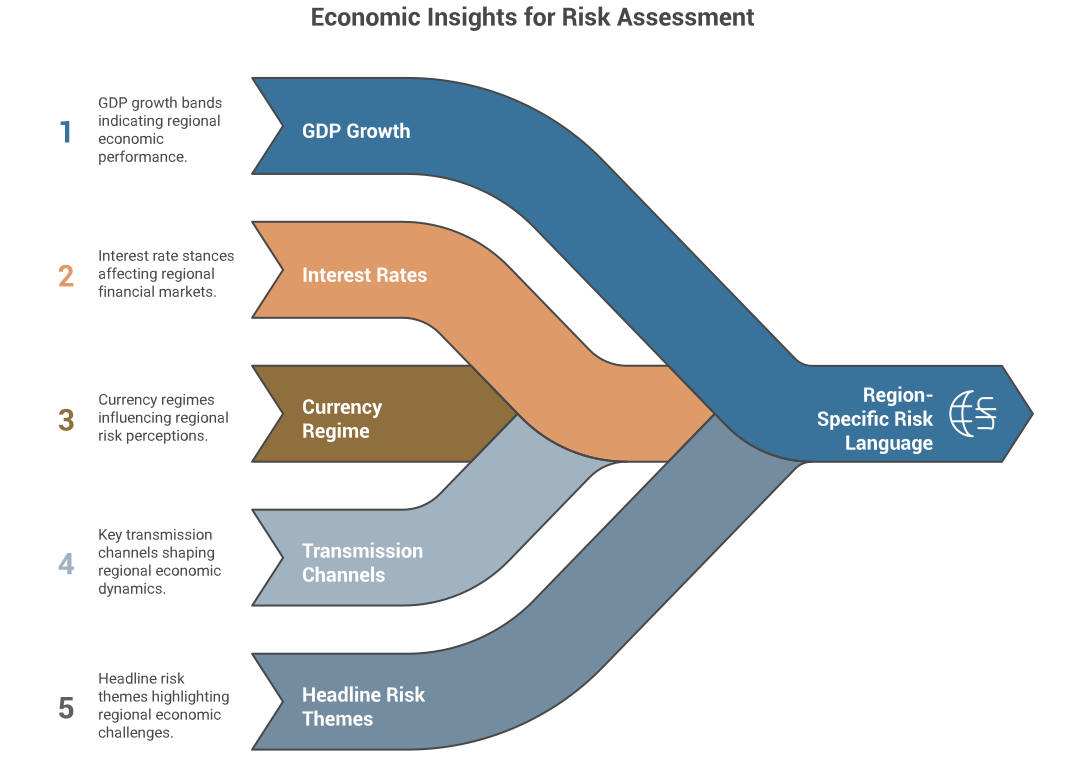
A first step is to acknowledge that India, the UK and GCC economies are not in the same place in the cycle. That has direct implications for how issuers talk about demand, funding and market risk.
“Greater market volatility and rising regulatory scrutiny are redefining risk reporting, requiring disclosures that reflect genuine exposures, credible scenarios and the differentiated realities of each operating geography.”
Table 1: Selected macro indicators for FY25-26
| Region | Indicator | 2025 projection | 2026 projection | Source |
|---|---|---|---|---|
| India | Real GDP growth (percent) | 6.6 | 6.2 | IMF country data and Indian government summary of external forecasts^1,5(IMF) |
| India | Consumer price inflation (percent, 2025) | 2.8 | n.a. | IMF country data^1(IMF) |
| United Kingdom | Real GDP growth (percent) | 1.3 | 1.3 | IMF forecast summarised by UK House of Commons Library^6(IMF) |
| GCC (aggregate) | Real GDP growth (percent) | 3.2 | 4.5 | World Bank GCC economic update; recent GCC outlook commentary^7,8(World Bank) |
Implications for MD&A and risk sections
-
-
India: A 6-7 percent growth environment with moderating inflation allows issuers to present strong demand prospects, but also requires realism about capacity planning, wage pressures, and potential policy responses if inflation resurges. Markets are already pricing India as a growth outlier, and sell-side research expects robust earnings growth into 2026-27.^9(Press Information Bureau)
-
United Kingdom: A roughly 1.3 percent growth trajectory suggests a low growth, disinflation context. This heightens investor focus on cost efficiency, pricing power, funding cost and FX pass-through in UK issuers’ risk narratives.^6(IMF)
-
GCC: Growth is expected to accelerate as OPEC+ production cuts are unwound and non-oil sectors benefit from large project pipelines, even though softer oil prices and wider fiscal deficits remain a risk.^7,8(World Bank) Issuers here need to connect project execution, oil price sensitivity and funding access more explicitly to their risk disclosures.
-
The FY26 MD&A should avoid “one size fits all” macro wording. Instead, it should present a short paragraph that locates the issuer in its main macro theatres, then ties that paragraph immediately to the risk factors that matter to funding, liquidity and sector performance.
3. FX risk: from generic wording to exposure-based narrative
The FX story is particularly instructive. India’s rupee, the UK’s sterling and GCC currencies face quite different regimes and pressures, yet risk disclosures often sound nearly identical.
3.1 What the FX data is telling investors
For India, the rupee has recently traded near record lows around 90 per US dollar, with one month realised volatility at a six month high.^10(Trading Economics) Forecasts diverge sharply. Some analytical houses expect the rupee to hover around 90-91 in 2025-26,^11,12(BookMyForex) while a recent report from Bank of America suggests a possible recovery to around 86 per dollar by end 2026.^13(mint)
Table 2: Illustrative USD/INR views for 2025-26
| Source | Time frame | Indicative level (INR per USD) | Comment |
|---|---|---|---|
| Spot (Trading Economics, 11 Dec 2025) | Current | 90.1 | Rupee near recent record lows^10(Trading Economics) |
| Short-term forecasts (BookMyForex) | Next 30-90 days | 88.6 – 89.9 | Suggests modest near-term range^11(BookMyForex) |
| BMI / Fitch Solutions | End 2025-26 | Near 90-90.5 | Assumes gradual depreciation with steady policy rate^12(The Economic Times) |
| Long-term technical forecast | March 2026 | Around 93 (range 91.9-94.7) | Illustrates upside risk to USD/INR^12(EFA Forecast) |
| Bank of America Global Research | End 2026 | 86 | Contrarian view of rupee recovery^13(mint) |
For an investor, the message is simple. There is no consensus path for USD/INR. Risk disclosures that state only that “the company is exposed to currency fluctuations” no longer provide insight.
In the UK, sterling is driven by a different set of forces: modest growth, the pace of Bank of England rate cuts and political developments. IMF projections of 1.3 percent growth and still elevated inflation underscore that sterling could be sensitive to each Monetary Policy Committee decision and any renewed political uncertainty.^6(IMF)
In the GCC, currencies such as the UAE dirham remain pegged to the US dollar, but that does not remove FX-related risk. Oil-linked fiscal dynamics, US rate decisions and the prevalence of foreign currency borrowing for project finance mean that cash flows can still be affected by the interaction of FX pegs, oil prices and global rates.^7,8,14(World Bank)
3.2 How to translate FX realities into MD&A and risk wording
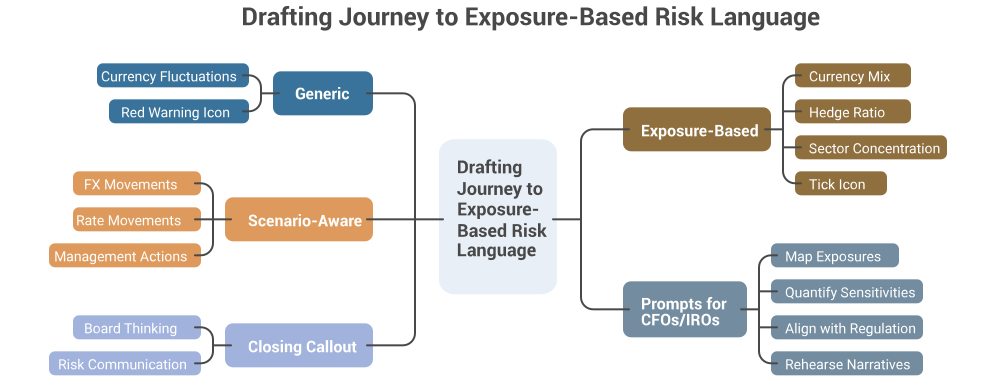
A more market-specific approach starts by mapping:
-
Revenue, cost and capex by currency.
-
Balance sheet items by currency (debt, lease liabilities, inter-company loans).
-
Natural hedges and derivative positions.
From there, FX risk language can move beyond boilerplate. Examples:
-
Indian IT exporter with USD revenues and INR cost base
-
MD&A: “Approximately 82 percent of the Group’s FY26 revenue is denominated in US dollars, while more than 70 percent of operating costs and domestic capital expenditure are in Indian rupees. A sustained move in USD/INR below 88, absent repricing of contracts, would compress operating margin on existing fixed-price engagements. The Group’s hedging policy seeks to cover 60-75 percent of the next 12 months’ net USD inflows through forward contracts, with residual exposure monitored through scenario analysis.”
-
Risk factor: “A sharp appreciation of the rupee against the US dollar could adversely affect our reported revenue growth and profitability, particularly if the move is not matched by a corresponding adjustment in billing rates or productivity.”
-
-
UK consumer business importing in USD and selling in GBP
-
MD&A: “Roughly 55 percent of our merchandise purchases are priced in US dollars. We manage the risk of sterling weakness through six to nine months of forward cover and through price architecture that allows calibrated pass-through of input cost increases. A 10 percent depreciation of sterling against the US dollar, after existing hedges, would reduce FY26 operating profit by approximately X million pounds if not offset through pricing and mix.”
-
-
GCC infrastructure issuer with USD and local-currency debt
-
MD&A: “The Group operates in currency regimes pegged to the US dollar and carries 71 percent of its borrowings in US dollars and 29 percent in local currencies. While peg stability limits translation risk, sudden changes in global dollar liquidity or US monetary policy can affect refinancing conditions, spreads and investor appetite for regional project bonds.”
-
This type of wording helps investors understand the actual transmission channels between FX moves and financial performance. It also shows that management has quantified exposures rather than relying on generic statements.
4. Sector shocks: reflecting how macro themes hit specific business models
FY26 risk narratives also need to better connect macro headlines with the reality of sector exposures. Examples across India, the UK and the GCC illustrate how this might work.
4.1 Indian cyclicals and exporters
With India projected to grow near 6.5 percent through 2026 and with strong equity market expectations for earnings growth,^1,5,9(IMF) risk language for Indian issuers should acknowledge two tensions:
-
Domestic cyclicals (cement, capital goods, building materials, discretionary consumption) face upside demand risk but also potential stress if interest rates, wage inflation or state capex slow.
-
Export-oriented sectors such as IT, pharma and auto components remain tied to global demand, FX movements and client spending cycles in the US and Europe.
Sector-specific wording could resemble:
-
“Our capital goods order book is linked to public and private capex cycles in India. A material reduction in central or state infrastructure spending, delays in project clearances, or tightening in domestic liquidity conditions could lead to lower order intake or slower execution.”
-
“A prolonged slowdown in global IT spending or pricing pressure from large clients in the US and Europe could affect revenue growth and margins in our technology services business.”
4.2 UK financials and real assets
In the UK, low growth combined with a changing rate environment raises distinctive issues for banks, insurers and real estate investment trusts (REITs):
-
Banks must communicate how shifts in the yield curve affect net interest margins, credit quality and funding costs.
-
REITs need to explain valuation risks from discount rate shifts and occupancy trends in office, retail or logistics segments.
Risk language should therefore spell out:
-
Sensitivity of loan books to sectors most exposed to cost of living pressures or higher for longer rates.
-
The impact of alternative valuation scenarios on loan-to-value covenants in real estate backed structures.
4.3 GCC project, energy and real estate exposures
GCC issuers often sit at the intersection of oil price cycles, large project pipelines and real estate development. World Bank and IMF analysis highlights the region’s dependence on non-oil diversification and project execution to achieve the projected 3-4.5 percent growth range in 2025-26.^7,8(World Bank)
Sector-specific risk discussions could include:
-
“Delays in government approvals or funding for planned infrastructure projects, or a sustained period of oil prices below our planning assumptions, may affect our contract pipeline and working capital.”
-
“A correction in regional real estate prices or oversupply in key sub-markets could reduce demand for our district cooling capacity and affect customer collections.”
The common thread is that sector shocks are framed in terms that match the issuer’s own revenue model, not only in generic references to “macroeconomic uncertainty”.
5. Building simple, credible scenarios into FY26 MD&A
Investors are rarely seeking complex stochastic modelling in public reports. They are looking for evidence that Boards have asked “what if” questions that are relevant to the next 12-24 months.
A practical approach is to disclose high-level scenarios that combine FX, rate and sector variables in a way that is meaningful for the business. The design can be as simple as a small table and some narrative.
Illustrative scenario framework for an India headquartered export-heavy issuer
| Scenario | Macro/market assumptions | Directional impact on FY26 | Narrative focus |
|---|---|---|---|
| Base case | India GDP ~6.5 percent; USD/INR 88-92; stable developed market growth | Revenue and margins broadly in line with FY26 plan | Explain how current hedging, pricing and capacity plans support this case. |
| FX stress | USD/INR appreciates to 84-86 by end 2026; client budgets unchanged | Margin pressure on USD revenues; translation impact on offshore debt | Describe contingency levers such as repricing, productivity and cost rebalancing.^13(mint) |
| Global slowdown | Developed market growth 0.5-1.0 percent below base; client budgets cut | Lower export revenue, slower order intake | Link to diversification of client base and cost flex. |
| Domestic funding squeeze | Local rates rise 50-100 bps relative to expectations; liquidity tightens | Higher interest cost, potential delay in capex | Discuss refinancing strategy, undrawn facilities and capex phasing. |
Similar matrices can be built for UK or GCC issuers, substituting relevant drivers such as sterling moves, Bank of England policy, oil prices or regional project approvals.
The narrative should clarify:
-
Which scenarios have been considered in the Board’s risk discussions.
-
Qualitative management actions identified for each scenario.
-
The level of confidence management has in maintaining going concern and viability assessments within these scenarios, consistent with regulatory requirements in each jurisdiction.^3,15(FRC (Financial Reporting Council))
6. Practical drafting checklist for FY26 MD&A and risk sections
To convert these concepts into actual text, CFOs, IROs and risk teams can work through a structured checklist. This can be adapted into an internal template or a designer-friendly page in the Annual Report.
Step 1: Map exposures
-
Currency composition of revenues, operating costs, capex and debt.
-
Geographic revenue and asset splits for India, UK, GCC and other regions.
-
Sectoral concentration across domestic cyclicals, exports, financials, real estate, infrastructure, energy and consumption.
Step 2: Align with regulatory expectations
-
For Indian issuers, cross-check MD&A against SEBI LODR Schedule V guidance on industry structure, opportunities, threats, segment performance, outlook and risk concerns.^2(CAIRR)
-
For UK issuers, ensure that the strategic report clearly sets out principal risks and uncertainties, cross-referenced to business model and strategy, in line with Companies Act and FRC guidance.^3(FRC (Financial Reporting Council))
-
For GCC financial or capital market entities, align risk wording on market, FX and interest rate risks with prudential guidance from regulators such as the DFSA or central banks.^4(dfsaen.thomsonreuters.com)
Step 3: Replace generic language with exposure-based statements
-
Rewrite FX risk to describe actual currency mixes, hedging policy and sensitivity.
-
Rewrite sector risk to show how specific demand or regulatory shifts in India, the UK or GCC would affect cash flows, asset values or covenants.
-
Distinguish clearly between short-term volatility risk and structural changes affecting the business model.
Step 4: Introduce a small number of quantified sensitivities
-
For example, impact on profit before tax of a 5 percent move in key currencies, based on current hedge ratios.
-
Effect on interest expense of a 100 basis point change in relevant benchmark rates, acknowledging any regulatory or internal guidance on interest rate risk in banking or non-trading books.^4(dfsaen.thomsonreuters.com)
-
Impact on fair values or loan-to-value ratios in real estate or infrastructure portfolios under alternative discount rate or occupancy assumptions.
Step 5: Incorporate scenarios into Board reporting and then into MD&A
-
Use the same scenarios in Board risk papers, internal capital planning and external reporting so that messages are consistent.
-
Summarise two or three scenarios in the MD&A, explaining management actions rather than treating scenarios as abstract exercises.
Step 6: Coordinate with investor communications
-
Ensure that earnings call scripts, investor presentations and rating agency materials use language that is consistent with MD&A and risk factors when discussing FX, rates and sector outlooks.
-
Use the Annual Report to set anchor language for FY26, then build quarterly commentary around that anchor rather than improvising on each call.
7. Conclusion: turning risk sections into a thought leadership asset
FY26 will test how well issuers can connect risk language to observable macro and market realities. For India, investors will compare management’s words on FX and sector prospects with actual rupee behaviour and with the country’s still strong growth profile. For UK and GCC issuers, the test will be whether disclosures adequately reflect low growth and rate uncertainty in the UK, and the combination of oil-linked risks and project-led growth in the GCC.
Boards that insist on market-specific, exposure-based narratives will not only meet regulatory expectations. They will also signal to investors that management understands its own risk drivers and has thought through plausible scenarios for the next two years. That turns MD&A and risk sections from compliance exercises into genuine evidence of stewardship.
“When risk narratives reflect actual FX trends, sector prospects and geography-specific uncertainties, disclosures evolve from obligatory statements into credible evidence of stewardship and scenario thinking.”
Footnotes:
-
International Monetary Fund, “India and the IMF – Country Data”, 2025 projections. Available at: https://www.imf.org/en/countries/ind
-
SEBI (Listing Obligations and Disclosure Requirements) Regulations, 2015, Schedule V and related guidance on Management Discussion and Analysis. Summary at: https://ca2013.com/lodr-schedule-v-2/ and https://ca2013.com/lodr-regulation-34/
-
UK Financial Reporting Council, “Guidance on the Strategic Report”, including requirements on principal risks and uncertainties. Overview at: https://www.frc.org.uk/ and specific guidance pages such as: https://www.frc.org.uk/library/standards-codes-policy/accounting-and-reporting/annual-corporate-reporting/guidance-on-the-strategic-report/
-
Dubai Financial Services Authority and regional prudential regulators, including DFSA Market Risk and Interest Rate Risk guidance. For example: https://dfsaen.thomsonreuters.com/rulebook/general-market-risk and https://dfsaen.thomsonreuters.com/entiresection/18039 and related market risk materials from GCC regulators such as the UAE Central Bank: https://rulebook.centralbank.ae/en/entiresection/2643
-
Press Information Bureau, Government of India, “8.2% GDP: India’s Growth Story Strengthens”, summarising IMF, World Bank, OECD and rating agency forecasts for 2025-26. Available at: https://www.pib.gov.in/PressReleasePage.aspx?PRID=2195990
-
International Monetary Fund and UK House of Commons Library, “United Kingdom and the IMF – Country Data” and “GDP international comparisons: Economic indicators”, including 2025-26 UK growth forecasts. Available at: https://www.imf.org/en/countries/gbr and https://commonslibrary.parliament.uk/research-briefings/sn02784/
-
World Bank, “The World Bank Group in the Gulf Cooperation Council (GCC) Countries – Economic Update” and related GCC growth outlooks. Available at: https://www.worldbank.org/en/region/mena/gcc
-
World Bank and IMF press releases on GCC growth, for example “GCC economies demonstrate resilience, advance diversification and accelerate digital transformation”, December 2025. Available at: https://www.worldbank.org/en/news/press-release/2025/12/04/gcc-economies-demonstrate-resilience-advance-diversification-and-accelerate-digital-transformation and regional commentary such as: https://www.arabnews.com/node/2625349/amp
-
Citi Research, equity strategy note as reported in Reuters, “Citi projects 10% rise in India’s Nifty by 2026-end on demand rebound”, 10 December 2025. Available at: https://www.reuters.com/world/india/citi-projects-10-rise-indias-nifty-by-2026-end-demand-rebound-2025-12-10/
-
Trading Economics, “Indian Rupee – Quote, Chart, Historical Data, News”, USD/INR level around 90 on 11 December 2025. Available at: https://tradingeconomics.com/india/currency and Reuters, “Rupee tiptoes higher, near-tenor volatility touches six-month peak”, 10 December 2025
-
BookMyForex, “USD to INR Forecast” short-term projections. Available at: https://www.bookmyforex.com/currency-converter/usd-to-inr/forecast/
-
BMI (Fitch Solutions) and long-range technical forecasts summarised in Economic Times and Longforecast, for example: https://m.economictimes.com/news/economy/policy/rbi-may-maintain-repo-rate-at-5-25-through-fy27-fitch/articleshow/125896864.cms and https://longforecast.com/usd-to-inr-forecast-2017-2018-2019-2020-2021-indian-rupee
-
Bank of America Global Research, INR projections as reported in LiveMint and other outlets, for example “USD vs INR: Rupee has fallen hard, but BofA predicts a climb to 86 per dollar by 2026”. Available at: https://www.livemint.com/ and supporting coverage such as: https://www.zeebiz.com/markets/currency/news-rupee-recovery-in-a-year-why-bofa-has-pegged-inr-at-86-per-dollar-385178
-
Dubai Financial Services Authority, “DIFC OTC Fixed Income Securities Market” report, describing foreign currency issuance patterns of GCC issuers. Available at: https://www.dfsa.ae/application/files/5215/8425/3036/DFSA-Over_The_Counter_Report-Final-Spread-view-23-Oct-2018.pdf
-
Institute of Risk Management and related UK guidance on risk appetite statements and linkage between principal risks, performance and strategy. For example: https://www.theirm.org/media/4666/0926-irm-risk-appetite-12-10-17-v2.pdf
Contact Us: To learn more or schedule a consultation, please reach out to us at www.dickensonworld.com
Email:enquiry@dickensonworld.com.
About the Author
Kinneri is an Economics Major graduate, with minors in Liberal Arts and Business Study from NY University (NYU). She joined Dickenson full-time in May 2016 as an Associate Consultant within the firm’s Investor Relations practice, and as an Editor for the Corporate Reporting practice. Since then, she has successfully developed strong skills in developing investor presentations, in Bloomberg/ FactSet data mining, News Release preparation, IR Analytics, Investor Targeting reports and curating the content’s team work for the Corporate Reporting and Financial PR practices of Dickenson. In February 2017, she took up the responsibility of seeding the company’s UK presence and based herself permanently in London. As a Director of the company’s UK arm, she is currently responsible for developing the firm’s business in the North Atlantic markets.
From FX Swings to Sector Shocks
To download and save this article.
Authored by:
Kinneri Saha
Director, Dickenson World
Visit www.dickensonworld.com to learn more about our services and how we can help streamline your corporate reporting process.
Leave A Comment