

From Call to Control Room:
Why Your FY26 Results Webinars Need a Tech-Stack Upgrade
Why Your FY26 Results Webinars Need a Tech-Stack Upgrade
Quarterly results were once a narrow communications ritual: a press release on the wire, a dial-in line, and a short Q&A with brokers and buy-side analysts. That era is ending.
Today, your results webcast is a central governance and disclosure event. It is where material information is consolidated, distributed, questioned and archived. It is where regulators, investors and the media test whether your narrative, your controls and your numbers are aligned. It is also where practical weaknesses in your technology stack can translate directly into reputational and regulatory risk.
“For CFOs and Investor Relations Officers planning their FY26 calendar, the question is no longer whether to host a results call. The question is whether your webcasting infrastructure is reliable, compliant and analytically intelligent enough to meet current expectations in India, the United Kingdom, the United States, the Gulf and other key markets.”
This article argues that upgrading your results-webinar technology stack before FY26 is not a marginal enhancement. It is a governance and capital-markets decision. It also explains why an integrated, IR-specialist solution such as ElevEase by Dickenson, which combines results webcasting with registration, moderation and analytics, provides a more robust foundation than generic “voice-only” conferencing tools.
As a practical next step, it proposes that CFOs and IROs ringfence an hour in January for a technical walk-through of their current setup, before the next cycle of results begins.7
1. Results webcasts have become regulated disclosure events
Across jurisdictions, regulators have progressively formalised expectations around results calls and investor meetings. A modern tech stack must be designed around these requirements, not retrofitted after the fact.
1.1 India: SEBI has brought earnings calls into the disclosure perimeter
In India, Regulation 46 of the SEBI (Listing Obligations and Disclosure Requirements) Regulations now requires listed companies to place audio or video recordings and transcripts of post-earnings or quarterly calls on their websites within tight timelines, typically before the next trading day or within twenty-four hours of the conclusion of such calls, whichever is earlier.
More recently, SEBI’s expert committee on facilitating listing and public issues has recommended that presentations prepared for analyst or institutional investor meets and post-earnings calls be filed with stock exchanges before or simultaneously with such events.
A results-webinar tech stack that does not guarantee:
-
high-quality, complete recordings (Audio and Video)
-
reliable generation of transcripts
-
easy export of presentations and decks for exchange and website upload
is now misaligned with the regulatory trajectory.
1.2 United States: Reg FD has made openness and equal access non-negotiable
In the United States, Regulation Fair Disclosure (Reg FD) requires that material information be disclosed to all investors at the same time. SEC staff guidance indicates that advance notice of earnings calls must include the date, time, subject matter and call-in or webcast details, and that the call must be accessible to the public.
Many corporate Reg FD policies now explicitly require that:
-
quarterly earnings calls and webcasts be open to analysts, media and the general public
-
calls be recorded and maintained for defined periods (for example, at least twelve months), with web replays available for at least seven days after the event
Your technology stack needs to make this operationally effortless. If recordings fail, if access is restricted due to capacity constraints, or if replay functionality is unreliable, then the compliance burden falls back on already stretched finance and IR teams.
1.3 United Kingdom and Europe: calls must be integrated with MAR and prospectus thinking
The UK Financial Conduct Authority’s guidance on inside information and shareholder communications stresses that calls and webcasts must be considered in the context of the Market Abuse Regulation and the wider disclosure framework. Primary Market Bulletins have clarified that listed companies need governance processes capable of identifying inside information and ensuring consistent treatment across regulatory announcements, webcasts, and other investor communications.
The implication is that your results webcast is no longer a standalone event. It is part of an integrated disclosure ecosystem. The tech stack must therefore support:
-
clear scripts and slide sequences
-
real-time coordination between IR, legal and finance during Q&A
-
proper record-keeping in case regulators later need to understand what was said and when.
1.4 GCC and other markets: convergence in expectations
Market authorities and tax regulators across the Gulf are progressively raising expectations on governance, transparency and tax compliance. Recent UAE VAT amendments, for example, are expected to feed into “tax governance” and “regulatory compliance” narratives in corporate reporting. For groups with regional hubs in Dubai, Doha or Riyadh, results webcasts are now one of the key venues where these narratives are articulated and tested. A resilient, compliant tech stack is a prerequisite for confident communication.
2. Why legacy conference-call infrastructure is no longer sufficient
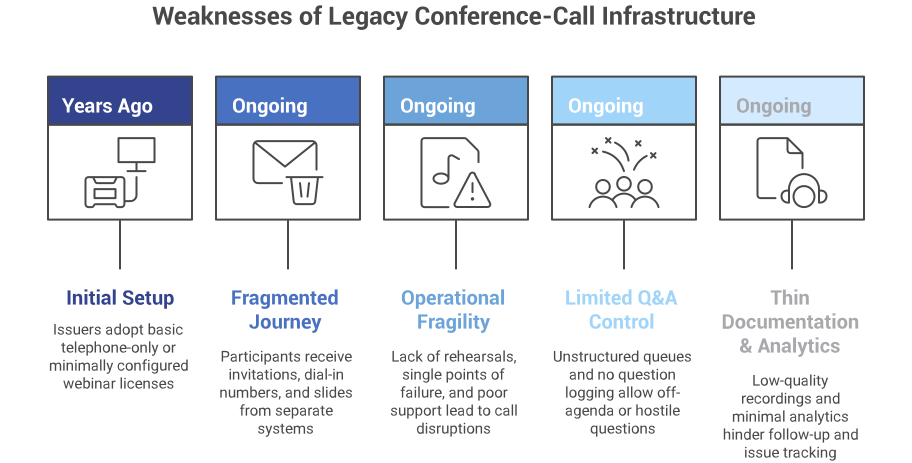
Despite the regulatory evolution, many issuers still rely on telephone-only conference bridges or minimally configured webinar licenses that were set up years ago. Common weaknesses include:
-
Fragmented participant journey
-
Invitations issued by email from one system
-
Dial-in numbers from another provider
-
Slides distributed separately as PDF
-
Minimal registration data and weak integration with CRM or IR databases.
-
-
Operational fragility
-
No structured rehearsals or formal technical testing
-
Single points of failure (one host, one line, no redundant connections)
-
Poor support when audio drops or screen-sharing fails.
-
-
Limited control over Q&A
-
Unstructured queues, where hostile or off-agenda questions can derail the call
-
No disciplined triage to balance sell-side, buy-side and ESG-focused questions
-
No capability to log who asked what for follow-up and issue tracking.
-
-
Thin documentation and analytics
-
Low-quality or partial recordings
-
No time-stamped link between slides, script and questions
-
Minimal analytics on investor attendance, geography, segment or engagement.
-
“Best-practice investor-relations guidance recognises that earnings calls are one of the most visible demonstrations of a company’s preparedness and narrative discipline. Industry notes from global IR advisers emphasise the choice of format, rehearsal, and technical reliability as central to an effective earnings call.”
The conclusion is straightforward: a legacy setup that “worked adequately in the past” is unlikely to be defensible in FY26, when scrutiny, expectations and the complexity of cross-border investor bases are all higher.
3. What an upgraded results-webinar tech stack should deliver
An upgraded tech stack is not a single platform licence. It is a coordinated configuration of technology, process and people. At a minimum, a modern FY26-ready stack should provide the following four pillars.
3.1 Reliability and resilience: the engineering layer
Reliability begins with the infrastructure on which your call is hosted:
-
Enterprise-grade webinar platform with proven track record in handling investor events, not just internal meetings.
-
Redundant connectivity (for example, multiple hosts and back-up dial-in options) to mitigate the risk of local outages.
-
Structured technical rehearsals involving the CFO, CEO, IRO and key presenters, with pre-event checks on audio, video, slide transitions and cueing.
-
Proactive technical support available live during the call, not just a helpdesk number.
Leading investor-relations practice notes emphasise that selecting the right format and technology, combined with robust preparation, is one of the most important determinants of a successful earnings call.
At Dickenson, ElevEase results-hosting solutions place this engineering layer at the centre, with dedicated technical staff, structured rehearsals and pre-defined contingency plans as standard in the service tiers.
3.2 Compliance, audit trail and documentation
Each results webcast must generate a complete, traceable record:
-
High-quality audio and video recordings capable of being repurposed for website hosting, internal training or regulatory review.
-
Accurate transcripts, ideally generated with a combination of transcription technology and human review, suitable for filing under SEBI or similar website disclosure rules.
-
Systematic linkage between scripts, slides and Q&A, ensuring that you can reconstruct exactly what was said about key metrics, guidance or risks.
-
Retention policies that match your internal Reg FD, MAR or equivalent disclosure policies, including defined periods for public replays and internal archiving.
A well-designed tech stack should handle these requirements as part of the workflow, not as an afterthought. ElevEase explicitly integrates high-quality recording, transcription and post-event documentation across its service tiers, aligning operational processes with issuer disclosure obligations.
3.3 Moderated Q&A and narrative control
The Q&A session is often where the greatest risk resides: forward-looking comments, selective disclosures and off-the-cuff remarks can create legal and reputational challenges. Regulatory guidance in jurisdictions such as the UK stresses the need for robust processes when communicating during shareholder calls and meetings, especially where inside information might be discussed.
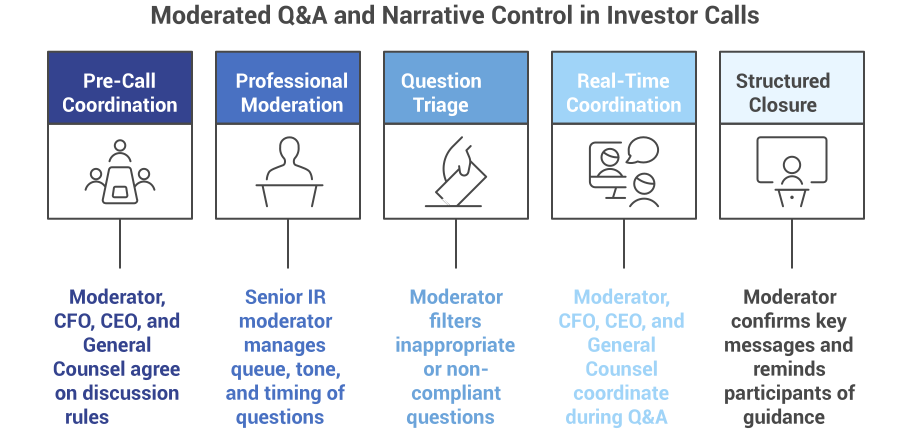
An upgraded stack should therefore provide:
-
Professional moderation, ideally by a senior IR moderator who understands capital-markets dynamics and can manage the queue, tone and timing of questions.
-
Question triage, ensuring a fair mix of sell-side, buy-side and covering analysts while filtering inappropriate or non-compliant questions.
-
Real-time coordination between the moderator, CFO, CEO and General Counsel, with pre-agreed rules on what can be discussed, and which topics should be deferred.
-
Structured closure, confirming key messages, signposting to the website or replay links, and reminding participants of guidance and limitations where relevant.
ElevEase’s Premium, Professional and Executive tiers all incorporate professional moderation, with senior IR analyst or director involvement at higher tiers, explicitly designed to support narrative control and investor engagement rather than simply opening a microphone line.
3.4 Registration, integration and analytics
Finally, a modern tech stack must treat each results webcast as a data event:
-
Integrated registration pages that capture role, institution, geography and sector, providing a structured view of your investor audience.
-
Consent and compliance checks that align with privacy and marketing rules in Europe, the UK and other jurisdictions.
-
Real-time and post-event analytics, including attendance, duration of participation, drop-off points and engagement with specific sections of the presentation.
-
Seamless integration with CRM and IR databases, enabling follow-up by geography, investor tier or topic of interest.
Vendor commentary on webcasting underscores how carefully mapping event calendars, investor segments and engagement data can transform IR webcasts from isolated events into strategic tools.
“ElevEase’s Professional and Executive packages extend beyond hosting by incorporating targeted marketing, Salesforce-driven outreach and detailed post-event reporting, turning raw attendance data into actionable intelligence for the IR team and the Board.”
4. Why CFOs should treat the tech stack as a board-level decision
There are three reasons why results-webinar infrastructure belongs in the CFO’s board-facing agenda rather than in a purely operational discussion.
4.1 It is directly connected to disclosure controls and procedures
Under most securities regimes, Boards are expected to maintain disclosure controls and procedures that ensure information is recorded, processed, summarised and reported within prescribed timelines. Your results webcast is one of the highest-profile manifestations of those controls.
If the technology repeatedly fails, if Q&A is unmanaged, or if recordings and transcripts are incomplete, the effectiveness of your overall disclosure controls can reasonably be questioned.
4.2 It shapes the market’s perception of management quality
Analyst and investor feedback often emphasises that clear audio, structured presentations and disciplined Q&A materially influence their perception of management credibility. Industry practice notes recognise that an effective earnings call demonstrates preparedness, strategic coherence and operational discipline, not merely the delivery of numbers.
A dated or unreliable tech setup, even if tolerated during crisis periods such as the early months of the pandemic, sends the opposite signal.
4.3 It plays into capital access and valuation outcomes
In an environment where audit markets are diversifying, global regulators are raising expectations on governance disclosures, and cross-border investors are increasingly data-driven in their assessment of issuers, well-executed results webcasts become part of the wider capital-access narrative.
Consistent, professional webcasts help:
-
reduce perception gaps between management and the market
-
reinforce messages around risk management, tax governance and strategic priorities
-
demonstrate that the company is operationally ready for more sophisticated financing structures, listings or investor bases.
Seen through this lens, investment in a robust results-webinar tech stack is part of capital budgeting for market access, not administrative overhead.
5. ElevEase: an integrated, IR-specialist approach to results webcasting
Generic collaboration platforms and conferencing providers can host calls. They were, however, not designed specifically around the needs of listed issuers, securities regulators and institutional investors.
ElevEase by Dickenson approaches results hosting as an integrated IR offering that combines:
-
Webinar engineering: internet-based webinar setup, participant management, and technical rehearsal as standard.
-
Professional moderation and Q&A: experienced IR moderators who understand both markets and governance.
-
Branding and narrative support: custom-branded event templates, investor deck finalisation and narrative review with IR directors at the Executive tier.
-
Compliance-ready documentation: high-quality recording, transcription and structured post-event reporting.
-
Targeted outreach and analytics: audience curation, Salesforce-driven campaigns and detailed engagement analytics.
“For issuers with multi-jurisdictional listings or investor bases spanning India, the UK, the US and the Gulf, this convergence of technical and regulatory sensibilities is particularly valuable. It allows the CFO and IRO to treat each webcast as a carefully staged disclosure event, aligned with SEBI, Reg FD and FCA expectations, supported by a team that works exclusively in capital-markets communication.”
6. A practical roadmap: using January for a technical and governance review
Given the concentration of year-end activities, Boards and management teams often defer technical upgrades until a failure forces the issue. The FY26 cycle presents an opportunity to be more deliberate.
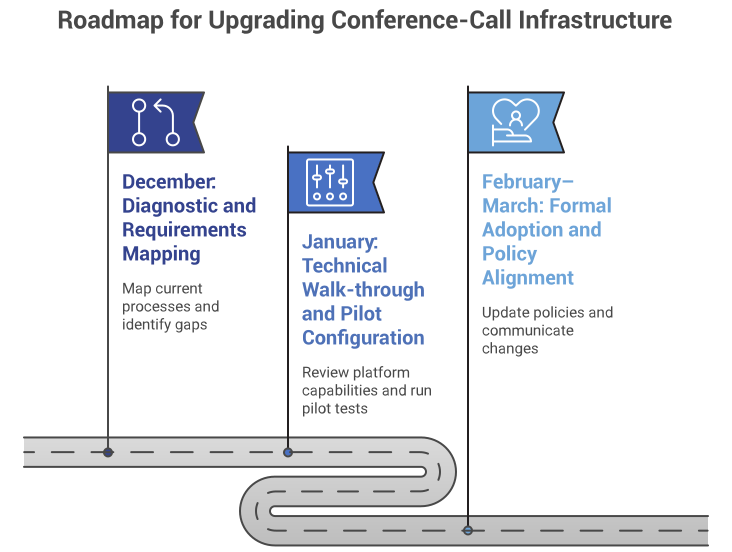
A pragmatic roadmap could be:
-
December: diagnostic and requirements mapping
-
Map your current processes from results release to webcast replay.
-
Identify gaps relative to SEBI, Reg FD, MAR and local website-disclosure requirements.
-
Capture user experience feedback from analysts, investors and internal stakeholders.
-
-
January: technical walk-through and pilot configuration
-
Schedule a one-hour technical walk-through with an IR-specialist provider such as Dickenson’s ElevEase team to review platform capabilities, moderation options, integration with your CRM and analytics outputs.
-
Run a short internal pilot (for example, a mock results call) to test the full workflow under realistic conditions.
-
Finalise service tier selection (Premium Foundation, Professional or Executive) based on the complexity of your investor base and Board expectations.
-
-
February–March: formal adoption and policy alignment
-
Update your internal disclosure controls and Reg FD / MAR policies to reflect the new processes.
-
Brief the Audit Committee and Board on the enhanced infrastructure, positioning it as a step forward in governance and market communication.
-
Communicate changes proactively to the market, for example in your investor-relations website section, emphasising improved access, replay options and documentation.
-
Taking this structured approach in January 2026 means that by the time FY26 results are announced, your company will be operating with a tested, compliant and analytically rich results-webinar stack, rather than improvising under pressure.
7. Invitation to CFOs and IROs: schedule a January FY26 tech-stack review
For many issuers, the decision to upgrade their results-webinar infrastructure has been postponed not due to lack of intent, but due to time constraints and the absence of a clear comparison framework.
ElevEase was designed precisely to address this gap: integrating twenty-five years of investor-relations experience with professional results hosting across multiple markets.
If you are a CFO, IRO or Company Secretary planning your FY26 calendar, a constructive next step would be to ringfence an hour in January for a confidential, technical walk-through of your current setup and potential upgrade path. The objectives of such a session would be to:
-
map your existing workflows against current regulatory and market expectations
-
demonstrate what a fully integrated, moderated and analytics-enabled results webcast looks and feels like
-
identify a practical migration plan that respects your internal resources, budgets and timelines.
Details of ElevEase’s call-hosting solutions, service tiers and global coverage are available at: https://dickensonworld.com/services/investor-relations/call-hosting-solutions/
“In an environment where disclosure quality, governance and market access are more connected than ever, upgrading your results-webinar tech stack before FY26 is not just a technical refresh. It is one of the most controllable levers you have to demonstrate to investors, regulators and your own Board that your company treats every results call as the strategic event it has become.”
More reading:

Why Partnering with Dickenson Elevates Your Quarterly Investor Calls
Why Partnering with Dickenson Elevates Your Quarterly Investor Calls Beyond Basic Conference Solutions When it comes to quarterly investor calls, you’re not just making an announcement—you’re telling your company’s story, building trust, and shaping perceptions. Yet, too often, businesses settle for traditional conference call services that are as exciting as dial-up internet. Sure, they get the job done, but at what cost? Enter Dickenson Intellinetics, a professional capital markets communications firm that turns your investor calls from robotic routine into dynamic, engaging events that people actually want to be part of. Read More

Q&A with Shankhini Saha, Director IR, on ElevEase
Q&A with Shankhini Saha, Director IR, on ElevEase -Dickenson’s New Results Call Hosting Service Q: Shankhini, why did Dickenson Intellinetics introduce ElevEase? Shankhini Saha: We noticed a persistent gap in the market when it came to hosting quarterly results calls. Issuers and brokers were relying on basic platforms that simply weren’t cutting it for strategic investor relations. These services were often limited to just facilitating a call, without adding any real value. With our 25 years of IR expertise, we knew we could transform the experience. ElevEase was designed to be more than just a technical solution – it’s a comprehensive service that integrates the depth of strategic IR management with the convenience of seamless call hosting. Read More
Contact Us: To learn more or schedule a consultation, please reach out to us at www.dickensonworld.com
Email:enquiry@dickensonworld.com.
About the Author
Shankhini Saha, the Director of Investor Relations at Dickenson, holds an MPhil with distinction from the University of Cambridge, UK, and a BA magna cum laude from The New School, USA. Specializing in stakeholder engagement across diverse sectors, Shankhini is dedicated to transparent communication and providing strategic insights into clients’ financial performance and growth initiatives. With a proven track record of managing complex investor relations for a diverse portfolio of global clients, she excels in crafting impactful narratives that resonate with investors, analysts, and stakeholders. Shankhini’s leadership in high-profile quarterly results hosting and comprehensive IR campaigns showcases her commitment to creating lasting value for issuers in the global capital market.
From Call to Control Room
To download and save this article.
Authored by:
Shankhini Saha
Director, Dickenson World
Visit www.dickensonworld.com to learn more about our services and how we can help streamline your corporate reporting process.
Leave A Comment