

Capital-Raising Windows And Instrument Choices For 2026
Global growth is expected to remain moderate but resilient through 2026, while India and other key emerging markets continue to attract disproportionate capital and IPO activity. In this environment, issuers that plan their funding around credible windows and the appropriate instruments can still access equity on attractive terms.
This note distils recent evidence from the IMF, OECD, EY and Reuters on growth, IPO flows and India’s position, then translates it into practical guidance on 2026 fundraising windows and the relative suitability of rights issues, QIPs and private placements for serious mid and large cap issuers.
Strategic note for mid-cap and large-cap CFOs and promoters
The capital markets are entering 2026 with an unusual combination of steady macro growth, moderating inflation and episodic volatility driven by trade policy, technology valuations and geopolitics. The October 2025 World Economic Outlook from the IMF projects global growth softening only marginally from 3.3 percent in 2024 to 3.2 percent in 2025 and 3.1 percent in 2026, with advanced economies growing around 1.5 percent and emerging markets just above 4 percent.
The OECD’s December 2025 Economic Outlook echoes this pattern, with global GDP growth projected at 3.2 percent in 2025 and 2.9 percent in 2026, and further policy rate reductions expected as inflation converges towards central-bank targets.
For India and several other key emerging markets, the backdrop is more supportive. The OECD’s country assessment for India notes that the policy rate has already been reduced from 6.5 percent in January to 5.5 percent by September 2025, with inflation running below the Reserve Bank of India’s 4 percent target and bank credit supported by strong balance sheets and easing financial conditions.
Taken together, this suggests that 2026 is unlikely to be a “boom” year in growth terms, but it should still offer constructive conditions for well-prepared issuers, particularly in markets where real rates are falling and domestic savings continue to deepen.
“A stable macro base and deepening domestic savings set the stage for mid- and large-cap issuers to capitalise on credible fundraising windows in 2026.”

Primary-market dynamics: where investors are already voting with capital
After two years of subdued issuance following the 2021 cycle, global equity capital markets have normalised. A 2024 review by Houlihan Lokey reports that US equity capital markets raised approximately USD 273 billion in 2024, the third-highest total in the past decade, with convertibles contributing about 32 percent of proceeds and a particularly strong Q4 – the most active quarter since 2021.
On IPOs specifically, EY’s Global IPO Trends work notes that the first half of 2024 saw volumes and proceeds lower year-on-year, but with a marked divergence: Americas and EMEIA rebounded while Asia-Pacific remained subdued. Industrials accounted for the largest number of IPOs, while technology raised the most capital.
India stands out within this landscape. According to EY’s 2024 data and subsequent coverage, India rose to the top globally by number of IPOs for the first time, with IPO proceeds of about USD 19.9 billion in 2024, the highest in over twenty years.
Prime Database and media summaries indicate that 91 Indian firms together raised approximately ₹1.59 trillion through main-board IPOs in 2024, with total equity fundraising (IPOs, QIPs, rights and other routes) approaching ₹4 trillion, setting an all-time record.
The momentum has extended into 2025. JPMorgan expects India’s 2025 IPO market to surpass already-record 2024 levels, citing USD 20.5 billion raised across 91 offerings in 2024 and a very strong pipeline for late 2025. Reuters estimates that by September 2025, Indian firms had already raised USD 8.2 billion through 49 IPOs, with nearly USD 31.7 billion of potential deals approved or pending.
More recently, large consumer-tech offerings such as Meesho’s USD 604 million IPO in December 2025 have seen full subscription on day one, with strong oversubscription from retail and institutional investors in what is already a record year for tech listings in India.
For CFOs and promoters in mid-cap and large-cap companies, the signal is clear: investors remain willing to support seasoned growth and balance-sheet repair, but the bar for clarity on strategy, governance, ESG and use-of-proceeds is now significantly higher.
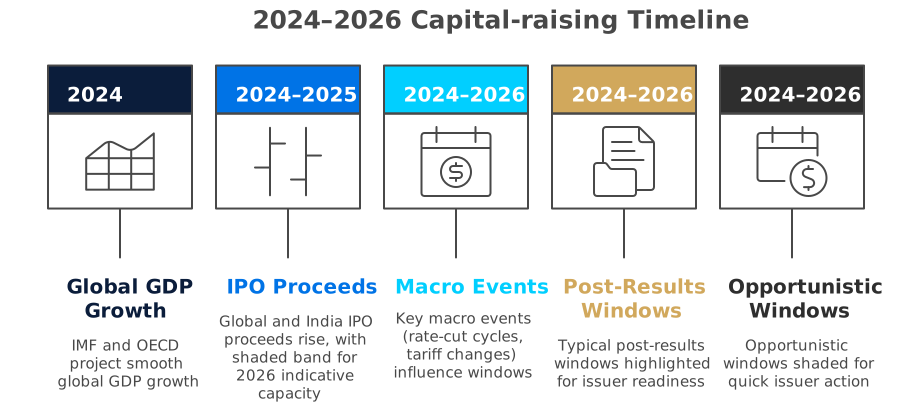
Indicative 2026 fundraising windows
While no one can forecast the exact pattern of issuance in 2026, the data above point to several practical assumptions:
-
-
More selective, but not closed, equity windows
With global growth moderating rather than collapsing, and with policy rates gently declining in many markets, issuance should continue, although investors will differentiate sharply between issuers with credible narratives and those without. The pattern of strong Q4 2024 US issuance suggests that well-signalled windows can still be crowded but workable when volatility is contained and the macro narrative is stable. (Houlihan Lokey) -
Post-results windows will remain the anchor
Across jurisdictions, we expect the most reliable windows to be 4–10 weeks after annual and half-year earnings, once blackouts end and guidance is refreshed. For Indian issuers, this typically translates into post-Q4/FY results (late Q1 / early Q2 of the financial year) and, where relevant, post-Q2 results (around the middle of the financial year). These windows are usually best suited to follow-on equity such as QIPs and accelerated primary or secondary blocks, where investors can underwrite near-term earnings with limited informational asymmetry. -
Opportunistic windows around policy clarity
2026 will see continued uncertainty around tariffs, AI-driven equity valuations and regulatory recalibration in several markets, as signalled by the OECD. This combination may periodically compress risk premiums and create short windows where valuations in specific sectors are temporarily favourable. We view these as appropriate for pre-marketed private placements or convertibles, particularly where the issuer is willing to move quickly with a well-prepared shelf of documentation. (Reuters)
-
Our working hypothesis for 2026 is therefore not of a uniformly “strong” or “weak” year, but of a year in which successful issuers are those that align their financing plan with the reporting calendar, have prepared disclosure and investor education well in advance, and are ready to execute when market micro-conditions are supportive.
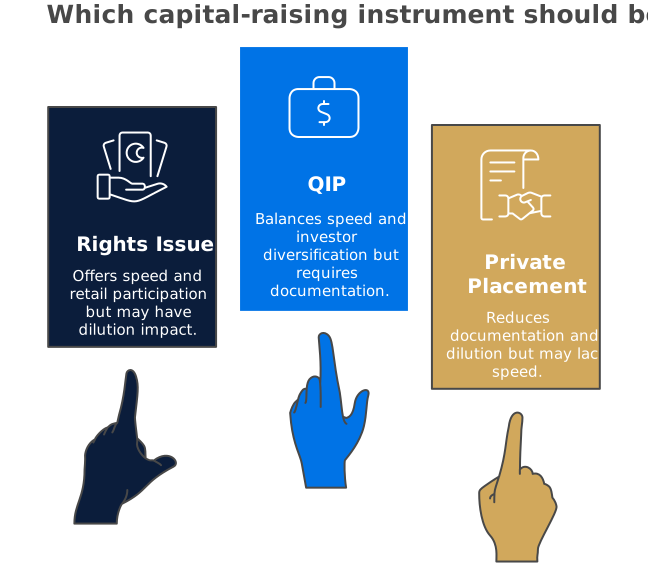
Rights issues, QIPs and private placements: indicative suitability
Instrument choice will depend on your specific balance-sheet, rating, shareholder profile and strategic agenda. At a high level:
-
Rights issues
Well suited where the promoter group and core institutional shareholders are willing to commit fresh capital and prefer to preserve proportional holdings. Rights tend to be attractive when:-
the free float is relatively broad and supportive
-
leverage reduction or regulatory capital is a key objective
-
the company wishes to offer retail holders participation without widening the register to new investors in a significant way
-
-
Qualified Institutions Placements (QIPs)
Primarily relevant to Indian listed issuers, QIPs are designed for rapid capital-raising from domestic and foreign institutional investors under SEBI regulations, with lighter documentation and marketing than a full public offer. They are generally best deployed when:-
there is strong institutional demand already visible in secondary-market flows
-
the story is institutionally understood and the company has an active engagement programme
-
the objective is growth capital or acquisition financing, where speed and discretion matter
-
-
Private placements and club deals
These can be structured domestically or as cross-border 144A/Reg S transactions (subject to jurisdictional constraints). They are most relevant when:-
the company seeks one or a small group of anchor investors (for example, a strategic partner or long-only global fund)
-
there is a need for structural flexibility, including convertibles or preferred equity
-
confidentiality and bespoke covenants are more important than immediate trading liquidity
-
Across all three instruments, rating considerations are central. A properly sequenced equity raise can support rating stability or even an upgrade path, whereas excessive leverage prior to issuance can constrain both pricing and investor appetite. In practice, we would usually model a small set of scenarios across debt, hybrid and equity, stress-testing them against your current rating band, covenants and sector-specific metrics.
“Issuers can maximise outcomes by matching the strengths of rights issues, QIPs and private placements with their growth agenda and governance requirements.”
How we would apply this to your situation
For an issuer in your size bracket, our typical approach would be to:
-
Map your funding needs over the next three to five years against credible macro and sector assumptions for 2026–2028.
-
Analyse rating headroom and the sensitivity of key ratios under different capex and distribution policies.
-
Build an issuance calendar anchored around your financial reporting dates, expected regulatory milestones and potential geopolitical or policy overhangs that are specific to your sector.
-
From there, define two or three realistic instrument combinations (for example, a QIP followed by a rights buffer; or a staged private placement leading into a larger listed transaction) and assess their feasibility with target investor segments.
We would be pleased to walk you through this framework in a confidential session, using your balance sheet, pipeline and rating profile to convert the high-level views above into an actionable 2026 capital-raising roadmap.
Parting thoughts
As India progresses towards a potential USD 10 trillion economy over the next decade, capital planning over the next 24 months will be a quiet but decisive differentiator. The issuers that will be “ready” are not necessarily those with the largest pipelines, but those that align capex, deleveraging and strategic acquisitions with clearly defined fundraising windows, credible instruments and disciplined investor communication. In practical terms, this means treating equity and quasi-equity issuance as an integral part of strategy execution, rather than a one-off event, so that corporate growth trajectories remain commensurate with India’s macro ambitions rather than constrained by avoidable funding gaps.

-
IMF World Economic Outlook, October 2025: https://www.imf.org/en/publications/weo/issues/2025/10/14/world-economic-outlook-october-2025 (IMF)
-
OECD Economic Outlook 2025-2: https://www.oecd.org/en/publications/oecd-economic-outlook-volume-2025-issue-2_9f653ca1-en.html (OECD)
-
OECD India outlook (Dec 2025): https://www.oecd.org/en/publications/oecd-economic-outlook-volume-2025-issue-2_9f653ca1-en/full-report/india_65a8d75a.html (OECD)
-
Houlihan Lokey “Equity Capital Markets Update – 2024 Year in Review”: https://www2.hl.com/pdf/2025/equity-capital-markets-update-2024-year-in-review.pdf (Houlihan Lokey)
-
EY Global IPO Trends Q2 2024: https://www.ey.com/en_hu/insights/ipo/trends (EY)
-
Moneycontrol summary of EY report: https://www.moneycontrol.com/news/business/ipo/ipo-news-here-s-how-india-s-ipo-market-fared-in-2024-as-per-ey-12951488.html (Moneycontrol)
-
Business Standard / Prime Database: https://www.business-standard.com/markets/news/fundraising-via-equity-debt-hit-all-time-high-in-2024-prime-database-125010901214_1.html (Business Standard)
-
Reuters, 23 September 2025: https://www.reuters.com/world/india/jpmorgan-sees-india-ipos-surpass-2024-levels-fund-raising-gathers-steam-2025-09-23/ (Reuters)
-
Reuters, 3 December 2025: https://www.reuters.com/world/india/indian-e-commerce-platform-meeshos-604-mln-ipo-fully-subscribed-day-one-2025-12-03/ (Reuters)
-
Sources for India’s USD 10 trillion trajectory and growth outlook:
https://www.morganstanley.com/ideas/india-economy-2030
https://www.goldmansachs.com/intelligence/pages/india-at-100.html
Contact Us: To learn more or schedule a consultation, please reach out to us at www.dickensonworld.com
Email:enquiry@dickensonworld.com.
About the Author
With over 25 years of experience in corporate finance and a deep-rooted understanding of ESG imperatives, Manoj Saha brings a wealth of knowledge to the discourse on corporate governance. Educated in the UK in Accountancy & Finance, he has dedicated his career to guiding organizations through the intricacies of financial management and stakeholder engagement across global markets, including India, the USA, the UK, and the Middle East and North Africa (MENA) region.
Capital-Raising Windows And Instrument Choices For 2026
To download and save this article.
Authored by:
Manoj Saha
Managing Director, Dickenson World
Visit www.dickensonworld.com to learn more about our services and how we can help streamline your corporate reporting process.
Leave A Comment