
2026 IR Readiness:
Do You Have a Bench, Or Just a Business Card?
Do You Have a Bench, Or Just a Business Card?
Why IR capability planning belongs on the 2026 board agenda
Across markets, Investor Relations has shifted from a disclosure function to a strategic driver of corporate value, influencing valuation, liquidity and access to capital. Boards and CFOs now rely on IR not only to communicate results, but to interpret market sentiment, explain strategy, and support decisions on capital allocation and risk. EY notes that an effective IR team serves as the organisation’s interface with investors and analysts, giving leadership a clearer understanding of trends in the wider investment landscape.
At the same time, the remit of the Investor Relations Officer has expanded considerably. A 2024 guide by Lumi reports that more than two thirds of IROs have seen their responsibilities increase, with many becoming strategic advisers and internal counsellors on governance, ESG and stakeholder communication.
Against this backdrop, treating IR capability as a narrow “training” topic misses the point. For 2026, the more searching question for any board is: Do we have a resilient IR bench that can support our strategy under stress, or only a single name on a business card?
The anatomy of a modern IR bench
Today’s high-performing IR function is a team sport. Even when the organisation has a single named IRO, that individual depends on a small ecosystem of internal and external collaborators. The core capabilities usually span four domains:
-
Financial and capital-markets fluency
IR analysts and officers are expected to understand financial statements, valuation drivers and market dynamics to a depth that allows them to discuss performance, guidance and risk in a credible way with institutional investors and research analysts. -
Regulatory and ESG literacy
Regulatory expectations around disclosure, insider information, ESG reporting and stewardship codes are expanding. IR teams increasingly need working knowledge of global ESG frameworks and reporting standards to integrate non-financial metrics into the equity story. -
Storytelling and stakeholder management
The IR function must shape a coherent narrative that connects strategy, capital allocation, risk, and sustainability in language that institutional investors, proxy advisers, rating agencies and employees can understand. Relationship management and communication skills are repeatedly cited as critical success factors for IR careers. -
Data, technology and AI comfort
From ownership analytics and perception studies to AI-assisted drafting and monitoring, IR teams now work with data platforms and digital channels as standard tools. This requires analytical judgement and comfort with new technologies, not just basic spreadsheet skills.
A genuine IR “bench” is one where these capabilities are distributed across a cohort of IROs and analysts at different levels of seniority, instead of being concentrated in a single over-stretched individual.
“In 2026, Investor Relations capability will be judged not by a single eloquent IRO, but by the strength of the internal bench that can explain strategy, ESG and capital allocation with the same discipline as financial reporting.”
The growing IR talent gap
Demand for sophisticated IR talent is rising across public companies, private equity, infrastructure and alternatives. Recruiters report that IR professionals are in strong demand because they are central to fundraising and investor confidence, especially in more volatile markets.
At the same time, the skills profile is becoming more demanding. The integration of ESG into mainstream investor dialogue, the complexity of cross-border listings, and the rise of AI-driven investor workflows mean that IROs need broader capability than traditional financial communication alone.
Yet many issuers continue to operate with:
-
A single key-person IRO, with limited succession planning
-
Minimal structured development for junior IR analysts
-
Ad hoc exposure to capital-markets events rather than a deliberate capability programme
The result is a quiet but material risk: in a year where guidance is challenged, a rating review is under way or a strategic transaction is announced, the organisation discovers that its IR “function” is essentially one person and a presentation deck.
From “training course” to IR capability roadmap
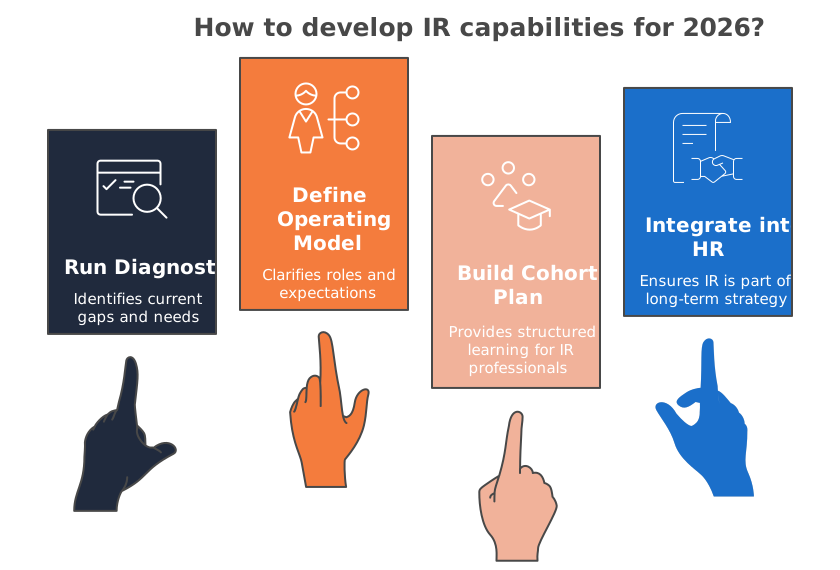
For 2026, CFOs, HR leaders and IROs can reframe the conversation from “sending people for training” to designing an IR capability roadmap that the board can recognise as part of its human-capital oversight. A practical roadmap can follow four steps.
-
Run a short IR capability diagnostic
Start with a structured assessment of the current IR set-up: roles, skills, succession, coverage of ESG and sustainability topics, exposure to investors and analysts, and use of data and technology. This can be done through a focused questionnaire and a set of interviews with the CFO, IRO, Company Secretary and HR. -
Define the 2026 IR operating model
Translate strategy and risk into a clear picture of the IR function you need by end-2026. For example: a lead IRO, an IR or ESG analyst, and one designated “internal bench” colleague from finance or strategy who regularly shadows investor interactions and board-facing communication. -
Design a cohort-based development plan
Rather than isolated workshops, plan a 9 to 12 month learning and exposure journey for a defined cohort of IROs and analysts. This can combine:-
Targeted classroom or virtual modules on capital markets, valuation, ESG and regulation
-
Practical assignments on earnings materials, investor decks and MD&A drafting
-
Simulated investor meetings or results calls with structured feedback
Specialist academies and partners can provide structured curricula and placement-style support, which helps HR and CFOs demonstrate to the board that IR capability development is being managed with rigour, not informality.
-
-
Integrate IR into human-capital and succession discussions
Finally, make IR benches visible in talent and succession reviews. Boards expect transparency on critical roles linked to market confidence. Positioning IR cohorts as part of leadership development, rather than a peripheral communication function, strengthens both governance and market perception.

Why start this conversation now
Several macro trends will converge in 2026: more demanding ESG and sustainability expectations, greater scrutiny of capital allocation choices, and accelerating adoption of AI in both investor workflows and corporate reporting.(PwC)
Issuers that arrive in that environment with a deliberate IR capability roadmap and a visible internal bench will be better placed to:
-
Engage confidently with long-term investors and rating agencies
-
Support the board on strategy, risk and sustainability dialogue
-
Navigate capital-raising opportunities when conditions are favourable
Those who continue to treat IR as a single job title with occasional training may find that when markets start asking harder questions, their most important “asset” can also be their most fragile single point of disappointment.
Designing a 2026 IR capability roadmap is therefore not a training decision. It is a board-supportive human-capital decision that directly influences valuation, resilience and access to capital.
Contact Us: To learn more or schedule a consultation, please reach out to us at www.dickensonworld.com
Email:enquiry@dickensonworld.com.
About the Author
Shankhini Saha, the Director of Investor Relations at Dickenson, holds an MPhil with distinction from the University of Cambridge, UK, and a BA magna cum laude from The New School, USA. Specializing in stakeholder engagement across diverse sectors, Shankhini is dedicated to transparent communication and providing strategic insights into clients’ financial performance and growth initiatives. With a proven track record of managing complex investor relations for a diverse portfolio of global clients, she excels in crafting impactful narratives that resonate with investors, analysts, and stakeholders. Shankhini’s leadership in high-profile quarterly results hosting and comprehensive IR campaigns showcases her commitment to creating lasting value for issuers in the global capital market.
2026 IR Readiness
To download and save this article.
Authored by:
Shankhini Saha
Director, Dickenson World
Visit www.dickensonworld.com to learn more about our services and how we can help streamline your corporate reporting process.
Leave A Comment